


 一键配货
一键配货
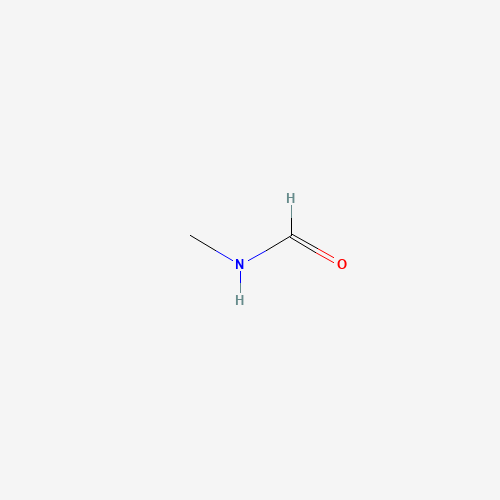
化合物详情
CAS123-39-7
分子式C2H5NO
分子量59.07 g/mol g/mol
危化品
Physical Description | N-methylformamide is a clear colorless liquid with a slight amine odor. (NTP, 1992)
科学粮草官-词典编辑部,修订于:2026-07-06
Toxicity
ToxicityBody Burden
The concn of N-methylformamide in urine was 7.7 mg/l and 23.3 mg/l before shift and after shift, respectively, for workers exposed to N,N-dimethylformamide at a synthetic leather factory(1). N-Methylformamide is a metabolite of N,N-dimethylformamide(1).
Fate Summary
ATMOSPHERIC FATE: According to a model of gas/particle partitioning of semivolatile organic compounds in the atmosphere(1), N-methylformamide, which has a vapor pressure of 0.253 mm Hg at 25 °C(2), is expected to exist solely as a vapor in the ambient atmosphere(SRC). Vapor-phase N-methylformamide is degraded in the atmosphere by reaction with photochemically-produced hydroxyl radicals(SRC); the half-life for this reaction in air is estimated to be 57 hours(SRC), calculated from its rate constant of 6.8X10⁻¹² cu cm/molecule-sec at 25 °C(SRC) determined using a structure estimation method(3).
Soil Adsorption / Mobility
The Koc of N-methylformamide is estimated as 7(SRC), using a log Kow of -0.97(1) and a regression-derived equation(2). According to a classification scheme(3), this estimated Koc value suggests that N-methylformamide is expected to have very high mobility in soil(SRC).
Environmental Biodegradation
AEROBIC: N-Methylformamide, present at 400 mg/l, reached 4%, 98%, and 100% of its theoretical BOD in 3 hrs, 3 days, and 7 days, respectively, using an industrial activated sludge inoculum and the Zahn-Wellens test(1). Using the BOD test, N-methylformamide achieved 2% of its theoretical BOD after 5 days(1). N-Methylformamide has also been shown to biodegrade by microorgansism obtained through soil enrichment(2). Therefore, N-methylformamide may biodegrade in the environment(SRC).
Environmental Bioconcentration
An estimated BCF of 3 was calculated for N-methylformamide(SRC), using a log Kow of -0.97(1) and a regression-derived equation(2). According to a classification scheme(3), this BCF suggests the potential for bioconcentration in aquatic organisms is low(SRC).
Volatilization from Water / Soil
The Henry's Law constant for N-methylformamide is estimated as 2.0X10⁻⁸ atm-cu m/mole(SRC) based upon its vapor pressure, 0.253 mm Hg(1), and water solubility, 1.0X10+6 mg/l(2). This Henry's Law constant indicates that N-methylformamide is expected to be essentially nonvolatile from water surfaces(3). N-Methylformamide is not expected to volatilize from dry soil surfaces(SRC) based upon its vapor pressure(1).
Environmental Abiotic Degradation
The rate constant for the vapor-phase reaction of N-methylformamide with photochemically-produced hydroxyl radicals has been estimated as 6.8X10⁻¹² cu cm/molecule-sec at 25 °C(SRC) using a structure estimation method(1). This corresponds to an atmospheric half-life of about 57 hours at an atmospheric concentration of 5X10+5 hydroxyl radicals per cu cm(1). N-Methylformamide is not expected to undergo hydrolysis in the environment since amides hydrolyze very slowly under environmental conditions(2) nor to directly photolyze due to the lack of absorption in the environmental UV spectrum (>290 nm).
Fish/Seafood Concentrations
N-Methylformamide has been detected at concns of 0.09 and 4.06 ug/g in two samples of mussel collected at the Oarai Coast in Ibaraki, Japan on July 31, 1985 and July 31, 1986, respectively(1).
Artificial Pollution Sources
N-Methylformamide's production and use as an intermediate in the synthesis of pesticides; as an extraction solvent for aromatic hydrocarbons(1); and in the manufacture of methyl isocyanate(2); may result in its release to the environment through various waste streams(SRC). N-Methylformamide has been detected in cigarette smoke(3). N-Methylformamide may be also released to the atmosphere as a result of the photolysis of dimethylamine or trimethylamine(4), and may occur in water as a result of photolysis of the aquatic herbicide fluridone(5).
Probable Routes of Human Exposure
Occupational exposure to N-methylformamide may occur through inhalation and dermal contact with this compound at workplaces where N-methylformamide is produced or used(SRC). The concn of N-methylformamide in urine was 7.7 mg/l and 23.3 mg/l before shift and after shift, respectively, for workers exposed to N,N-dimethylformamide at a synthetic leather factory(1). N-Methylformamide is a metabolite of N,N-dimethylformamide(1).
Other Environmental Concentrations
N-Methylformamide has been detected in cigarette smoke(1).
Environmental Fate / Exposure Summary
N-Methylformamide's production and use as an intermediate in the synthesis of pesticides, as an extraction solvent for aromatic hydrocarbons, and in the manufacture of methyl isocyanate may result in its release to the environment through various waste streams. If released to air, a vapor pressure of 0.25 mm Hg at 25 °C indicates N-methylformamide will exist solely as a vapor in the ambient atmosphere. Vapor-phase N-methylformamide will be degraded in the atmosphere by reaction with photochemically-produced hydroxyl radicals; the half-life for this reaction in air is estimated to be 57 hours. If released to soil, N-methylformamide is expected to have very high mobility based upon an estimated Koc of 7. Volatilization from moist soil surfaces is not expected to be an important fate proce...
Symptoms
Eye Exposure: Redness. Pain.
Interactions
Like dimethylformamide NMF or its metabolites appear to interact with the metab of ethanol. Admin of 2 or 20 mmol/kg NMF to rats 3 or 18 hr before ethanol (both orally) induced an elevation in blood acetaldehyde levels. In the case of high doses of NMF admin 18 hr before alcohol, the level of ethanol in the blood was also raised significantly over controls.
Toxicity Data
ToxicityData: Dog(iv): LD10 1262 mg/kg
Adverse Effects
Reproductive Toxin - A chemical that is toxic to the reproductive system, including defects in the progeny and injury to male or female reproductive function. Reproductive toxicity includes developmental effects. See Guidelines for Reproductive Toxicity Risk Assessment.
Exposure Routes
The substance can be absorbed into the body by inhalation, through the skin and by ingestion.
Human Toxicity Excerpts
/N-methylformamide/ is an eye irritant.









