

 一键配货
一键配货
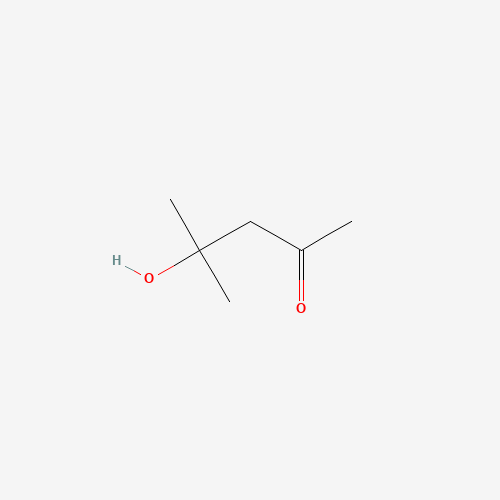
化合物详情
CAS123-42-2
分子式C6H12O2
分子量116.16 g/mol g/mol
危化品
Physical Description | Diacetone alcohol appears as a clear colorless liquid with a pleasant odor. Flash point below 141 °F. Less dense than water. Vapors heavier than air.
科学粮草官-词典编辑部,修订于:2026-07-06
Toxicity
ToxicityEcotoxicity Values
LD50 Goldfish > 5000 mg/l/24 hr. /Conditions of bioassay not specified/
Fate Summary
ATMOSPHERIC FATE: If 4-hydroxy-4-methyl-2-pentanone is released to the atmosphere, it can be expected to exist mainly in the vapor-phase in the ambient atmosphere(1,SRC) based upon an experimental vapor pressure of 1.71 mm Hg at 25 °C(2). The estimated rate constant for vapor-phase reaction with photochemically produced hydroxyl radicals is 1.34X10⁻¹² cu cm/molecule-sec at 25 °C(3) which corresponds to an atmospheric half-life of 12 days at an atmospheric concentration of 5X10+5 hydroxyl radicals per cu cm(SRC). 4-Hydroxy-4-methyl-2-pentanone may be susceptible to direct photolysis in the atmosphere(SRC) based upon its possible absorption(SRC) of light at wavelengths >290 nm(4). Based upon its high water solubility(5), the compound may be susceptible to removal from the atmosphere by wa...
Soil Adsorption / Mobility
An estimated Koc of 21 can be calculated(SRC) from an estimated log Kow of -0.098(2) using a recommended regression equation(1). Based upon the estimated Koc and the reported infinite solubility of the compound in water(3), 4-hydroxy-4-methyl-2-pentanone will not be expected to strongly adsorb to sediment or suspended particulate matter(4,SRC). It will be expected to exhibit very high mobility in soil(4), and therefore, 4-hydroxy-4-methyl-2-pentanone may leach through soil to groundwater if it does not volatilize or biodegrade first(SRC).
Environmental Biodegradation
Two sets of tests using acclimated mixed microbial cultures as inoculum gave percent theoretical BOD of 47%(1) and 46%(2) after 5 days for 4-hydroxy-4-methyl-2-pentanone under aerobic conditions(1,2). A percent theoretical BOD of 3% was observed after 5 days in screening tests using the standard dilution technique under aerobic conditions and effluent sewage from a biological sanitary waste treatment plant as inoculum; 31% theoretical BOD was observed after 5 days using adapted effluent sewage(3). No information regarding biodegradation in natural media was found(SRC).
Environmental Bioconcentration
An estimated BCF of 0.50 can be calculated(SRC) from an estimated log Kow of -0.098(2) using a recommended regression equation(1). Based upon the estimated BCF and the reported infinite solubility of the compound in water(3), 4-hydroxy-4-methyl-2-pentanone will not be expected to significantly bioconcentrate in aquatic organisms(SRC).
Volatilization from Water / Soil
The Henry's Law constant for 4-hydroxy-4-methyl-2-pentanone has been estimated to be 4.24X10⁻⁹ atm-cu m/mole(1,SRC). Based upon this value for the Henry's Law constant, volatilization of 4-hydroxy-4-methyl-2-pentanone from surface water will not be expected to be an important transport process(2,SRC).
Environmental Abiotic Degradation
Photochemical smog studies results placed 4-hydroxy-4-methyl-2-pentanone in the high reactivity category in relation to maximum oxidant formation, intermediate reactivity category in relation to NO2 maximum times, and low reactivity category in relation to formaldehyde formation and eye response times(1). Hydrolysis should not be an important removal process since aliphatic alcohols and ketones (the two functional groups that 4-hydroxy-4-methyl-2-pentanone contains) generally are resistant to hydrolysis(2).
Environmental Water Concentrations
SURFACE WATER: 4-Hydroxy-4-methyl-2-pentanone was qualitatively detected in samples of surface water taken from the St. Joseph River, a tributary of Lake Michigan(1). Trace amounts (defined as generally <1 ng/L) have been detected in samples of water from the lower reaches of the River Lee, a water supply for North London(2).
Food Survey Values
4-Hydroxy-4-methyl-2-pentanone has been qualitatively detected in foodstuffs exposed to acetone: meat carcasses exposed to surfaces that were freshly painted with acetone containing paints and vegetables and seeds which were extracted with acetone(1).
Effluent Concentrations
It was detected at a concn of 20 ppb in the effluent for the Los Angeles County wastewater treatment plant between Nov 1980 and Aug 1981(1). The compound was qualitatively detected in the final effluent from the Addison, IL publicly-owned treatment works sampled in April 1980; it was not detected (detection limit not specified) in the final effluent from seven other publicly-owned treatment works, a refinery and an industrial plant in Illinois sampled between Feb and June 1980(2). It was qualitatively found in trench leachate from low level radioactive waste sites at Maxey Flats, KY and/or West Valley, NY(3). The compound was found in spent chlorination liquor from bleaching of sulfite pulp at normal lignin content after oxygen treatment at a concn of 1 g/ton of pulp, at 9 g/ton pulp in...
Natural Pollution Sources
It is the toxic principle in Stipa Vaseyi, commonly known as sleepy grass.
Artificial Pollution Sources
4-Hydroxy-4-methyl-2-pentanone may be released as a result of its manufacture and use as a solvent for many materials including but not limited to lacquers, nitrocellulose, cellulose acetate, epoxy resins, vinyl chloride-vinyl acetate, dyestuffs, inks, various oils, waxes, fats, tars, wood preservatives, and pesticides(1-4); and its use in textile printing, fuel additives, antifreeze mixtures, and ink removal(1-4). It has been used in hydraulic fluids(1), as a pharmaceutical preparation preservative(2), and as an intermediate in the synthesis of dyes, inhibitors, pharmaceuticals, and insecticides(4).
Sediment/Soil Concentrations
4-Hydroxy-4-methyl-2-pentanone was qualitatively detected in sediment from one of two sites located midchannel in Tobin Lake, Nipawin, Saskatchewan, Canada(1).
Probable Routes of Human Exposure
NIOSH (NOES Survey 1981-1983) has statistically estimated that 225,328 workers are potentially exposed to 4-hydroxy-4-methyl-2-pentanone in the USA(1). NIOSH (NOHS Survey 1972-1974) has statistically estimated that 978,524 workers are potentially exposed to the compound in the USA(2). The time weighted avg concn of the compound found in the breathing zone of workers in a screen printing plant in various job sites were as follows (avg of 12-19 samples each): 14 ppm in printing press, 3.5 ppm in automatic dryer, 12 ppm in manual drying, 2.8 ppm in paint mixing, and 6.8 ppm in screen wash(3). The concn were somewhat lower in the general air of most of the work areas than in the breathing zone air except in the automatic and manual dryer areas(3). The time weighted avg concn of the compound...
Environmental Fate / Exposure Summary
4-Hydroxy-4-methyl-2-pentanone may be released to the environment as a result of its manufacture and use as a solvent, additive or synthetic intermediate for many materials. If released to soil, it will be expected to exhibit very high mobility, based upon the reported infinite solubility of the compound in water and an estimated Koc of 21. The compound may, therefore, leach through soil. Although no data were located regarding its biodegradation in environmental media, the compound may be subject to biodegradation in soil based upon results observed in laboratory biodegradation aqueous aerobic screening tests. It should not be subject to volatilization from moist near-surface soil based upon an estimated Henry's Law constant of 4.24X10⁻⁹ atm-cu m/mole. However, it may volatilize from d...
Symptoms
irritation eyes, skin, nose, throat; corneal damage; In Animals: narcosis, liver damage
Target Organs
Eyes, skin, respiratory system, central nervous system, liver
Toxicity Data
LCLo (rat) = 1,000 ppm/4h
Adverse Effects
Neurotoxin - Acute solvent syndrome
Exposure Routes
inhalation, ingestion, skin and/or eye contact
Toxicity Summary
Cosmetic Ingredient Review Finding(s): Safe in the present practices of use and concentration. Ingredient, concentration, and use information are available in documents discoverable at https://cir-reports.cir-safety.org
Human Toxicity Values
Estimated lethal dose for man is 30 g.
Human Toxicity Excerpts
/Diacetone alcohol/ ... at higher concentrations ... causes excitement and sleepiness. Prolonged exposure may result in liver and kidney damage and in blood changes.
Non-Human Toxicity Values
LD50 Rabbit /dermal/ 14.5 ml/kg