

 一键配货
一键配货
化合物详情
CAS123-51-3
分子式C5H12O
分子量88.15 g/mol g/mol
危化品
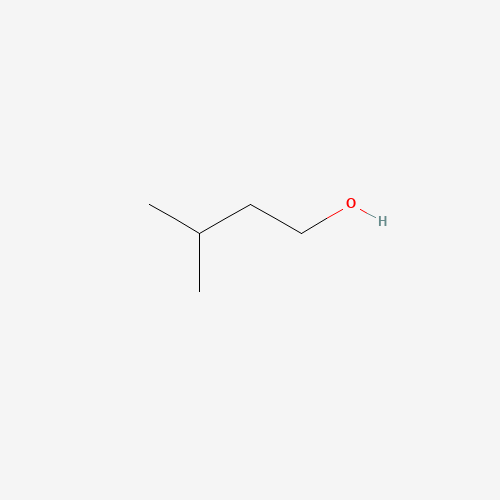
Physical Description | Isoamyl alcohol is a colorless liquid with a mild, choking alcohol odor. Less dense than water, soluble in water. Hence floats on water. Produces an irritating vapor. (USCG, 1999)
科学粮草官-词典编辑部,修订于:2026-07-06
Toxicity
ToxicityBody Burden
In a study in which the exhaled breaths of 26 smokers and 43 non-smokers were analyzed, 16% of the breaths of non-smokers and 77% of that of smokers contained isopentanol(1). In an earlier study of components of expired air of 8 male volunteers, three of the eight contained isopentanol and were expired at 2.6, 0.002, and 0.11 ug/hr(2). Two of these subjects were smokers(2). The isopentanol was believed to be of metabolic origin(2). As part of EPA's National Human Adipose Tissue Survey, 46 composite adipose fat samples were analyzed. Eighty-three percent of these samples contained isopentanol ranging from 1.51 to 14.82 ppm(3).
Fate Summary
ATMOSPHERIC FATE: Isopentanol will react with photochemically-produced hydroxyl radicals in the atmosphere. The rate constant estimated for this reaction is 7.8X10⁻¹² cu cm/molec-sec(1). Assuming a hydroxyl radical concn of 5X10+5 radicals/cu cm, the half-life of isopentanol in the atmosphere will be 2.0 days(SRC).
Soil Adsorption / Mobility
The Koc for isopentanol estimated from its water solubility, 26.7 mg/L(1), using recommended regression equations are 720(2) and 679(4). However, the chemicals used in developing these equations were mainly pesticides and their structures are not similar to isopentanol. The Koc for isopentanol estimated from molecular structure is 4(3). This should be a reasonable estimate for the Koc because it is close to the experimental value for the structurally similar chemical, 1-pentanol, 1.6(6). According to a suggested classification scheme(5), the estimated Kocs based on molecular structure suggests that isopentanol is very highly mobile in soil(SRC).
Environmental Biodegradation
Isopentanol is readily biodegraded in aerobic screening tests using sewage or activated sludge inocula(1-5). In one screening study utilizing a sewage seed, 75% and 100% of the isopentanol degraded within 4.5 and 6 days, respectively(1). In another, the half-life of isopentanol was 2.4 days(2). Five day BOD values ranged from 49% to 77% of theoretical(3-5). In a semi-continuous activated sludge treatment plant simulation, a 47% BOD reduction was achieved in 8 hr(3). The half-lives of isopentanol in ground water, Lester River, MN river water and Lake Superior harbor water were 15, 11, and 6.1 days, respectively(6). Isopentanol was >75% mineralized when incubated for 8 weeks in an anaerobic reactor using a 10% sludge inoculum from a secondary digester(7). The mean removal rate of isopenta...
Environmental Bioconcentration
The BCF for isopentanol estimated from isopentanol's octanol/water partition coefficient, log 1.42(1), using a recommended regression equation is 7(2). Such a low BCF would indicate that isopentanol would not bioconcentrate in aquatic organisms(SRC).
Volatilization from Water / Soil
The Henry's Law constant for isopentanol is 1.41X10⁻⁵ atm-cu m/mol(1). Using this value for the Henry's Law constant, one can estimate that the volatilization half-life of isopentanol in a model river 1 m deep flowing at 1 m/s with a wind speed of 3 m/s is 2.55 days(2). Similarly, the half-life of isopentanol in a model lake 1 m deep with a 0.05 m/s current and a 0.5 m/s wind is 21 days(2). In view of isopentanol's relatively high vapor pressure, 2.37 mm Hg at 25 °C(3) and moderate Henry's Law constant and low adsorptivity to soil, isopentanol would be expected to volatilize from dry and moist soil(SRC).
Environmental Abiotic Degradation
Isopentanol reacts with photochemically-produced hydroxyl radicals in the atmosphere with an estimated rate constant of 7.8X10⁻¹² cu cm/molec-sec(1). Assuming a hydroxyl radical concn of 5X10+5 radicals/cu cm, the half-life of isopentanol in the atmosphere will be 2.0 days(SRC). Isopentanol exhibits moderate photochemical reactivity in smog chamber tests(2).
Environmental Water Concentrations
Isopentanol has been identified in drinking water(1). No concns were reported.
Food Survey Values
Isopentanol has been identified, but not quantified, in peanut oil(1), blue cheese(2) and a cheese made in the French Alps(3), filberts(4), beer(5), wine(7), meat(8-9), chickpeas(10), oranges(11), bananas(12), Concord grapes(13), and nectarines(6). Eighty proof whiskey contained 154.4 mg/L of isopentanol(14).
Effluent Concentrations
In an analysis of 455 wastewater samples from 35 industrial categories, isopentanol was only identified in 1 sample from the synfuels industry(2). In a comprehensive survey of wastewater from 4000 industrial and publicly owned treatment works (POTWs) sponsored by the Effluent Guidelines Division of the U.S. EPA, isopentanol was identified in discharges of the following industrial category (positive occurrences, median concn in ppb): synfuels (7; 39.8), publicly owned treatment works (1; 176.7). The highest effluent concn was in a publically-owned treatment works at 177 ppb(3). The mean and range of isopentanol emissions from four whiskey fermentation vats was 0.166 and 0.141-0.183 g per cu m of grain input, respectively(1). The maximum concn of isopentanol in the vat gas was about 9 mg/...
Natural Pollution Sources
CONSTITUTES MAJOR PORTION OF FUSEL OIL; ALSO KNOWN AS FERMENTATION AMYL ALCOHOL. ... IDENTIFIED AS ESTER AMONG CONSTITUENTS OF ROMAN CAMOMILE OIL, & IN SEVERAL ESSENTIAL OILS ... ALSO IN AROMAS OF STRAWBERRY & RASPBERRY; IDENTIFIED IN RUM.
Atmospheric Concentrations
INDOOR AIR: In a 1985-1986 study of VOC's in the air of 500 West German homes, the mean and range of isopentanol concns were 1 and <1.0 to 10 ug/cu m, respectively(1).
Fish/Seafood Concentrations
The concn of isopentanol in mussels collected at the Oarai Coast in Ibaraki, Japan in July 1985 was 0.03 ppm(1). The volatile components were separated from the tissue by freeze vacuum distillation.
Artificial Pollution Sources
Isopentanol may be released to the environment during its manufacture, transport, disposal and use as a solvent, extracting agent, additive, photographic chemical, chemical intermediate in the production of herbicides and pharmaceuticals, and in the synthesis of flavors and fragrances(1,4). It is also a fermentation product of sugars and starches and may be released during fermentation(2-3). Isopentanol is also released during petroleum manufacture and storage and from wood pulping(3).
Probable Routes of Human Exposure
Workers may be exposed to isopentanol via inhalation and dermal contact. The general public is exposed to isopentanol in a variety of foods, including fruit, nuts, and meat, and in indoor air. (SRC)
Other Environmental Concentrations
The average concn of isopentanol in fusel oil, a by-product of alcoholic fermentation of starches and sugars is 60-65%(1). The concn of isopentanol in the volatile fraction of fresh poultry manure was 0.398 ppm(2). The concn of isopentanol was 4.01 ppm and not detectable in manure samples that had been incubated for 9 and 28 days, respectively, at 27-28 °C under nearly anaerobic conditions(2). In a study in which 29 samples of printer's inks from different European manufacturers were analyzed, isopentanol was found in only one sample at a concn of 0.3%(3).
Environmental Fate / Exposure Summary
Isopentanol is a naturally occurring substance that is released to the environment by plants, microorganisms, and from animal wastes. It may also be released during its manufacture, transport, disposal and use as a solvent, extracting agent, additive, photographic chemical, chemical intermediate in the production of herbicides and pharmaceuticals, in the synthesis of flavors and fragrances, and during the fermentation of sugars and starches. If released on soil, it should readily volatilize as well as leach. Based upon results from biodegradation studies with surface water and ground water, biodegradation in soil should be rapid. If released in water, it should also be lost by evaporation. Biodegradation should also be rapid. Isopentanol's volatilization half-life from a model river is...
Symptoms
irritation eyes, skin, nose, throat; headache, dizziness; cough, dyspnea (breathing difficulty), nausea, vomiting, diarrhea; skin cracking; In Animals: narcosis
Interactions
The purpose of this study was to investigate whether isopentanol, the most abundant hiqher chain alcohol in alcoholic beverages, contributes to induction of different forms of hepatic p450s associated with consumption of these beverages. Induction of p450 by isopentanol alone and in combination with ethanol in cultured chick and rat hepatocytes. The forms of induced p450 were identified both enzymaticaly and immunochemically. In cultured chick hepatocytes, both isopentanol and ethanol induced p450 2E, but combined treatment with these alcohols had no greater effect than treatment with ethanol alone. In cultured rat hepatocytes, isopentanol alone did not induce p450 2E or 2B1/2 and had no effect on the ethanol mediated induction of p450 2E. However, isopentanol combined with ethanol caus...
Target Organs
Eyes, skin, respiratory system, central nervous system
Adverse Effects
Neurotoxin - Acute solvent syndrome
Exposure Routes
inhalation, ingestion, skin and/or eye contact
Non-Human Toxicity Values
LD50 Rabbit oral 3.4 g/kg
Populations at Special Risk
Persons with pre-existing skin disorders may be more susceptible to the effects of this agent. ... In persons with impaired pulmonary function, expecially those with obstructive airway diseases, the breathing of isoamyl alcohol might cause exacerbation of symptoms due to its irritant properties.