


 一键配货
一键配货
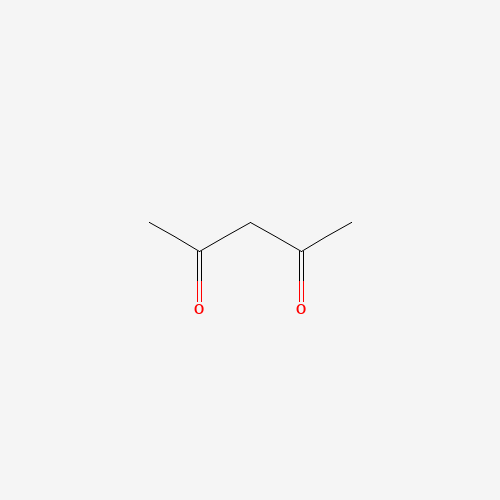
化合物详情
CAS123-54-6
分子式C5H8O2
分子量100.12 g/mol g/mol
危化品
Physical Description | Pentane-2,4-dione appears as a colorless or yellow colored liquid. Less dense than water. Vapors are heavier than air. Used as a solvent in paints and varnishes.
科学粮草官-词典编辑部,修订于:2026-07-06
Toxicity
ToxicityFate Summary
ATMOSPHERIC FATE: According to a model of gas/particle partitioning of semivolatile organic compounds in the atmosphere(1), acetyl acetone, which has a vapor pressure of 2.96 mm Hg at 20 °C(2), is expected to exist solely as a vapor in the ambient atmosphere. Vapor-phase acetyl acetone is degraded in the atmosphere by reaction with photochemically-produced hydroxyl radicals(SRC); the half-life for this reaction in air is estimated to be 22 days(SRC), calculated from its rate constant of 9.05X10⁻¹¹ cu cm/molecule-sec at 25 °C(3). Acetyl acetone absorbs UV light at wavelengths >314 nm(5) and, therefore, may be susceptible to direct photolysis by sunlight(SRC).
Soil Adsorption / Mobility
The Koc of acetyl acetone is estimated as 34(SRC), using a log Kow of 0.40(1) and a regression-derived equation(2). According to a classification scheme(3), this estimated Koc value suggests that acetyl acetone is expected to have very high mobility in soil(SRC).
Environmental Biodegradation
AEROBIC: In a screening study using settled sewage seed at 20 °C, 5.6, 40.0, 62.8, and 69.6% of theoretical BOD was determined after 5, 10, 15, and 20 incubation days, respectively(1). Acetyl acetone, present at 100 mg/L, reached 83% of its theoretical BOD in 4 weeks using an activated sludge inoculum at 30 mg/L in the Japanese MITI test(2).
Environmental Bioconcentration
An estimated BCF of 3 was calculated in fish for acetyl acetone(SRC), using a log Kow of 0.40(1) and a regression-derived equation(2). According to a classification scheme(3), this BCF suggests the potential for bioconcentration in aquatic organisms is low(SRC).
Volatilization from Water / Soil
The Henry's Law constant for acetyl acetone is estimated as 2.4X10⁻⁶ atm-cu m/mole(SRC) derived from its vapor pressure, 2.96 mm Hg(1), and water solubility, 166,000 mg/L(2). This Henry's Law constant indicates that acetyl acetone is expected to volatilize from water surfaces(3). Based on this Henry's Law constant, the volatilization half-life from a model river (1 m deep, flowing 1 m/sec, wind velocity of 3 m/sec)(3) is estimated as 16 days(SRC). The volatilization half-life from a model lake (1 m deep, flowing 0.05 m/sec, wind velocity of 0.5 m/sec)(3) is estimated as 120 days(SRC). Acetyl acetone's estimated Henry's Law constant indicates that volatilization from moist soil surfaces may occur(SRC). The potential for volatilization of acetyl acetone from dry soil surfaces may exist(SR...
Environmental Abiotic Degradation
The rate constant for the vapor-phase reaction of acetyl acetone (enol form) with photochemically-produced hydroxyl radicals has been measured as 9.05X10⁻¹¹ cu cm/molecule-sec at 25 °C(1). This corresponds to an atmospheric half-life of about 22 days at an atmospheric concentration of 5X10+5 hydroxyl radicals per cu cm(1). The aquatic oxidation rate for acetyl acetone has been experimentally determined to be 9.9X10⁻⁹ L/mol-s at pH 6.4(2). Based on this rate and a hydroxyl radical concentration of 1X10-17 mol/L in water under continuous sunlight(3), the half-life for the aquatic oxidation of acetyl acetone can be estimated to be 81 days(SRC). Acetyl acetone is not expected to undergo hydrolysis in the environment due to the lack of functional groups that hydrolyze under environmental con...
Food Survey Values
Acetyl acetone has been identified, not quantified in chicken(1).
Effluent Concentrations
Acetyl acetone was identified, not quantified in ozone treated sludge press liquors from a waste water treatment facility in Kent, England(1). The compound was identified in an odor profiling study of a confined animal (swine) feeding operation in north western Texas. It was not identified as a major odorant from a beef operation(2).
ICSC Environmental Data
The substance is harmful to aquatic organisms.
Artificial Pollution Sources
Acetyl acetone's production and use as gasoline additives, lubricant additives, driers for varnishes and printer inks, and dyes(1) may result in its release to the environment through various waste streams(SRC). Acetyl acetone's former use as a fungicide(1), bactericide(2), wood preservative(2) and insecticide(1) resulted in its direct release to the environment(SRC).
Probable Routes of Human Exposure
NIOSH (NOES Survey 1981-1983) has statistically estimated that 6,173 workers (1,577 of these are female) are potentially exposed to acetyl acetone in the US(1). Occupational exposure to acetyl acetone may occur through inhalation and dermal contact with this compound at workplaces where acetyl acetone is produced or used. Limited monitoring data indicate that the general population may be exposed to acetyl acetone via use of tobacco products and via inhalation in localized areas near confined animal feeding operations(SRC).
Other Environmental Concentrations
Acetyl acetone was found at 6% weight/weight in one of 29 different types of printing inks(1). The compound has been identified in tobacco and tobacco substitute smoke(2).
Environmental Fate / Exposure Summary
Acetyl acetone's production and use as gasoline additives, lubricant additives, driers for varnishes and printer inks, and dyes may result in its release to the environment through various waste streams. Acetyl acetone's former use as fungicide, bactericide, wood preservative and insecticide resulted in its direct release to the environment. If released to air, a vapor pressure of 2.69 mm Hg at 20 °C indicates acetyl acetone will exist solely as a vapor in the atmosphere. Vapor-phase acetyl acetone will be degraded in the atmosphere by reaction with photochemically-produced hydroxyl radicals; the half-life for this reaction in air is estimated to be 22 days. Based on its high water solubility (166,000 mg/L), removal from air via wet deposition may occur. Acetyl acetone absorbs UV light...
Symptoms
Ingestion Exposure: Diarrhoea. Weakness. Further see Inhalation.
Interactions
... Acetylacetone inhibited the mutagenicity of 2-naphthohydroxamic acid.
Toxicity Data
LCLo (rat) = 1,000 ppm/4H
Adverse Effects
Neurotoxin - Acute solvent syndrome
Exposure Routes
The substance can be absorbed into the body by inhalation of its vapour, through the skin and by ingestion.
Toxicity Summary
IDENTIFICATION AND USE: Acetyl acetone is a colorless or slightly yellow liquid. It forms organometallic complexes which are used as gasoline additives, lubricant additives, driers for varnishes and printer's inks. HUMAN STUDIES: Acetly acetone (2 to 14 ppm) was reported to produce nausea and headaches in several persons. A case was reported involving an individual who had developed contact dermatitis to Cu(II)-acetyl acetonate and who also showed a cross reaction to acetyl acetone. The skin sensitizing properties of acetyl acetate were examined in a human patch test. Of the 12 persons tested three showed no reaction, seven doubtful, and two had a positive reaction after an exposure period of 24 hr. No skin reactions were evident after 48 and 72 hr, respectively. The results observed in...
Human Toxicity Excerpts
/CASE REPORTS/ ... A case /was reported/ involving an individual who had developed contact dermatitis to Cu(II)-acetyl acetonate and who also showed a cross reaction to 2,4-pentanedione.
Antidote and Emergency Treatment
/SRP:/ Advanced treatment: Consider orotracheal or nasotracheal intubation for airway control in the patient who is unconscious, has severe pulmonary edema, or is in severe respiratory distress. Positive-pressure ventilation techniques with a bag-valve-mask device may be beneficial. Consider drug therapy for pulmonary edema ... . Consider administering a beta agonist such as albuterol for severe bronchospasm ... . Monitor cardiac rhythm and treat arrhythmias if necessary ... . Start IV administration of D5W /SRP: "To keep open", minimal flow rate/. Use 0.9% saline (NS) or lactated Ringer's (LR) if signs of hypovolemia are present. For hypotension with signs of hypovolemia, administer fluid cautiously. Watch for signs of fluid overload ... . Use proparacaine hydrochloride to assist eye i...









