


 一键配货
一键配货
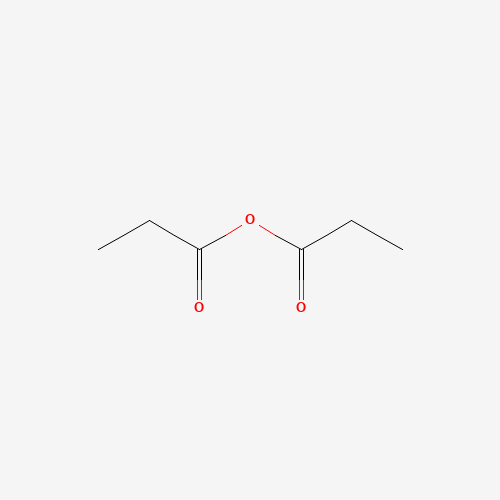
化合物详情
CAS123-62-6
分子式C6H10O3
分子量130.14 g/mol g/mol
危化品
Physical Description | Propionic anhydride is a colorless liquid with a pungent odor. Flash point 165 °F. Density 8.4 lb /gal. Corrosive to metals and tissue.
科学粮草官-词典编辑部,修订于:2026-07-06
Toxicity
ToxicityFate Summary
ATMOSPHERIC FATE: According to a model of gas/particle partitioning of semivolatile organic compounds in the atmosphere(1), propionic anhydride, which has a vapor pressure of 1.36 mm Hg at 25 °C(2), is expected to exist solely as a vapor in the ambient atmosphere. Vapor-phase propionic anhydride is degraded in the atmosphere by reaction with photochemically-produced hydroxyl radicals(SRC); the half-life for this reaction in air is estimated to be 18 days(SRC), calculated from its rate constant of 9.1X10⁻¹³ cu cm/molecule-sec at 25 °C(SRC) that was derived using a structure estimation method(3). Photolysis of propionic anhydride is not expected to be an important environmetnal fate process due to the rapid hydrolysis rate(SRC).
Soil Adsorption / Mobility
Soil adsorption and mobility of propionic anhydride are not expected to be important environmental fate processes due to the rapid hydrolysis to propionic acid under aqueous conditions(1-2).
Environmental Biodegradation
Biodegradation is not expected to be an important environmental fate process due to the rapid hydrolysis of propionic anhydride under aqueous conditions(1-2). Propionic anhydride, present at 100 mg/L, reached 83% of its theoretical BOD in 2 weeks using an activated sludge inoculum at 30 mg/L in the Japanese MITI test(3), however it is believed that this biodegradation measurement was of the acid(SRC).
Environmental Bioconcentration
Bioconcentration of propionic anhydride is not expected to be an important environmental fate process due to the rapid hydrolysis to propionic acid under aqueous conditions(1-2).
Volatilization from Water / Soil
Volatilization from water surfaces or moist soil surfaces is not expected to be an important fate process due to the rapid hydrolysis of propionic anhydride under aqueous conditions(1-2). Propionic anhydride is expected to volatilize from dry soil surfaces(SRC) based upon a vapor pressure of 1.36 mm Hg(3).
Environmental Abiotic Degradation
The rate constant for the vapor-phase reaction of propionic anhydride with photochemically-produced hydroxyl radicals has been estimated as 9.1X10⁻¹³ cu cm/molecule-sec at 25 °C(SRC) using a structure estimation method(1). This corresponds to an atmospheric half-life of about 18 days at an atmospheric concentration of 5X10+5 hydroxyl radicals per cu cm(1). A base-catalyzed second-order hydrolysis rate constant of 1.1X10+4 L/mole-sec(SRC) was estimated using a structure estimation method(2); this corresponds to half-lives of 10 and 1.0 minutes at pH values of 7 and 8, respectively(2). Photolysis of propionic anhydride is not expected to be an important environmetnal fate process due to the rapid hydrolysis rate(SRC).
Artificial Pollution Sources
Propionic anhydride's production and use as an esterifying agent for perfume oils, fats, cellulose, alkylated resins, dyestuffs, drugs and as a dehydrating agent(1) may result in its release to the environment through various waste streams(SRC).
Probable Routes of Human Exposure
NIOSH (NOES Survey 1981-1983) has statistically estimated that 489 workers (32 of these were female) were potentially exposed to propionic anhydride in the US(1). Occupational exposure to propionic anhydride may occur through inhalation and dermal contact with this compound at workplaces where propionic anhydride is produced or used(SRC).
Environmental Fate / Exposure Summary
Propionic anhydride's production and use as an esterifying agent for perfume oils, fats, cellulose, alkylated resins, dyestuffs, drugs and as a dehydrating agent may result in its release to the environment through various waste streams. If released to air, a vapor pressure of 1.36 mm Hg at 25 °C indicates propionic anhydride will exist solely as a vapor in the ambient atmosphere. Vapor-phase propionic anhydride will be degraded in the atmosphere by reaction with photochemically-produced hydroxyl radicals; the half-life for this reaction in air is estimated to be 17 days. Photolysis of propionic anhydride is not expected to be an important environmetnal fate process due to the rapid hydrolysis rate. Acid anhydrides react with water to form the corresponding acid. Propionic anhydride is...
Symptoms
Ingestion Exposure: Burns in mouth and throat. Abdominal pain. Shock or collapse.
Adverse Effects
Toxic Pneumonitis - Inflammation of the lungs induced by inhalation of metal fumes or toxic gases and vapors.
Exposure Routes
The substance can be absorbed into the body by inhalation and by ingestion.
Human Toxicity Excerpts
/SIGNS AND SYMPTOMS/ The substance is corrosive to the eyes, the skin and the respiratory tract. Inhalation of vapor or aerosol may cause lung edema. The effects may be delayed.
Non-Human Toxicity Values
LD50 Rat oral 2360 mg/kg
Non-Human Toxicity Excerpts
/LABORATORY ANIMALS: Acute Exposure/ Rated 8 on rabbit eyes. /substances are rated on a scale of 1 to 10 according to the degree of injury observed after 24 hr. The most severe injuries are rated 10/
Antidote and Emergency Treatment
Advanced treatment: Consider orotracheal or nasotracheal intubation for airway control in the patient who is unconscious, has severe pulmonary edema, or is in severe respiratory distress. Early intubation, at the first sign of upper airway obstruction, may be necessary. Positive-pressure ventilation techniques with a bag valve mask device may be beneficial. Consider drug therapy for pulmonary edema ... . Consider administering a beta agonist such as albuterol for severe bronchospasm ... . Monitor cardiac rhythm and treat arrhythmias as necessary ... . Start IV administration of D5W /SRP: "To keep open", minimal flow rate/. Use 0.9% saline (NS) or lactated Ringer's (LR) if signs of hypovolemia are present. For hypotension with signs of hypovolemia, administer fluid cautiously. Consider v...









