


 一键配货
一键配货
化合物详情
CAS123-63-7
分子式C6H12O3
分子量132.16 g/mol
危化品
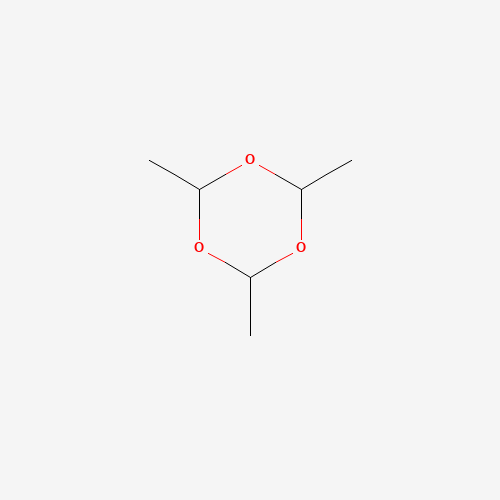
Physical Description | Paraldehyde appears as a clear colorless liquid with a pleasant odor. Flash point 96 °F. Melting point 54 °F. Less dense than water. Vapors are heavier than air.
科学粮草官-词典编辑部,修订于:2026-07-06
Toxicity
ToxicityEcotoxicity Values
USDA APHIS Chemical Effects: collection=usda_chemeffect&query_type=synonym&query='^123-63-7$'
Fate Summary
ATMOSPHERIC FATE: Based on a vapor pressure of 25.5 mm Hg at 20 °C(1), paraldehyde is expected to exist almost entirely in the vapor phase in the atmosphere(2,SRC). Reaction with photochemically generated hydroxyl radicals is expected to be the dominant removal mechanism (half-life 45 hours). The relatively high water solubility of paraldehyde (125,000 mg/l at 25 °C(3)) suggests that this compound may also be removed from the atmosphere in precipitation(SRC).
Environmental Biodegradation
Japanese MITI, initial concn 100 ppm, 14 days <30% BODT, activated sludge inoculum(1). A bacterium isolated from sewage, C. paraldehydium KY 4359, was found to degrade paraldehyde to acetaldehyde and acetic acid(2).
Environmental Bioconcentration
Based on a water solubility of 125,000 mg/l at 25 °C and a log Kow of 0.67, bioconcentration factors (BCF) of 0.8-2 were estimated for paraldehyde(1,2,3,SRC). These BCF values suggest that paraldehyde would not bioaccumulate significantly in aquatic organisms(SRC).
Volatilization from Water / Soil
Henry's Law Constant for paraldehyde has been estimated to be on the order of 4X10⁻⁵ atm-cu m/mole based on a water solubility of 125,000 mg/l at 25 °C and a vapor pressure of 25.5 mm Hg at 20 °C(1,2,SRC). This value of Henry's Law Constant suggests that paraldehyde would volatilize fairly rapidly from all bodies of water and from moist soil surfaces(3,SRC). Based on this value the volatilization half-life of paraldehyde from a model river 1 m deep flowing 1 m/sec with a wind velocity of 3 m/sec has been estimated to be 31 hr(3,SRC). The relatively high vapor pressure of paraldehyde suggests that this compound would volatilize rapidly from dry soil surfaces(2,SRC).
Environmental Abiotic Degradation
Paraldehyde decomposes on standing(1). This compound is stable to alkalies but slowly decomposes to acetaldehyde when treated with mineral acid(1). The half-life for paraldehyde reacting with photochemically generated hydroxyl radicals in natural water has been estimated to be >2 years based on a measured reaction rate constants of 6.0X10+8 and 1.0X10+9 l/mole-sec and an ambient hydroxyl radical concentration of 1X10-17 mol/l(2,3,4,SRC). The half-life for paraldehyde vapor reacting with photochemically generated hydroxyl radicals in the atmosphere has been estimated to be 45 hours based on an estimated reaction rate constant of 8.5X10⁻¹² cu cm/molecules-sec at 25 °C and an average ambient hydroxyl concentration of 5X10+5 molecules/cu cm(5,SRC).
Food Survey Values
Identified as a volatile flavor component of fried bacon(1).
Effluent Concentrations
Identified in the effluent from a publicly owned treatment works in the USA(1). Identified in leachate samples taken from low-level radioactive waste disposal sites in Maxy Flats, KY and West Valley, NY(2).
Artificial Pollution Sources
Paraldehyde may be released to the environment in emissions or effluents from sites of its manufacture or industrial use (paraldehyde is used as a drug, chemical intermediate, dyestuff intermediate, and solvent(1)) and from disposal of wastes containing this compound (ie hospital wastes)(2,3,SRC).
Probable Routes of Human Exposure
NIOSH (NOES Survey 1981-1983) has statistically estimated that 1,728 workers are potentially exposed to paraldehyde in the USA(1).
Other Environmental Concentrations
Identified as a volatile component of hydrated collagen heated at normal roasting temperatures(1). Although this is not the same as actually roasting fresh meat, this suggests that paraldehyde may be present in cooked meat(1).
Environmental Fate / Exposure Summary
Paraldehyde may be released to the environment in emissions or effluents from sites of its manufacture or industrial use (paraldehyde is used as a drug, chemical intermediate, dyestuff intermediate, and solvent) and from disposal of wastes containing this compound (ie hospital wastes). If released to soil surfaces, paraldehyde may volatilize rapidly or it may leach into deeper soil. Potential degradation products include acetaldehyde and acetic acid. If released to water, volatilization is expected to be an imporant, if not the dominant, fate process (half-life in a model river 31 hr). If released to the atmosphere, reaction with photochemically generated hydroxyl radicals is expected to be the dominant removal mechanism (half-life 45 hr). This compound may also be removed from the atmo...
Symptoms
Ingestion Exposure: Burning sensation in the throat and chest. Nausea. Vomiting. Diarrhoea. Drowsiness. Unconsciousness.
Toxicity Data
LCLo (rat) = 4,000 ppm/4h
Adverse Effects
Occupational hepatotoxin - Secondary hepatotoxins: the potential for toxic effect in the occupational setting is based on cases of poisoning by human ingestion or animal experimentation.
Exposure Routes
The substance can be absorbed into the body by inhalation of its vapour and by ingestion.
Non-Human Toxicity Values
LD50 Dog oral (acute) 3.0 to 4.0 g/kg
Non-Human Toxicity Excerpts
PARALDEHYDE HAS BEEN TESTED FOR INFLUENCE ON INTRAOCULAR PRESSURE WHEN ADMIN SYSTEMICALLY TO DOGS & TO NORMAL & GLAUCOMATOUS RABBITS, & WAS FOUND TO CAUSE NO ELEVATION, POSSIBLY SLIGHT REDN OF PRESSURE.
Antidote and Emergency Treatment
Treatment is directed toward maintenance of airway, breathing, and circulation. Supportive care is the mainstay of therapy. Patients are often critically ill and must be under constant supervision.









