


 一键配货
一键配货
化合物详情
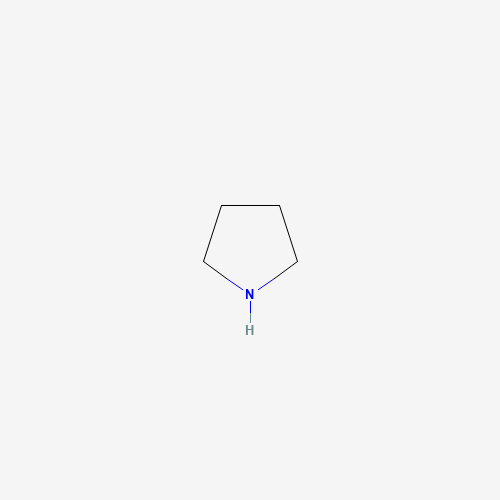
CAS123-75-1
分子式C4H9N
分子量71.12 g/mol g/mol
危化品
Physical Description | Pyrrolidine appears as a colorless to pale yellow liquid with an ammonia-like odor. Vapors heavier than air. Produces toxic oxides of nitrogen during combustion.
科学粮草官-词典编辑部,修订于:2026-07-06
Toxicity
ToxicityEcotoxicity Values
USDA APHIS Chemical Effects: collection=usda_chemeffect&query_type=synonym&query='^123-75-1$'
Fate Summary
ATMOSPHERIC FATE: According to a model of gas/particle partitioning of semivolatile organic compounds in the atmosphere(1), pyrrolidine, which has a vapor pressure of 62.7 mm Hg at 25 °C(2), is expected to exist solely as a vapor in the ambient atmosphere. Vapor-phase pyrrolidine is degraded in the atmosphere by reaction with photochemically-produced hydroxyl radicals(SRC); the half-life for this reaction in air is estimated to be 5 hours(SRC), calculated from its rate constant of 7.8X10⁻¹¹ cu cm/molecule-sec at 25 °C(SRC) that was derived using a structure estimation method(3). Pyrrolidine does not contain chromophores that absorb at wavelengths >290 nm(4) and therefore is not expected to be susceptible to direct photolysis by sunlight(SRC).
Soil Adsorption / Mobility
The Koc of pyrrolidine is estimated as 42(SRC), using a log Kow of 0.46(1) and a regression-derived equation(2). According to a classification scheme(3), this estimated Koc value suggests that pyrrolidine is expected to have very high mobility in soil. The pKa of pyrrolidine is 11.31(4), indicating that this compound will primarily exist in the cation form in the environment and cations generally adsorb more strongly to soils containing organic carbon and clay than their neutral counterparts(5).
Environmental Biodegradation
ANAEROBIC: Pyrrolidine was found to degrade anaerobically via denitrification in 7-15 days in microbial consortia from freshwater sediments, estuarine sediments and activated sludge(1).
Environmental Bioconcentration
An estimated BCF of 3 was calculated in fish for pyrrolidine(SRC), using a log Kow of 0.46(1) and a regression-derived equation(2). According to a classification scheme(3), this BCF suggests the potential for bioconcentration in aquatic organisms is low(SRC).
Volatilization from Water / Soil
The Henry's Law constant for pyrrolidine is 2.39X10⁻⁶ atm-cu m/mole(1). A pKa of 11.31(1) indicates pyrrolidine will exist almost entirely in the cation form at pH values of 5 to 9 and therefore volatilization from water surfaces is not expected to be an important fate process(2). Pyrrolidine is expected to volatilize from dry soil surfaces(SRC) based upon a vapor pressure of 62.7 mm Hg(3).
Environmental Abiotic Degradation
The rate constant for the vapor-phase reaction of pyrrolidine with photochemically-produced hydroxyl radicals has been estimated as 7.8X10⁻¹¹ cu cm/molecule-sec at 25 °C(SRC) using a structure estimation method(1). This corresponds to an atmospheric half-life of about 5 hours at an atmospheric concentration of 5X10+5 hydroxyl radicals per cu cm(1). Pyrrolidine is not expected to undergo hydrolysis in the environment due to the lack of functional groups that hydrolyze under environmental conditions(2). Pyrrolidine does not contain chromophores that absorb at wavelengths >290 nm(2) and therefore is not expected to be susceptible to direct photolysis by sunlight(SRC).
Environmental Water Concentrations
SURFACE WATER: Pyrrolidine was detected in the Alster, Au, Kruckau and Pinnau rivers of Germany at 1.5 ug/kg, 2.5 ug/kg, 0.2 ug/kg, and 0.9 ug/kg, respectively(1).
Food Survey Values
Pyrrolidine was detected in 10 g samples of baked ham at 0.013 ppm(1). Pyrrolidine can be found in tilsiter, camembert, limburger, and brown bread cheeses at 19.9 mg/kg, 1 mg/kg, 0.1 mg/kg and 0.3 mg/kg, respectively(2). In coffee, pyrrolidine was detected in coffee extract and freeze dried coffee at 10 mg/kg and 11 mg/kg, respectively(3).
Plant Concentrations
Pyrrolidine was detected in 10 g samples of spinach and miso at 0.250 ppm and 0.020 ppm, respectively(1). Pyrrolidine can be found in spinach, red radish, and celery at 2.5 mg/kg, 38 mg/kg, and 0.4 mg/kg, respectively(2). It can also be found in maize, apple peels, beans, kale, paprika red and cornichons at 3.5 mg/kg, 1.5 mg/kg, 0.2 mg/kg, 1.6 mg/kg, 0.6 mg/kg, and 0.1 mg/kg, respectively(2). It is also found in barley, hops, and malt at 0.9 mg/kg, 1 mg/kg, and 1.5 mg/kg, respectively(2).
Effluent Concentrations
Pyrrolidine was identified in the primary effluent at a concentration of 14 ug/L from municipal wastewater treatment plants(1).
Natural Pollution Sources
Pyrrolidine was detected in spinach(1,2) and miso(1). Pyrrolidine was also detected in red radish, celery, maize, apple peels, beans, kale, paprika red, cornichons, barley, hops, and malt(2).
Fish/Seafood Concentrations
Pyrrolidine was detected in 10 g samples of cod roe at 0.006 ppm(1).
Artificial Pollution Sources
Pyrrolidine's production and use in the synthesis of drugs and antibiotics(1) and in vulcanization accelerators(1) may result in its release to the environment through various waste streams.
Probable Routes of Human Exposure
Occupational exposure to pyrrolidine may occur through inhalation and dermal contact with this compound at workplaces where pyrrolidine is produced or used. Monitoring and use data indicate that the general population may be exposed to pyrrolidine via ingestion of food and drinking water, use of tobacco products, and dermal contact with this compound and other products containing pyrrolidine. (SRC)
Other Environmental Concentrations
In tobacco & cigarette smoke condensate (tar), pyrrolidine was one of predominant amines found in both substances.
Environmental Fate / Exposure Summary
Pyrrolidine's production and use in the synthesis of drugs and antibiotics and in vulcanization accelerators may result in its release to the environment through various waste streams. Naturally occurring sources of pyrrolidine can be found in vegetables, dairy products, cigarettes, alcoholic beverages and coffee. If released to air, a vapor pressure of 62.7 mm Hg at 25 °C indicates pyrrolidine will exist solely as a vapor in the atmosphere. Vapor-phase pyrrolidine will be degraded in the atmosphere by reaction with photochemically-produced hydroxyl radicals; the half-life for this reaction in air is estimated to be 5 hours. Pyrrolidine does not contain chromophores that absorb at wavelengths >290 nm and therefore is not expected to be susceptible to direct photolysis by sunlight. If re...
Symptoms
Ingestion Exposure: Convulsions. Sore throat. Vomiting. See Inhalation.
Interactions
Formation of n-nitrosopyrrolidine in a dog's stomach from Na nitrate & pyrrolidine. N-nitrosopyrrolidine disappeared rapidly from stomach, probably due to absorption.
Toxicity Data
LC50 (mouse) = 1,300 mg/m3/2hr
Adverse Effects
Toxic Pneumonitis - Inflammation of the lungs induced by inhalation of metal fumes or toxic gases and vapors.
Exposure Routes
The substance can be absorbed into the body by inhalation and by ingestion.
Human Toxicity Excerpts
/SIGNS AND SYMPTOMS/ Inhalation: Burning sensation. Convulsions. Cough. Headache. Nausea. Sore throat. Vomiting. Skin: Redness. Skin burns. Pain. Blisters. Eyes: Redness. Pain. Blurred vision. Severe deep burns. Ingestion: Convulsions. Sore throat. Vomiting. (See Inhalation).









