


 一键配货
一键配货
化合物详情
CAS123-79-5
分子式C22H42O4
分子量370.57 g/mol
非危品
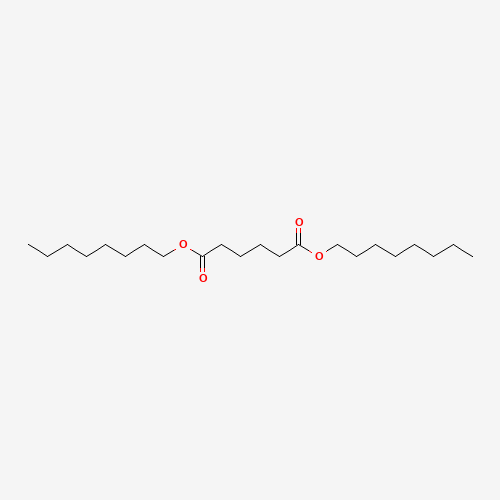
Dioctyl hexanedioate is a carboxylic ester.
科学粮草官-词典编辑部,修订于:2026-07-06
Toxicity
ToxicityFate Summary
ATMOSPHERIC FATE: According to a model of gas/particle partitioning of semivolatile organic compounds in the atmosphere(1), di-n-octyl adipate, which has a vapor pressure of 8.5X10⁻⁷ mm Hg at 20 °C(2), will exist in both the vapor and particulate phases in the ambient atmosphere. Vapor-phase di-n-octyl adipate is degraded in the atmosphere by reaction with photochemically-produced hydroxyl radicals(SRC); the half-life for this reaction in air is estimated to be 0.67 days(SRC), calculated from its rate constant of 2.4X10⁻¹¹ cu cm/molecule-sec at 25 °C(3) determined using a structure estimation method(3). Particulate-phase di-n-octyl adipate may be removed from the air by wet and dry deposition(SRC). Di-n-octyl adipate may undergo direct photolysis in the environment, since this compound...
Soil Adsorption / Mobility
Using a structure estimation method based on molecular connectivity indices(1), the Koc for di-n-octyl adipate can be estimated to be 57,000(SRC). According to a classification scheme(2), this estimated Koc value suggests that di-n-octyl adipate is expected to be immobile in soil.
Environmental Biodegradation
AEROBIC: In a semi-continuous activated sludge method used to simulate sewage treatment plant biodegradation, di-n-octyl adipate was observed to undergo primary degradation of 65-96% (at concns of 5 and 20 mg/l added/24 hr)(1); in a CO2 evolution study, di-n-octyl adipate was observed to biodegrade 94% over a 35-day incubation period which corresponds to a first-order half-life of 2.7 days(1).
Environmental Bioconcentration
A whole-fish BCF of 27 was observed for blue-gill fish exposed di-n-octyl adipate levels of 250 ug/l for a 28-day period(1). According to a classification scheme(2), this BCF suggests the potential for bioconcentration in aquatic organisms is low.
Volatilization from Water / Soil
The estimated Henry's Law constant for di-n-octyl adipate is 4.34X10⁻⁷ atm-cu m/mole(1). This estimated Henry's Law constant indicates that di-n-octyl adipate is not expected to volatilize from water surfaces(2). Di-n-octyl adipate's estimated Henry's Law constant(1) indicates that volatilization from moist soil surfaces is not expected to occur(SRC). Di-n-octyl adipate is not expected to volatilize from dry soil surfaces(SRC) based upon a vapor pressure of 8.5X10⁻⁷ mm Hg(1).
Environmental Abiotic Degradation
The rate constant for the vapor-phase reaction of di-n-octyl adipate with photochemically-produced hydroxyl radicals has been estimated as 2.4X10⁻¹¹ cu cm/molecule-sec at 25 °C(1). This corresponds to an atmospheric half-life of about 0.67 days at an atmospheric concentration of 5X10+5 hydroxyl radicals per cu cm(1). Di-n-octyl adipate is expected to undergo hydrolysis producing octanol and adipic acid(SRC). A base-catalyzed second-order hydrolysis rate constant of 4.7 L/mole-sec(SRC) was estimated using a structure estimation method(2); this corresponds to half-lives of 5 years and 170 days at pH values of 7 and 8, respectively(2). Di-n-octyl adipate may undergo direct photolysis in the environment, since this compound contains a functional group that can absorb light >290 nm(3).
Environmental Water Concentrations
SURFACE WATER: Dioctyl adipate (isomer not reported) was detected at levels ranging from 2 to 86 ppb in 7 of 204 samples collected from 14 heavily industrialized river basins in the US between Aug 1975 and Sept 1976(1).
Effluent Concentrations
Release to the air can occur during incineration of municipal refuse, industrial rubbish and waste products from plastic production and other processes that use dioctyl adipate plasticizers(1). Leachates from municipal and industrial landfills that contain plastics may contain dioctyl adipate(1). Dioctyl adipate has been detected in wastewater effluents from the pulp and paper industry and in sewage treatment effluents(2,3). Di-n-octyl adipate was detected in effluent irrigation samples collected from Glil-Yam, 15 km north of Tel-Aviv, Israel at a concentration of 1,500 ppb from a depth of 9-10 m(4).
Artificial Pollution Sources
Di-n-octyl adipate's production and use as a plastizer for synthetic rubbers, nitro cellulose and ethyl cellulose(1) may result in its release to the environment through various waste streams(SRC).
Sediment/Soil Concentrations
SEDIMENT: Dioctyl adipate (isomer not reported) was detected (concn not reported) in sediment collected from the Charles River in Boston in Sept 1973(1).
Probable Routes of Human Exposure
Occupational exposure to di-n-octyl adipate may occur through inhalation of dust particles and dermal contact with this compound at workplaces where di-n-octyl adipate is produced or used. The general population may be exposed to di-n-octyl adipate via drinking water, and dermal contact with this compound and other products containing di-n-octyl adipate. (SRC)
Other Environmental Concentrations
Di-n-octyl adipate was detected by GC/MS, but not quantified, in weathered limestone samples collected from Sevilla, in southwestern Spain and Mechelen, in northern Belgium(1).
Environmental Fate / Exposure Summary
Di-n-octyl adipate's production and use as a plasticizer for synthetic rubbers, nitro cellulose and ethyl cellulose may result in its release to the environment through various waste streams. If released to air, a vapor pressure of 8.50X10⁻⁷ mm Hg at 20 °C indicates di-n-octyl adipate will exist in both the vapor and particulate phases. Vapor-phase di-n-octyl adipate will be degraded in the atmosphere by reaction with photochemically-produced hydroxyl radicals; the half-life for this reaction in air is estimated to be 0.67 days. Particulate-phase di-n-octyl adipate will be removed from the atmosphere by wet and dry deposition. Di-n-octyl adipate may undergo direct photolysis in the environment, since this compound contains a functional group that can absorb light >290 nm. If released to...
Non-Human Toxicity Values
LD50 Rabbit iv 540 mg/kg
Non-Human Toxicity Excerpts
Moderately toxic by intravenous route. Mildly toxic by ingestion. An eye and skin irritant.
Antidote and Emergency Treatment
/SRP:/ Advanced Treatment: Consider orotracheal or nasotracheal intubation for airway control in the patient who is unconscious. Positive pressure ventilation techniques with a bag valve mask device may be beneficial. Monitor cardiac rhythm and treat arrhythmias if necessary ... . Start an IV with D5W /SRP: "To keep open", minimal flow rate/. Use lactated Ringer's if signs of hypovolemia are present. Watch for signs of fluid overload. For hypotension with signs of hypovolemia, administer fluid cautiously. Consider vasopressors if patient is hypotensive with a normal fluid volume. Watch for signs of fluid overload ... . Consider drug therapy for pulmonary edema ... . Use propaparacaine hydrochloride to assist eye irrigation ... . /Esters and related compounds/









