


 一键配货
一键配货
化合物详情
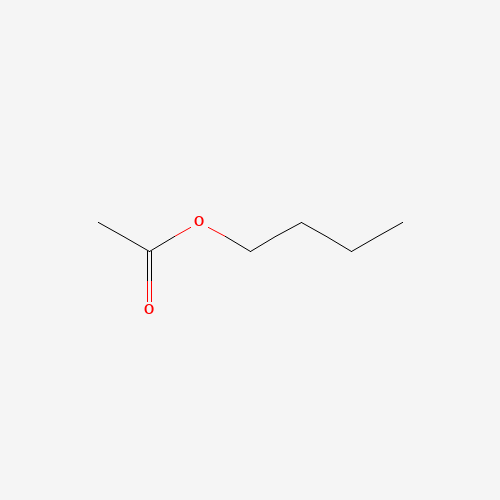
CAS123-86-4
分子式C6H12O2
分子量116.16 g/mol g/mol
危化品
Physical Description | Butyl acetate appears as a clear colorless liquid with a fruity odor. Flash point 72 - 88 °F. Density 7.4 lb / gal (less than water). Hence floats on water. Vapors heavier than air.
科学粮草官-词典编辑部,修订于:2026-07-06
Toxicity
ToxicityBody Burden
n-Butyl acetate was detected in the expired breath of 3 of 8 human subjects at an expiration rate of 8.7-41.0 ug/hr(1). n-Butyl acetate was detected in 31 % of 387 expired air samples collected from 54 human volunteers at a mean concentration of 0.2 ng/L(2).
Fate Summary
ATMOSPHERIC FATE: According to a model of gas/particle partitioning of semivolatile organic compounds in the atmosphere(1), n-butyl acetate, which has a vapor pressure of 11.5 mm Hg at 25 °C(2), is expected to exist solely as a vapor in the ambient atmosphere. Vapor-phase n-butyl acetate is degraded in the atmosphere by reaction with photochemically-produced hydroxyl radicals(SRC); the half-life for this reaction in air is estimated to be 3.2 days(SRC), calculated from its rate constant of 4.9X10⁻¹² cu cm/molecule-sec at 25 °C(3). n-Butyl acetate does not contain chromophores that absorb at wavelengths >290 nm(4) and, therefore, is not expected to be susceptible to direct photolysis by sunlight(SRC).
Soil Adsorption / Mobility
Using a structure estimation method based on molecular connectivity indices(1), the Koc of n-butyl acetate can be estimated to be 19(SRC). According to a classification scheme(2), this estimated Koc value suggests that n-butyl acetate is expected to have very high mobility in soil.
Environmental Biodegradation
AEROBIC: Using a settled sewage seed, 5-day and 20-day theoretical BODs of 23.5% and 57.4% were measured for n-butyl acetate via standard dilution water tests(1). Using river water as seed, 5-day and 20-day theoretical BODs of 20.9% and 55.4% were measured(1). Using a filtered sewage seed, 5-day and 20-day theoretical BODs of 58% and 83% were measured in freshwater dilution tests; 5-day and 20-day theoretical BODs of 40% and 61% were measured in salt water(2). A 5-day theoretical BOD of 56.8% and 51.8% were measured for n-butyl acetate in distilled water and seawater, respectively, using the standard dilution method(3). Using a raw sewage seed, 5, 10, 15, and 20-day theoretical BODs of 56%, 68%, 70% and 83% were observed for n-butyl acetate(4). Using OECD method 301D and Closed Bottle t...
Environmental Bioconcentration
An estimated BCF of 7 was calculated in fish for n-butyl acetate(SRC), using a log Kow of 1.78(1) and a regression-derived equation(2). According to a classification scheme(3), this BCF suggests the potential for bioconcentration in aquatic organisms is low(SRC).
Volatilization from Water / Soil
The Henry's Law constant for n-butyl acetate is 2.81X10⁻⁴ atm-cu m/mole(1). This Henry's Law constant indicates that n-butyl acetate is expected to volatilize from water surfaces(2). Based on this Henry's Law constant, the volatilization half-life from a model river (1 m deep, flowing 1 m/sec, wind velocity of 3 m/sec)(2) is estimated as 6.5 hours(SRC). The volatilization half-life from a model lake (1 m deep, flowing 0.05 m/sec, wind velocity of 0.5 m/sec)(2) is estimated as 5.3 days(SRC). n-Butyl acetate's Henry's Law constant indicates that volatilization from moist soil surfaces may occur(SRC). n-Butyl acetate is expected to volatilize from dry soil surfaces(SRC) based upon a vapor pressure of 11.5 mm Hg(3).
Environmental Abiotic Degradation
The rate constant for the vapor-phase reaction of n-butyl acetate with photochemically-produced hydroxyl radicals has been reported as 4.9X10⁻¹² cu cm/molecule-sec at 25 °C(1). This corresponds to an atmospheric half-life of about 3.2 days at an atmospheric concentration of 5X10+5 hydroxyl radicals per cu cm(1). A base-catalyzed second-order hydrolysis rate constant of 0.10 L/mole-sec(SRC) was estimated using a structure estimation method(2); this corresponds to half-lives of 2 yrs and 78 days at pH values of 7 and 8, respectively(2). n-Butyl acetate does not contain chromophores that absorb at wavelengths >290 nm(3) and, therefore, is not expected to be susceptible to direct photolysis by sunlight(SRC).
Environmental Water Concentrations
SURFACE WATER: n-Butyl acetate was qualitatively detected in Ijssel Lake water, The Netherlands(1).
Food Survey Values
n-Butyl acetate has been detected as a volatile flavor component of baked potatoes(1) and roasted filbert nuts(2). It has been identified as a naturally occurring flavor and fragrance component of apples(3). n-Butyl acetate has been identified in cheese volatiles(4), apricots and plumbs(5), dalieb fruit(6), apples(7,8), volatiles of chickpea seeds(9) and nectarines(10). n-Butyl acetate was not detected in scrambled eggs made from supermarket purchased, fresh unstored or fresh stored eggs(11).
Effluent Concentrations
n-Butyl acetate was identified in 1 of 63 US industrial wastewater effluents at a concentration below 10 ppb(1). n-Butyl acetate was detected at a mean concentration of 5.72 ug/cu m in the effluent of a waste incinerator in Germany(2). n-Butyl acetate was identified in the effluents of waste treatment facilities in CA and Washington DC(3). UK emissions of n-butyl acetate were reported as 0.44% by mass distribution in 1990(4). Estimated yearly road traffic emissions of n-butyl acetate in Switzerland is reported as 0.007 kilotons(5). n-Butyl acetate was detected in 33 of 44 furniture emission samples(6).
ICSC Environmental Data
The substance is harmful to aquatic organisms.
Natural Pollution Sources
n-Butyl acetate occurs naturally in many fruits and plants(1,2) and may be released into the environment as a plant volatile(1). n-Butyl acetate occurs especially in some varieties of apples and in bananas(3).
Atmospheric Concentrations
SOURCE DOMINATED: n-Butyl acetate was reported in paint mixing area of six auto-painting garages at 0.2 to 2.0 ppm(1).
Fish/Seafood Concentrations
n-Butyl acetate was found in Charybdis feriatus crabs at 0.9, 0.8 and 1.5 ug/kg in the leg, body and carapace, respectively(1).
Artificial Pollution Sources
n-Butyl acetate's production and use in the manufacturing of lacquer, artificial leather, photographic films, plastics and safety glass and as an organic solvent(1) may result in its release to the environment through various waste streams(SRC).
Probable Routes of Human Exposure
The average TWA (time-weighted average) of n-butyl acetate detected in worker breathing zones of 3 companies using spray painting and gluing was 0.8 ppm; the highest single concentration was 6.8 ppm(1). The TWA of n-butyl acetate in workrooms of screen printing shops was in the range of 0.02-0.79 mg/cu m and the TWA of n-butyl acetate in houses above these shops were in the range of 0.08-0.14 mg/cu m(2). n-Butyl acetate was detected in the breathing zones of a microelectronics fabrication plant at concentrations of <0.3 ppb(3). n-Butyl acetate was detected in the breathing zone of a paint manufacturing plant at an average concentration of 5.07 ppm(4). n-Butyl acetate was reported in personal air samples of painters in six auto-painting garages at 0.3 to 1.0 ppm(5). n-Butyl acetate was i...
Other Environmental Concentrations
n-Butyl acetate was detected in the head space of a liquid wax house product(1). n-Butyl acetate was detected in 18% of 58 organic thinner products with an arithmetic mean of 16.8 and was not detected in degreasers or other miscellaneous organic solvent products collected nationwide in Japan(2). n-Butyl acetate was identified, not quantified, in the emissions of textile floor coverings(3) and printing inks(4). n-Butyl acetate was detected in printers ink for serigraphy on paper, paper boards, electric and electronic article(5). n-Butyl acetate was emitted from three day old floor coverings at rates of 5 and 1 ug/sq m-hr for oiled parquet and waxed parquet, respectively(6). These rates remained the same after 28 days(6). n-Butyl acetate was detected in 33 of 44 furniture emission samples...
Environmental Fate / Exposure Summary
n-Butyl acetate's production and use in the manufacturing of lacquers, artificial leather, photographic films, plastics, safety glass and as a solvent may result in its release to the environment through various waste streams. n-Butyl acetate occurs naturally in many fruits and plants and may be released into the environment as a plant volatile. If released to air, a vapor pressure of 11.5 mm Hg at 25 °C indicates n-butyl acetate will exist solely as a vapor in the atmosphere. Vapor-phase n-butyl acetate will be degraded in the atmosphere by reaction with photochemically-produced hydroxyl radicals; the half-life for this reaction in air is estimated to be 3.2 days. n-Butyl acetate does not contain chromophores that absorb at wavelengths >290 nm and, therefore, is not expected to be susc...
Symptoms
irritation eyes, skin, upper respiratory system; headache, drowsiness, narcosis
Interactions
... The developmental toxic potential ... was examined in Sprague-Dawley rats following whole body inhalation exposure, 6 hr /per/ day, from day 6 to 20 of gestation. ... The developmental toxic effects of simultaneous exposures to ethylbenzene (EB) and /n-butyl acetate/ BA, or to toluene (TOL) and BA were evaluated. Pregnant rats were administered EB (0, 250 or 1000 ppm) and BA (0, 500 or 1500 ppm), or TOL (0, 500 or 1500 ppm) and BA (0, 500, 1500 ppm), separately and in combinations, using a 2 x 2 factorial design. The maternal weight gain was reduced after exposure to 1000 ppm EB, to 1500 ppm BA, or to 1500 ppm TOL, either alone or in binary combinations. A significant reduction of fetal weight was associated with exposure to 1000 ppm EB alone, to either mixtures of EB with BA, or to...
Target Organs
Eyes, skin, respiratory system, central nervous system
Toxicity Data
LC50 (rat) = 390 ppm/4H
Adverse Effects
Occupational hepatotoxin - Secondary hepatotoxins: the potential for toxic effect in the occupational setting is based on cases of poisoning by human ingestion or animal experimentation.
Exposure Routes
inhalation, ingestion, skin and/or eye contact
Toxicity Summary
IDENTIFICATION AND USE: n-Butyl acetate is a colorless liquid. It is used in manufacture of lacquer, artificial leather, photographic films, plastics, and safety glass. It is also used as an organic solvent and synthetic flavoring ingredient. HUMAN STUDIES: Male and female volunteers were exposed to different concentrations of n-butyl acetate vapor for 2 to 5 minutes. With exposure at 200 ppm for 3 to 5 minutes, the majority of the subjects complained of throat irritation; at 300 ppm for 3 to 5 minutes, the majority reported eye and nose irritation and severe throat irritation. In cases of severe overexposure, weakness, drowsiness, and unconsciousness have been seen. Chronic exposure to n-butyl acetate in humans has been associated with mild skin irritation. Repeated contact of the skin...
Antidote and Emergency Treatment
Advanced treatment: Consider orotracheal or nasotracheal intubation for airway control in the patient who is unconscious, has severe pulmonary edema, or is in severe respiratory distress. Positive-pressure ventilation techniques with a bag-valve-mask device may be beneficial. Consider drug therapy for pulmonary edema ... . Monitor cardiac rhythm and treat arrhythmias if necessary ... . Start IV administration of D5W /SRP: "To keep open", minimal flow rate/. Use 0.9% saline (NS) or lactated Ringer's (LR) if signs of hypovolemia are present. For hypotension with signs of hypovolemia, administer fluid cautiously. Consider vasopressors if patient is hypotensive with a normal fluid volume. Watch for signs of fluid overload ... . Use proparacaine hydrochloride to assist eye irrigation ... . /...









