


 一键配货
一键配货
化合物详情
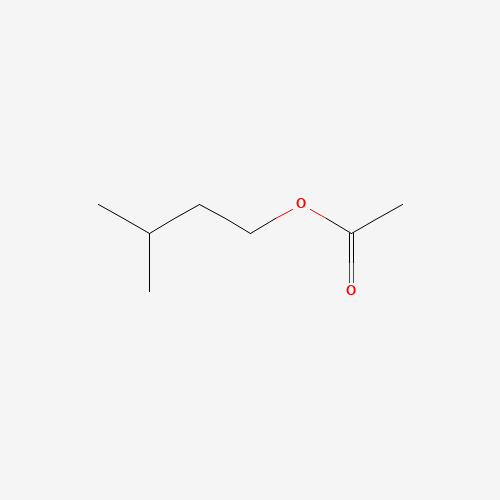
CAS123-92-2
分子式C7H14O2
分子量130.19 g/mol g/mol
危化品
Physical Description | Iso-amyl acetate is an oily liquid; colorless; banana odor. Floats and mixes with water. Flammable, irritating vapor is produced. (USCG, 1999)
科学粮草官-词典编辑部,修订于:2026-07-06
Toxicity
ToxicityFate Summary
ATMOSPHERIC FATE: According to a model of gas/particle partitioning of semivolatile organic compounds in the atmosphere(1), isoamyl acetate, which has a vapor pressure of 5.6 mm Hg at 25 °C(2), is expected to exist solely as a vapor in the ambient atmosphere. Vapor-phase isoamyl acetate is degraded in the atmosphere by reaction with photochemically-produced hydroxyl radicals(SRC); the half-life for this reaction in air is estimated to be 5 days(SRC), calculated from its rate constant of 6.0x10⁻¹² cu cm/molecule-sec at 25 °C(SRC) that was derived using a structure estimation method(3). Isoamyl acetate does not contain chromophores that absorb at wavelengths >290 nm(4) and, therefore, is not expected to be susceptible to direct photolysis by sunlight(SRC).
Soil Adsorption / Mobility
The Koc of isoamyl acetate is estimated as 130(SRC), using a log Kow of 2.25(1) and a regression-derived equation(2). According to a classification scheme(3), this estimated Koc value suggests that isoamyl is expected to have high mobility in soil.
Environmental Biodegradation
AEROBIC: Biodegradation studies with isoamyl acetate were not available(SRC, 2015). Structurally similar compounds such as butyl acetate and isopropyl acetate have achieved 50.7 and 40.0%, respectively, of their theoretical BODs after 10 days in mineralized water and settled sanitary sewage at 20 °C(1). Butyl acetate present at 100 mg/L, reached 86% of its theoretical BOD in 2 weeks using an activated sludge inoculum in the Japanese MITI test(2). Isobutyl acetate, methyl amyl acetate, and other alkyl acetates have achieved between 69-81% of their theoretical BODs after 20 days in fresh water tests with non-acclimated sludge(3). These data suggest that biodegradation of isoamyl acetate may be an important environmental fate process(SRC).
Environmental Bioconcentration
An estimated BCF of 14 was calculated in fish for isoamyl acetate(SRC), using a log Kow of 2.25(1) and a regression-derived equation(2). According to a classification scheme(3), this BCF suggests the potential for bioconcentration in aquatic organisms is low(SRC).
Volatilization from Water / Soil
The Henry's Law constant for isoamyl acetate is 5.87x10⁻⁴ atm-cu m/mole. This Henry's Law constant indicates that isoamyl acetate is expected to volatilize from water surfaces(2). Based on this Henry's Law constant, the volatilization half-life from a model river (1 m deep, flowing 1 m/sec, wind velocity of 3 m/sec)(3) is estimated as 2 hours(SRC). The volatilization half-life from a model lake (1 m deep, flowing 0.05 m/sec, wind velocity of 0.5 m/sec)(3) is estimated as 5 days(SRC). Isoamyl acetate's Henry's Law constant indicates that volatilization from moist soil surfaces may occur(SRC). The potential for volatilization of isoamyl acetate from dry soil surfaces may exist(SRC) based upon a vapor pressure of 5.6 mm Hg(4).
Environmental Abiotic Degradation
The rate constant for the vapor-phase reaction of isoamyl acetate with photochemically-produced hydroxyl radicals has been estimated as 6.0x10⁻¹² cu cm/molecule-sec at 25 °C(SRC) using a structure estimation method(1). This corresponds to an atmospheric half-life of about 5 days at an atmospheric concentration of 5X10+5 hydroxyl radicals per cu cm(1). A base-catalyzed second-order hydrolysis rate constant of 1.0x10⁻¹ L/mole-sec(SRC) was estimated using a structure estimation method(2); this corresponds to half-lives of 2 years and 78 days at pH values of 7 and 8, respectively(2). Isoamyl acetate does not contain chromophores that absorb at wavelengths >290 nm(3) and, therefore, is not expected to be susceptible to direct photolysis by sunlight(SRC).
Environmental Water Concentrations
SURFACE WATER: Isoamyl acetate was identified, not quantified, in Rickenbach East brook which flows into Lake Constance located in West Germany(1).
Food Survey Values
Isoamyl acetate was identified in the skin and pulp of Queen Anne's Pocket Melon (Cucumis melo var. dudaim (L.) Naudin) at concentrations of 280.7 and 334.9 ug/kg, respectively(1). Isoamyl acetate was identified in 2 of 3 commercial fermented soybean (Glycine max) curds prepared in Taiwan and Hong Kong at concentrations of 541.0 and 9027.4 ug/kg, respectively(2).
Milk Concentrations
ENVIRONMENTAL: Isoamyl acetate has been reported in cheeses, butter, and milk(1).
Natural Pollution Sources
Isoamyl acetate is a sting pheromone of the honey bee (Apis mellifera)(1).
Atmospheric Concentrations
RURAL/REMOTE: Isoamyl acetate was identified, but not quantified, in samples of air taken during late fall 1976 from the Talladega National Forest, AL(1).
Artificial Pollution Sources
Isoamyl acetate's production and use as a commercial solvent, and flavoring additive(1) may result in its release to the environment through various waste streams(SRC). Its use as a perfume and fragrance for various consumer products(1) and agent in respirator fit tests(2,3) may result in its direct release to the environment(SRC).
Probable Routes of Human Exposure
NIOSH (NOES Survey 1981-1983) has statistically estimated that 97,668 workers (32,512 of these are female) were potentially exposed to isoamyl acetate in the US(1). Occupational exposure to isoamyl acetate may occur through inhalation and dermal contact with this compound at workplaces where isoamyl acetate is produced or used. Limited monitoring data indicate that the general population may be exposed to isoamyl acetate via inhalation of ambient air and drinking water containing isoamyl acetate and cigarette smoke. Use data indicate that the general population may be exposed to isoamyl acetate via ingestion of food containing isoamyl acetate and dermal contact with consumer products containing isoamyl acetate(SRC).
Other Environmental Concentrations
Isoamyl acetate was identified, not quantified, in the volatile emissions of household detergents(1,2) and household waste(3,4).
Environmental Fate / Exposure Summary
Isoamyl acetate's production and use as a commercial solvent, flavoring additive, perfume and fragrance for various consumer products may result in its release to the environment through various waste streams. Isoamyl acetate is a component of several fruits and plant species. If released to air, a vapor pressure of 5.6 mm Hg at 25 °C indicates isoamyl acetate will exist solely as a vapor in the atmosphere. Vapor-phase isoamyl acetate will be degraded in the atmosphere by reaction with photochemically-produced hydroxyl radicals; the half-life for this reaction in air is estimated to be 5 days. Isoamyl acetate does not contain chromophores that absorb at wavelengths >290 nm and, therefore, is not expected to be susceptible to direct photolysis by sunlight. If released to soil, isoamyl ac...
Symptoms
irritation eyes, skin, nose, throat; dermatitis; In Animals: narcosis
Target Organs
Eyes, skin, respiratory system, central nervous system
Adverse Effects
Occupational hepatotoxin - Secondary hepatotoxins: the potential for toxic effect in the occupational setting is based on cases of poisoning by human ingestion or animal experimentation.
Exposure Routes
inhalation, ingestion, skin and/or eye contact
Toxicity Summary
IDENTIFICATION AND USE: At room temperature, the low molecular-weight ester isoamyl acetate (IAA) is a clear liquid with an intense sweet, but pleasant, banana or pear-like odor. In alcohol solutions, mineral waters and syrups it is used as a pear flavor. It is also used as solvent for old oil colors, for tannins, nitrocellulose, lacquers, celluloid and camphor; swelling bath sponges; covering unpleasant odors, perfuming shoe polish; manufacturing artificial silk, leather, or pearls, photographic films, celluloid cements, waterproof varnishes, bronzing liquids, and metallic paints; dying and finishing textiles. Honey bees use IAA as an alarm pheromone, and store IAA in their poison sting. Due to its strong smell, which can be perceived at low concentrations, and because of supposedly lo...
Carcinogen Classification
No indication of carcinogenicity to humans (not listed by IARC).
Non-Human Toxicity Values
LD50 Rabbit oral 7422 mg/kg
Non-Human Toxicity Excerpts
/GENOTOXICITY/ ...Amyl acetate and isoamyl acetate were nonmutagenic in a series of mutagenic assays...
Populations at Special Risk
In persons with impaired pulmonary function, especially those with obstructive airway diseases, the breathing of isoamyl acetate might cause exacerbation of symptoms due to its irritant properties. ... Persons with existing skin disorders may be more susceptible to the effects of /isoamyl acetate/. ... Although isoamyl acetate is not known as a kidney toxin in humans, the importance of this organ in the elimination of toxic substances justifies special consideration in those with possible impairment of renal function. ... Although isoamyl acetate is not known as a liver toxin in humans, the importance of this organ in the biotransformation and detoxification of foreign substances should be considered before exposing persons with impaired liver function.
Antidote and Emergency Treatment
Advanced treatment: Consider orotracheal or nasotracheal intubation for airway control in the patient who is unconscious, has severe pulmonary edema, or is in severe respiratory distress. Positive-pressure ventilation techniques with a bag-valve-mask device may be beneficial. Consider drug therapy for pulmonary edema ... . Monitor cardiac rhythm and treat arrhythmias if necessary ... . Start IV administration of D5W /SRP: "To keep open", minimal flow rate/. Use 0.9% saline (NS) or lactated Ringer's (LR) if signs of hypovolemia are present. For hypotension with signs of hypovolemia, administer fluid cautiously. Consider vasopressors if patient is hypotensive with a normal fluid volume. Watch for signs of fluid overload ... . Use proparacaine hydrochloride to assist eye irrigation ... . /...









