


 一键配货
一键配货
化合物详情
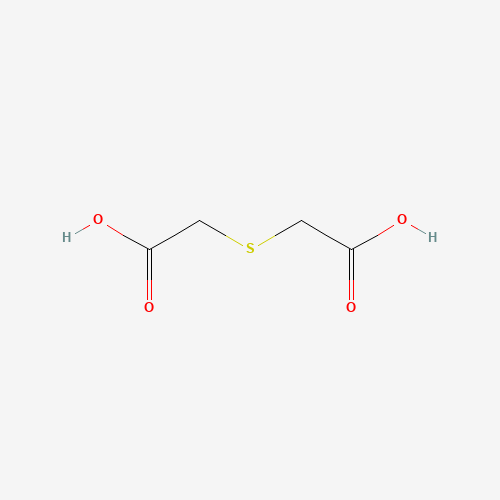
CAS123-93-3
分子式C4H6O4S
分子量150.15 g/mol g/mol
危化品
Thiodiacetic acid is a dicarboxylic acid.
科学粮草官-词典编辑部,修订于:2026-07-06
Toxicity
ToxicityFate Summary
ATMOSPHERIC FATE: According to a model of gas/particle partitioning of semivolatile organic compounds in the atmosphere(1), thiodiglycolic acid, which has an estimated vapor pressure of 5.5X10⁻⁵ mm Hg at 25 °C(SRC), determined from a fragment constant method(2), will exist in both the vapor and particulate phases in the ambient atmosphere. Vapor-phase thiodiglycolic acid is degraded in the atmosphere by reaction with photochemically-produced hydroxyl radicals(SRC); the half-life for this reaction in air is estimated to be 28 hrs(SRC), calculated from its rate constant of 1.4X10⁻¹¹ cu cm/molecule-sec at 25 °C(SRC) that was derived using a structure estimation method(3). Particulate-phase thiodiglycolic acid may be removed from the air by wet and dry deposition(SRC). Thiodiglycolic acid i...
Soil Adsorption / Mobility
Using a structure estimation method based on molecular connectivity indices(1), the Koc for thiodiglycolic acid can be estimated to be 12(SRC). According to a classification scheme(2), this estimated Koc value suggests that thiodiglycolic acid is expected to have very high mobility in soil. However, adsorption of thiodiglycolic acid was found to vary with soil type; observed maximum sorption capacities ranged from 19.9 mg/kg (53% sand, 14% silt, 33% clay, pH 8.5, 0.5% OM) to 427.4 mg/kg (43% sand, 21% silt, 36% clay, pH 4.7, 0.4% OM)(3). The estimated pKa of thiodiglycolic acid is 3.4(4), indicating that this compound will partially exist in the dissociated form in the environment and anions generally do not adsorb more strongly to organic carbon and clay than their neutral counterparts...
Environmental Bioconcentration
An estimated BCF of 3 was calculated for thiodiglycolic acid(SRC), using an estimated log Kow of -1.2(1) and a regression-derived equation(2). According to a classification scheme(3), this BCF suggests the potential for bioconcentration in aquatic organisms is low(SRC).
Volatilization from Water / Soil
The Henry's Law constant for thiodiglycolic acid is estimated as 4.4X10⁻¹⁴ atm-cu m/mole(SRC) using a fragment constant estimation method(1). This Henry's Law constant indicates that thiodiglycolic acid is expected to be essentially nonvolatile from water surfaces(2). Thiodiglycolic acid is not expected to volatilize from dry soil surfaces(SRC) based upon an estimated vapor pressure of 5.5X10⁻⁵ mm Hg(SRC), determined from a fragment constant method(3).
Environmental Abiotic Degradation
The rate constant for the vapor-phase reaction of thiodiglycolic acid with photochemically-produced hydroxyl radicals has been estimated as 1.4X10⁻¹¹ cu cm/molecule-sec at 25 °C(SRC) using a structure estimation method(1). This corresponds to an atmospheric half-life of about 28 hours at an atmospheric concentration of 5X10+5 hydroxyl radicals per cu cm(1). Thiodiglycolic acid is not expected to undergo hydrolysis in the environment(2); concentrations of 20 and 50 mg/l were tested at pHs of 4, 7, and 11 and resulted in 100% recovery of the thiodiglycolic acid after 48 and 96 hours(2). Also, thiodiglycolic acid does not directly photolyze(2). Initial concentrations of 50 and 20 mg/l thiodiglycolic acid were sunlight irradiated for 14 days with final concentrations reported at 49.4 and 19...
Artificial Pollution Sources
Thiodiglycolic acid's production and use as a detection agent of copper, lead, mercury, and silver(1) may result in its release to the environment through various waste streams(SRC). In soil, thiodiglycolic acid was shown to be a biodegradation product of thiodiglycol, a hydrolysis product of bis(2-chloroethyl) sulfide (mustard gas)(2).
Probable Routes of Human Exposure
Occupational exposure to thiodiglycolic acid may occur through inhalation and dermal contact with this compound at workplaces where thiodiglycolic acid is produced or used. (SRC)
Environmental Fate / Exposure Summary
Thiodiglycolic acid's production and use as detection agent for copper, lead, mercury, and silver may result in its release to the environment through various waste streams. In soil experiments, thiodiglycolic acid was shown to be a biodegradation product of thiodiglycol which is a hydrolysis product of bis(2-chloroethyl) sulfide (mustard gas). If released to air, an estimated vapor pressure of 5.5X10⁻⁵ mm Hg at 25 °C indicates thiodiglycolic acid will exist in both the vapor and particulate phases in the ambient atmosphere. Vapor-phase thiodiglycolic acid will be degraded in the atmosphere by reaction with photochemically-produced hydroxyl radicals; the half-life for this reaction in air is estimated to be 28 hrs. Particulate-phase thiodiglycolic acid will be removed from the atmospher...
Adverse Effects
Toxic Pneumonitis - Inflammation of the lungs induced by inhalation of metal fumes or toxic gases and vapors.
Non-Human Toxicity Values
LD50 Mouse ip 300 mg/kg
Non-Human Toxicity Excerpts
/ALTERNATIVE IN VITRO TESTS/ Our previous studies in mice indicated that the exposure to vinyl chloride (VC) produced a state of immunostimulation. The metabolism of VC was an important factor in this phenomenon. Two known metabolites of VC, namely thiodiglycolic acid and N-acetyl-S-(hydroxyethyl)-cysteine produced little or no effect when added to mouse splenic lymphocyte cultures in vitro but in vivo administration of thiodiglycolic acid produced apparent immune stimulation in mice.









