

 一键配货
一键配货
化合物详情
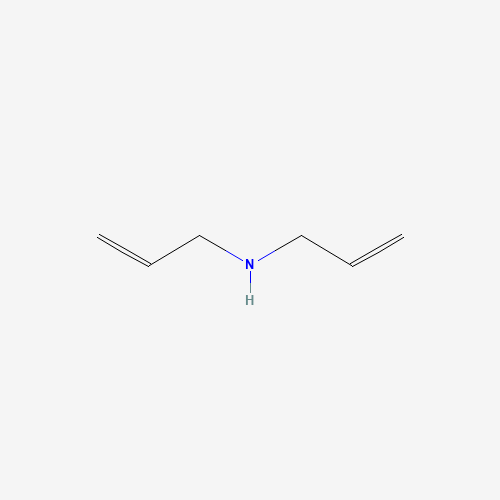
CAS124-02-7
分子式C6H11N
分子量97.16 g/mol g/mol
危化品
Physical Description | Diallylamine appears as a liquid with a disagreeable odor. Less dense than water. May be toxic by inhalation and skin absorption. Irritates skin and eyes. Used to make other chemicals.
科学粮草官-词典编辑部,修订于:2026-07-06
Toxicity
ToxicityFate Summary
ATMOSPHERIC FATE: According to a model of gas/particle partitioning of semivolatile organic compounds in the atmosphere(1), diallylamine, which has a vapor pressure of 20.2 mm Hg at 25 °C(2), will exist solely in the vapor phase in the ambient atmosphere. Vapor-phase diallylamine is degraded in the atmosphere by reaction with photochemically-produced hydroxyl radicals(SRC); the half-life for this reaction in air is estimated to be 11 hrs(SRC), calculated from its rate constant of 1.33X10⁻¹⁰ cu cm/molecule-sec at 25 °C(3) determined using a structure estimation method(3).
Soil Adsorption / Mobility
The Koc of diallylamine is estimated as 96(SRC), using a log Kow of 1.11(1) and a regression-derived equation(2). According to a classification scheme(3), this estimated Koc value suggests that diallylamine is expected to have high mobility in soil. The pKa of diallylamine is 9.29(4), indicating that this compound will exist in the protonated form in the environment and cations generally adsorb to organic carbon and clay more strongly than their neutral counterparts.
Environmental Bioconcentration
An estimated BCF of 1.4 was calculated for diallylamine(SRC), using a log Kow of 1.11(1) and a regression-derived equation(2). According to a classification scheme(3), this BCF suggests the potential for bioconcentration in aquatic organisms is low.
Volatilization from Water / Soil
The Henry's Law constant for diallylamine is estimated as 3.0X10⁻⁵ atm-cu m/mole(SRC), derived from its vapor pressure, 20.2 mm Hg(1), and water solubility, 8.6X10+4 mg/l(2). This Henry's Law constant indicates that diallylamine is expected to volatilize from water surfaces(3). Based on this Henry's Law constant, the volatilization half-life from a model river (1 m deep, flowing 1 m/sec, wind velocity of 3 m/sec)(3) is estimated as 20 hours(SRC). The volatilization half-life from a model lake (1 m deep, flowing 0.05 m/sec, wind velocity of 0.5 m/sec)(3) is estimated as 13 days(SRC). Diallylamine's estimated Henry's Law constant(1,2) indicates that volatilization from moist soil surfaces may occur(SRC). The potential for volatilization of diallylamine from dry soil surfaces may exist(SRC...
Environmental Abiotic Degradation
The rate constant for the vapor-phase reaction of diallylamine with photochemically-produced hydroxyl radicals has been estimated as 1.33X10⁻¹⁰ cu cm/molecule-sec at 25 °C(SRC) using a structure estimation method(1). This corresponds to an atmospheric half-life of about 11 hours(SRC) at an atmospheric concentration of 5X10+5 hydroxyl radicals per cu cm(1).
ICSC Environmental Data
The substance is toxic to aquatic organisms. It is strongly advised not to let the chemical enter into the environment.
Artificial Pollution Sources
Diallylamine's production and use as an intermediate in the production of pharmaceuticals and resins(1) and in crop protection, as an auxiliary in paper making(2), and as a solvent(3) may result in its direct release to the environment through various waste streams(SRC).
Probable Routes of Human Exposure
Occupational exposure to diallylamine may occur through inhalation and dermal contact with this compound at workplaces where diallylamine is produced or used. (SRC)
Environmental Fate / Exposure Summary
Diallylamine's production and use as an intermediate in the production of pharmaceuticals and resins, in crop protection, as an auxiliary in paper making, and as a solvent may result in its direct release to the environment. If released to air, a vapor pressure of 20.2 mm Hg at 25 °C indicates diallylamine will exist solely in the vapor phase in the ambient atmosphere. Vapor-phase diallylamine will be degraded in the atmosphere by reaction with photochemically-produced hydroxyl radicals; the half-life for this reaction in air is estimated to be 11 hrs. If released to soil, Diallylamine is expected to have high mobility based upon an estimated Koc of 96. A pKa value of 9.29 suggests that diallylamine will exist primarily in the protonated form in moist soils and the protonated form of di...
Symptoms
Ingestion Exposure: Burns in mouth and throat. Burning sensation in the throat and chest. Abdominal pain. Vomiting. Diarrhoea. Shock or collapse.
Toxicity Data
LC50 (rat) = 795 ppm/8h
Adverse Effects
Toxic Pneumonitis - Inflammation of the lungs induced by inhalation of metal fumes or toxic gases and vapors.
Exposure Routes
The substance can be absorbed into the body by inhalation of its vapour, through the skin and by ingestion. Serious local effects by all routes of exposure.
Human Toxicity Excerpts
/IN EXPTL HUMAN EXPOSURES/...RECOGNIZABLE BUT NOT UNPLEASANT @ 2 TO 9 PPM, MUCOUS MEMBRANE IRRITATION & CHEST DISCOMFORT IN A FEW SUBJECTS @ 22 PPM, NOT INTOLERABLE @ 70 PPM.