


 一键配货
一键配货
化合物详情
CAS124-19-6
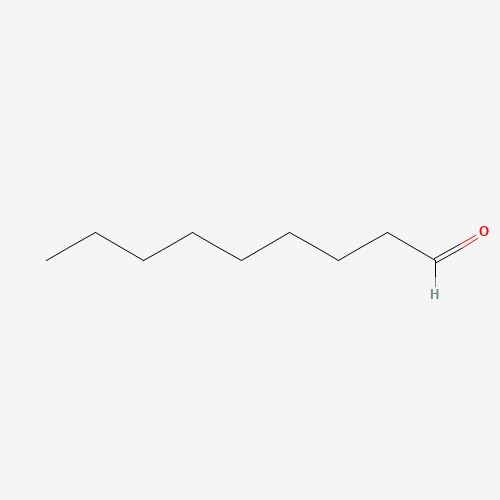
分子式C9H18O
分子量142.24 g/mol g/mol
危化品
Physical Description | Nonanal is a clear brown liquid characterized by a rose-orange odor. Insoluble in water. Found in at least 20 essential oils, including rose and citrus oils and several species of pine oil.
科学粮草官-词典编辑部,修订于:2026-07-06
Toxicity
ToxicityEcotoxicity Values
EC50; Species: Xenopus sp. (Frog) embryos; Concentration: 6.5 mg/L for 96 hr (95% confidence interval: 6-7 mg/L); Effect: malformation /Conditions of bioassay not specified in source examined/
Fate Summary
ATMOSPHERIC FATE: According to a model of gas/particle partitioning of semivolatile organic compounds in the atmosphere(1), nonanal, which has a vapor pressure of 0.37 mm Hg at 25 °C(2), is expected to exist solely as a vapor in the ambient atmosphere. Vapor-phase nonanal is degraded in the atmosphere by reaction with photochemically-produced hydroxyl radicals(SRC); the half-life for this reaction in air is estimated to be 1 day(SRC), calculated from its rate constant of 3.31X10⁻¹¹ cu cm/molecule-sec at 25 °C(SRC) Nonanal does not contain chromophores that absorb at wavelengths >290 nm(3) and, therefore, is not expected to be susceptible to direct photolysis by sunlight(SRC).
Soil Adsorption / Mobility
Using a structure estimation method based on molecular connectivity indices(1), the Koc of nonanal can be estimated to be 40(SRC). According to a classification scheme(2), this estimated Koc value suggests that nonanal is expected to have very high mobility in soil.
Environmental Biodegradation
AEROBIC: Nonanal, present at 100 mg/L, reached 32% of its theoretical BOD after 28 days using an activated sludge inoculum 100 mg/L at 22 °C(1). At 30 mg/L, nonanal reached 84% of its theoretical BOD after 28 days at 25 °C (OECD Guideline No. 302C. Inherent OECD Test)(1). The first set of results indicate that nonanal, when present at 100 mg/L at 22 °C, is not expected to biodegrade rapidly. However, when nonanal is present at a concentration of 30 mg/L at 25 °C, the compound is expected to biodegrade rapidly. In Warburg respirometer tests using activated sludge from 3 treatment plants (2500 mg/L sludge solids), 500 mg/L test compound, and incubated 24 hr at 20 °C, nonanal exhibited 8.4, 13.5, and 21.1 percent theoretical BODs after 6, 12, and 24 hours respectively(2). Nonanal, present...
Environmental Bioconcentration
An estimated BCF of 67 was calculated in fish for nonanal(SRC), using an estimated log Kow of 3.27(1) and a regression-derived equation(1). According to a classification scheme(2), this BCF suggests the potential for bioconcentration in aquatic organisms is moderate(SRC).
Volatilization from Water / Soil
The Henry's Law constant for nonanal is 7.34X10⁻⁴ atm-cu m/mole(1). This Henry's Law constant indicates that nonanal is expected to volatilize from water surfaces(2). Based on this Henry's Law constant, the volatilization half-life from a model river (1 m deep, flowing 1 m/sec, wind velocity of 3 m/sec)(2) is estimated as 2 hours(SRC). The volatilization half-life from a model lake (1 m deep, flowing 0.05 m/sec, wind velocity of 0.5 m/sec)(2) is estimated as 5 days(SRC). Nonanal's Henry's Law constant indicates that volatilization from moist soil surfaces may occur(SRC). Nonanal is not expected to volatilize from dry soil surfaces(SRC) based upon a vapor pressure of 0.37 mm Hg(3) and the detectable odor.
Environmental Abiotic Degradation
The rate constant for the vapor-phase reaction of nonanal with photochemically-produced hydroxyl radicals has been estimated as 3.3X10⁻¹¹ cu cm/molecule-sec at 25 °C(SRC) using a structure estimation method(1). This corresponds to an atmospheric half-life of about 1 day at an atmospheric concentration of 5X10+6 hydroxyl radicals per cu cm(2). Nonanal is not expected to undergo hydrolysis in the environment due to the lack of hydrolyzable functional groups(3). Nonanal does not contain chromophores that absorb at wavelengths >290 nm(3) and, therefore, is not expected to be susceptible to direct photolysis by sunlight(SRC).
Environmental Water Concentrations
RAIN/SNOW/FOG: Nonanal was detected in Antarctic snow samples collected during a 1993/1994 expedition at concentrations ranging from 16 to 227 ng/L(1).
Food Survey Values
Nonanal has been identified in the head-space at concentrations of 8,880, 9,130, and 24,200 relative peak areas following analysis of frankfurters with 30%, 12%, and 5% fat content, respectively(1). Nonanal has been identified, not quantified as a volatile component in scrambled eggs(2). The compound is one of the aroma components identified in uncured beef and chicken at concentrations of 1.44 and 11.59 mg/kg, respectively(3). Nonanal is one of the volatile components of water-boiled duck meat, duck fat, Cantonese-style roasted duck, and Cantonese-style roasted duck gravy at concentrations of 31.79, 24.97, 8.04, and 48.87 ppb, respectively(4). Nonanal was identified as one of the characteristic odorants in fresh rhizomes of ginger (Zingiber officinale Roscoe)(5).
Effluent Concentrations
Nonanal has been detected in the exhaust of small, medium, and large commercial Chinese restaurant kitchens at concentrations ranging from 68.8 to 111, 15.0-17.4, and 23.7-71.1 ppb, respectively, and in the exhaust of Sichuan Spicy food kitchens at a concentration range of 49.9 to 60.0 ppb(1). Average concentrations for nonanal from Chinese cooking have been reported as 1365, 2281, 4501, and 1373 ng/mg in Cantonese, Sichuan, Dongbei, and Hunan style cooking, respectively(2). Nonanal was detected in the gases sampled from wells and cover soils at a landfill in Tuscany at concentrations ranging from <2 to 523 ppbv(3).
Natural Pollution Sources
Nonanal has been identified as a plant volatile(1-4) and is a constituent in various tissues of several plant species(5).
Atmospheric Concentrations
RURAL/REMOTE: Nonanal was detected in ambient air sampled from September 16-17, 1991 in the Monti Cimini pine forest and a coastal wooded area near the Lido di Ostia, both in Italy(1). Night time levels of nonanal from a pine forest near Storkow, Germany ranged from 0.5, 1.4, and 0.39 ppbv at vertical profiles of 1, 14, and 30 meters, respectively(1).
Fish/Seafood Concentrations
Nonanal has been identified in crabmeat of Charybdis feriatus at concentrations of 6.1, 4.0, and 58.7 ug/kg in leg, body, and carapace, respectively(1).
Artificial Pollution Sources
Nonanal's production and use in perfumery and as a flavoring agent(1) may result in its release to the environment through various waste streams(SRC).
Probable Routes of Human Exposure
NIOSH (NOES Survey 1981-1983) has statistically estimated that 8,081 workers (1,350 of these are female) were potentially exposed to nonanal in the US(1). Occupational exposure to nonanal may occur through inhalation and dermal contact with this compound at workplaces where nonanal is produced or used. Nonanal was detected in 37 small and medium sized buildings such as restaurants, retail establishments, hair salons, and fitness gyms sampled in California; indoor concentrations ranged from not detected to 20.9 ug/cu m with a mean of 4.25 ug/cu m(2). Monitoring data indicate that the general population may be exposed to nonanal via inhalation of ambient air, ingestion of food and drinking water, and dermal contact with consumer products containing nonanal(SRC).
Other Environmental Concentrations
Nonanal has been identified in cigarette smoke at 3 ug/cu m(1). It is a component of tobacco, tobacco smoke, and tobacco smoke substitutes(2).
Environmental Fate / Exposure Summary
Nonanal's production and use in perfumery and as a flavoring agent may result in its release to the environment through various waste streams. Nonanal has been identified as a common plant volatile. If released to air, a vapor pressure of 0.37 mm Hg at 25 °C indicates nonanal will exist solely as a vapor in the atmosphere. Vapor-phase nonanal will be degraded in the atmosphere by reaction with photochemically-produced hydroxyl radicals; the half-life for this reaction in air is estimated to be 1 day. Nonanal does not contain chromophores that absorb at wavelengths >290 nm and, therefore, is not expected to be susceptible to direct photolysis by sunlight. If released to soil, nonanal is expected to have very high mobility based upon an estimated Koc of 40. Volatilization from moist soil...
Symptoms
As a uremic toxin, this compound can cause uremic syndrome. Uremic syndrome may affect any part of the body and can cause nausea, vomiting, loss of appetite, and weight loss. It can also cause changes in mental status, such as confusion, reduced awareness, agitation, psychosis, seizures, and coma. Abnormal bleeding, such as bleeding spontaneously or profusely from a very minor injury can also occur. Heart problems, such as an irregular heartbeat, inflammation in the sac that surrounds the heart (pericarditis), and increased pressure on the heart can be seen in patients with uremic syndrome. Shortness of breath from fluid buildup in the space between the lungs and the chest wall (pleural effusion) can also be present.
Treatment
Kidney dialysis is usually needed to relieve the symptoms of uremic syndrome until normal kidney function can be restored.
Toxicity Data
LC (rat) > 9,500 mg/m3/4h
Health Effects
Chronic exposure to uremic toxins can lead to a number of conditions including renal damage, chronic kidney disease and cardiovascular disease.
Exposure Routes
Endogenous, Ingestion, Dermal (contact)
Toxicity Summary
Uremic toxins such as nonanal are actively transported into the kidneys via organic ion transporters (especially OAT3). Increased levels of uremic toxins can stimulate the production of reactive oxygen species. This seems to be mediated by the direct binding or inhibition by uremic toxins of the enzyme NADPH oxidase (especially NOX4 which is abundant in the kidneys and heart) (A7868). Reactive oxygen species can induce several different DNA methyltransferases (DNMTs) which are involved in the silencing of a protein known as KLOTHO. KLOTHO has been identified as having important roles in anti-aging, mineral metabolism, and vitamin D metabolism. A number of studies have indicated that KLOTHO mRNA and protein levels are reduced during acute or chronic kidney diseases in response to high lo...
Human Toxicity Excerpts
/OTHER TOXICITY INFORMATION/ We have used multiple analytical methods to characterize the gas-phase products formed when ozone was added to cabin air during simulated 4-hour flights that were conducted in a reconstructed section of a B-767 aircraft containing human occupants. Two separate groups of 16 females were each exposed to four conditions: low air exchange (4.4 (hr-1)), <2 ppb ozone; low air exchange, 61-64 ppb ozone; high air exchange (8.8 hr(-1)), <2 ppb ozone; and high air exchange, 73-77 ppb ozone. The addition of ozone to the cabin air increased the levels of identified byproducts from approximately 70 to 130 ppb at the lower air exchange rate and from approximately 30 to 70 ppb at the higher air exchange rate. Most of the increase was attributable to acetone, nonanal, decan...
Carcinogen Classification
No indication of carcinogenicity to humans (not listed by IARC).
Non-Human Toxicity Values
LC50 Rat inhalation >0.46 mg/L but <3.8 mg/L/4 hr /Nonanoic acid, 97%/
Antidote and Emergency Treatment
/SRP:/ Advanced treatment: Consider Consider orotracheal or nasotracheal intubation for airway control in the patient who is unconscious, has severe pulmonary edema, or is in severe respiratory distress. Intubation should be considered at the first sign of upper airway obstruction caused by edema. Positive-pressure ventilation techniques with a bag valve mask device may be beneficial. Consider drug therapy for pulmonary edema ... . Consider administering a beta agonist such as albuterol for severe bronchospasm ... . Start IV administration of D5W /SRP: "To keep open", minimal flow rate/. Use 0.9% saline (NS) or lactated Ringer's (LR) if signs of hypovolemia are present. For hypotension with signs of hypovolemia, administer fluid cautiously. Consider vasopressors if patient is hypotensiv...









