

 一键配货
一键配货
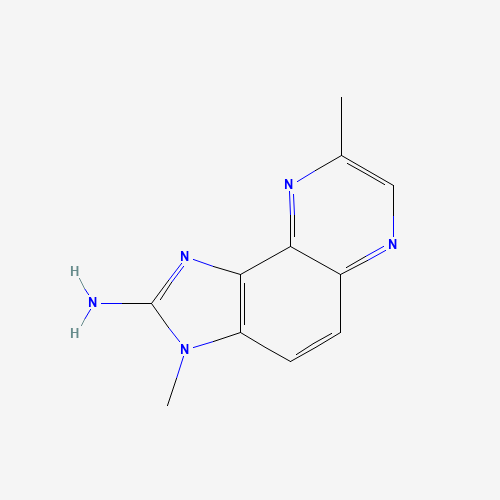
化合物详情
CAS77500-04-0
分子式C11H11N5
分子量213.24 g/mol g/mol
危化品
MeIQx (2-Amino-3,8-dimethylimidazo[4,5-f]quinoxaline) can cause cancer according to The World Health Organization's International Agency for Research on Cancer (IARC).
科学粮草官-词典编辑部,修订于:2026-07-06
Toxicity
ToxicityFate Summary
ATMOSPHERIC FATE: According to a model of gas/particle partitioning of semivolatile organic compounds in the atmosphere(1), 2-amino-3,8-dimethylimidazo[4,5-f]quinoxaline, which has an estimated vapor pressure of 1.7X10⁻⁸ mm Hg at 25 °C(SRC), determined from a fragment constant method(2), will exist in both the vapor and particulate phases in the ambient atmosphere. Vapor-phase 2-amino-3,8-dimethylimidazo[4,5-f]quinoxaline is degraded in the atmosphere by reaction with photochemically-produced hydroxyl radicals(SRC); the half-life for this reaction in air is estimated to be 11 hours(SRC), calculated from its rate constant of 3.4X10⁻¹¹ cu cm/molecule-sec at 25 °C(SRC) that was derived using a structure estimation method(3). Particulate-phase 2-amino-3,8-dimethylimidazo[4,5-f]quinoxaline m...
Soil Adsorption / Mobility
Using a structure estimation method based on molecular connectivity indices(1), the Koc of 2-amino-3,8-dimethylimidazo[4,5-f]quinoxaline can be estimated to be 2,500(SRC). According to a classification scheme(2), this estimated Koc value suggests that 2-amino-3,8-dimethylimidazo[4,5-f]quinoxaline is expected to have slight mobility in soil. The pKa of 2-amino-3,8-dimethylimidazo[4,5-f]quinoxaline is estimated as 5.2(3), indicating that this compound will exist partially in the cation form in the environment and cations generally do adsorb more strongly to soils containing organic carbon and clay than their neutral counterparts(4).
Environmental Bioconcentration
An estimated BCF of 2 was calculated in fish for 2-amino-3,8-dimethylimidazo[4,5-f]quinoxaline(SRC), using a log Kow of 1.01(1) and a regression-derived equation(2). According to a classification scheme(3), this BCF suggests the potential for bioconcentration in aquatic organisms is low(SRC).
Volatilization from Water / Soil
The Henry's Law constant for 2-amino-3,8-dimethylimidazo[4,5-f]quinoxaline is estimated as 1.6X10⁻¹³ atm-cu m/mole(SRC) using a fragment constant estimation method(1). This Henry's Law constant indicates that 2-amino-3,8-dimethylimidazo[4,5-f]quinoxaline is expected to be essentially nonvolatile from water surfaces(2). 2-Amino-3,8-dimethylimidazo[4,5-f]quinoxaline is not expected to volatilize from dry soil surfaces(SRC) based upon an estimated vapor pressure of 1.7X10⁻⁸ mm Hg(SRC), determined from a fragment constant method(3).
Environmental Abiotic Degradation
The rate constant for the vapor-phase reaction of 2-amino-3,8-dimethylimidazo[4,5-f]quinoxaline with photochemically-produced hydroxyl radicals has been estimated as 3.4X10⁻¹¹ cu cm/molecule-sec at 25 °C(SRC) using a structure estimation method(1). This corresponds to an atmospheric half-life of about 11 hours at an atmospheric concentration of 5X10+5 hydroxyl radicals per cu cm(1).
Food Survey Values
2-Amino-3,8-dimethylimidazo[4,5-f]quinoxaline was detected in meat and chicken purchased from local Okayama, Japan markets, following cooking and analysis on the same day: in chicken, pork, well done beef and medium beef at 77, 202, 198 and 138 pg/g of sample, respectively(1). Food purchased at a supermarket in Little Rock, AK and cooked, contained 2-amino-3,8-dimethylimidazo[4,5-f]quinoxaline in pan fried beef at 1450, 3720 and 5310 pg/g of meat, in pan fried beef scrapings at 62,600 pg/g of meat, in barbequed beef at 527 and 1600 pg/g of meat, beef extract at 37,800 pg/g of meat and in barbequed chicken at 335 pg/g of meat(2).
Fish/Seafood Concentrations
2-Amino-3,8-dimethylimidazo[4,5-f]quinoxaline was detected in fish purchased from local Okayama, Japan markets, following cooking and analysis on the same day: in the skin and flesh of pacific saury 424 and 191 pg/g; in the skin and flesh of sardine at 860 and 152 pg/g; at 385 and 25 pg/g in the skin and flesh of horse mackerel; in the skin and flesh of mackerel at 588 pg/g and not detected; in the skin and flesh of salmon at 593 and 99 pg/g; not detected in the skin and flesh of salted atka mackerel; not detected in seasoned eel skin and flesh; in semi-dried horse mackerel skin and flesh at 420 pg/g(1).
Probable Routes of Human Exposure
Limited occupational exposure to 2-amino-3,8-dimethylimidazo[4,5-f]quinoline may occur through inhalation and dermal contact with this compound at workplaces where 2-amino-3,8-dimethylimidazo[4,5-f]quinoline is produced or used. Monitoring data indicate that the general population may be exposed to 2-amino-3,8-dimethylimidazo[4,5-f]quinoxaline via ingestion of cooked food. (SRC)
Environmental Fate / Exposure Summary
2-Amino-3,8-dimethylimidazo[4,5-f]quinoxaline is formed and released in cooking fish, beef and chicken, resulting in its direct release to the environment. Its limited production and use for research purposes may result in its release to the environment through various waste streams. If released to air, an estimated vapor pressure of 1.7X10⁻⁸ mm Hg at 25 °C indicates 2-amino-3,8-dimethylimidazo[4,5-f]quinoxaline will exist in both the vapor and particulate phases in the atmosphere. Vapor-phase 2-amino-3,8-dimethylimidazo[4,5-f]quinoxaline will be degraded in the atmosphere by reaction with photochemically-produced hydroxyl radicals; the half-life for this reaction in air is estimated to be 11 hours. Particulate-phase 2-amino-3,8-dimethylimidazo[4,5-f]quinoxaline will be removed from the...
Interactions
... The effects of low doses of 2-amino-3,8-dimethyl-imidazo[4,5-f]quinoxaline (MeIQx) /were examined/ in combination with carbon tetrachloride (CCl4) on the formation of glutathione S-transferase placental form (GST-P)-positive foci in rat liver. Administration of diet containing MeIQx at 0.4, 4, or 40 ppm, representing one-thousandth, one-hundredth, and one-tenth of the dose proved to induce hepatocellular carcinomas (400 ppm), for 8 or 12 wk did not induce GST-P-positive foci. However, 40 ppm of MeIQx when co-administered with CCl4 (0.7 mL/kg, sc twice a wk) induced preneoplastic lesions: 7- and 3-fold increases in the numbers and areas of GST-P positive foci in wk 8, and 8- and 6-fold increases respectively in wk 12, over those with CCl4 alone. Furthermore, a marked increase in the...
Adverse Effects
NTP Carcinogen - Reasonably anticipated to be a human carcinogen.
Human Toxicity Excerpts
/GENOTOXICITY/ A co-expression plasmid (p1A2OR) carrying human CYP1A2 and NADPH-P450 reductase cDNAs and an expression plasmid (pOAT) carrying Salmonella TA1538/ARO cells. The CYP and OAT expressed in the Salmonella cells showed catalytic activity. The TA1538/ARO strain exhibited high sensitivity to heterocyclic amines (HCAs) such as 2-amino-3,4-dimethylimidazo[4,5-f]quinoline (MeIQ), 2-amino-3-methylimidazo[4,5-f]quinoline (IQ), 2-amino-3,8-dimenthylimidazo[4,5-f]quinoline (MeIQx), 2-amino-1-methyl-6-phenylimidazo[4,5-b]pyridine (PhIP) as compared with the parent Ames tester strain TA1538. It is suggested that the intracellular expression of drug-metabolizing enzymes makes the Salmonella cells highly sensitive to the HCAs.
Carcinogen Classification
IARC Monographs: Volume 56: (1993) Some Naturally Occurring Substances: Food Items and Constituents, Heterocyclic Aromatic Amines and Mycotoxins
Non-Human Toxicity Excerpts
/LABORATORY ANIMALS: Subchronic or Prechronic Exposure/ Aberrant crypt foci (ACFs) in the Fischer 344 (F344) rat colon, of control or 2-amino-3,8-dimethylimidazo[4,5-f]quinoxaline (MeIQx)-treated groups, were compared morphologically, immunohistochemically, and at the molecular biological level in order to elucidate their biological characteristics. Male 3-wk-old rats were fed a diet supplemented with or without MeIQx at doses of 100 ppm or less for 16 wk. The incidence of ACFs was the highest (90%) in animals given 100 ppm MeIQx but that in untreated rats was also surprisingly high (57%). Nine ACFs from nine MeIQx-treated rats and ten ACFs from ten untreated control rats were selected for detailed examination for their large size. There were no morphological differences in macroscopic...
Evidence for Carcinogenicity
There is inadequate evidence in humans for the carcinogenicity of MeIQx. There is suffcient evidence in experimental animais for the carcinogenicity of MeIQx. Overall evaluation: MeIQx (2-Amino-3,8-dimethylimidazo(4,5-j)quinoxaline) is possibly carcinogenic to humans (Group 2B).
Antidote and Emergency Treatment
/SRP:/ Advanced treatment: Consider orotracheal or nasotracheal intubation for airway control in the patient who is unconscious, has severe pulmonary edema, or is in severe respiratory distress. Consider drug therapy for pulmonary edema ... . Positive-pressure ventilation techniques with a bag valve mask device may be beneficial. Consider drug therapy for pulmonary edema ... . Consider administering a beta agonist such as albuterol for severe bronchospasm ... . Monitor cardiac rhythm and treat arrhythmias if necessary ... Start IV administration of D5W /SRP: "To keep open", minimal flow rate/. Use 0.9% saline (NS) or lactated Ringer's (LR) if signs of hypovolemia are present. For hypotension with signs of hypovolemia, administer fluid cautiously. Watch for signs of fluid overload ... .T...