


 一键配货
一键配货
化合物详情
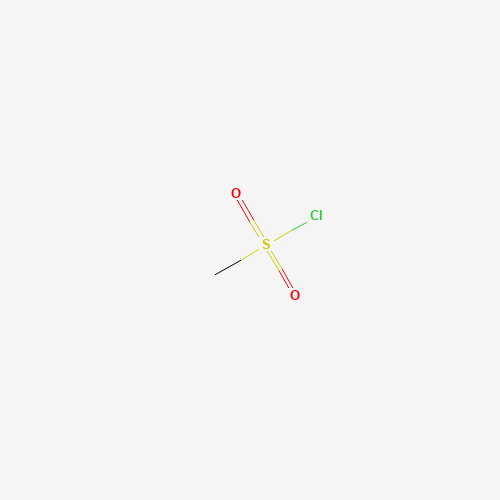
CAS124-63-0
分子式CH3ClO2S
分子量114.55 g/mol
危化品
Physical Description | Methanesulfonyl chloride appears as a pale yellow corrosive liquid. More dense than water and insoluble in water. Very toxic by ingestion, inhalation, or skin absorption.
科学粮草官-词典编辑部,修订于:2026-07-06
Toxicity
ToxicityEcotoxicity Values
LC50 Lepomis macrochirus (bluegill, length 33-75 mm) 11 mg/L/96 hr; static, 23 °C, pH 7.6-7.9, hardness 55 mg/L CaCO3
Fate Summary
ATMOSPHERIC FATE: According to a model of gas/particle partitioning of semivolatile organic compounds in the atmosphere(1), methanesulfonyl chloride, which has an estimated vapor pressure of 3.1 mm Hg at 25 °C(SRC), determined from a fragment constant method(2), is expected to exist solely as a vapor in the ambient atmosphere. Vapor-phase methanesulfonyl chloride is degraded in the atmosphere by reaction with photochemically-produced hydroxyl radicals(SRC); the half-life for this reaction in air is estimated to be 150 days(SRC), calculated from its rate constant of 1.1X10⁻¹² cu cm/molecule-sec at 25 °C(SRC) that was derived using a structure estimation method(3). Methanesulfonyl chloride does not contain chromophores that absorb at wavelengths >290 nm and therefore is not expected to be...
Soil Adsorption / Mobility
Using a structure estimation method based on molecular connectivity indices(1), the Koc of methanesulfonyl chloride can be estimated to be 6.1(SRC). According to a classification scheme(2), this estimated Koc value suggests that methanesulfonyl chloride is expected to have very high mobility in soil.
Environmental Bioconcentration
An estimated BCF of 1.9 was calculated for methanesulfonyl chloride(SRC), using an estimated log Kow of 1.3(1) and a regression-derived equation(2). According to a classification scheme(3), this BCF suggests the potential for bioconcentration in aquatic organisms is low(SRC).
Volatilization from Water / Soil
The Henry's Law constant for methanesulfonyl chloride is estimated as 4.4X10⁻⁵ atm-cu m/mole(SRC) using a fragment constant estimation method(1). This Henry's Law constant indicates that methanesulfonyl chloride is expected to volatilize from water surfaces(2). Based on this Henry's Law constant, the volatilization half-life from a model river (1 m deep, flowing 1 m/sec, wind velocity of 3 m/sec)(2) is estimated as 15 hours(SRC). The volatilization half-life from a model lake (1 m deep, flowing 0.05 m/sec, wind velocity of 0.5 m/sec)(2) is estimated as 11 days(SRC). Methanesulfonyl chloride's Henry's Law constant indicates that volatilization from moist soil surfaces may occur(SRC). Methanesulfonyl chloride is expected to volatilize from dry soil surfaces(SRC) based upon an estimated va...
Environmental Abiotic Degradation
The rate constant for the vapor-phase reaction of methanesulfonyl chloride with photochemically-produced hydroxyl radicals has been estimated as 1.1X10⁻¹² cu cm/molecule-sec at 25 °C(SRC) using a structure estimation method(1). This corresponds to an atmospheric half-life of about 150 days at an atmospheric concentration of 5X10+5 hydroxyl radicals per cu cm(1). Methanesulfonyl chloride hydrolyzes slowly in water(2). Methanesulfonyl chloride does not contain chromophores that absorb at wavelengths >290 nm and therefore is not expected to be susceptible to direct photolysis by sunlight(3).
Environmental Water Concentrations
DRINKING WATER: Methanesulfonyl chloride was detected and identified as an ozonation byproduct in ozone treated water that was collected from Jefferson Parish, LA in January 1994, August 1994, May 1995, and September 1996(1).
ICSC Environmental Data
The substance is harmful to aquatic organisms.
Artificial Pollution Sources
Methanesulfonyl chloride's production and use in flame-resistant products, as a stabilizer for liquid sulfur trioxide, as a biological chemical, as a chemical intermediate(1) in the photographic, fiber dye, agricultural, and pharmaceutical industries, a catalyst, curing agent, and chlorinating agent(2) may result in its release to the environment through various waste streams(SRC).
Probable Routes of Human Exposure
Methylsulfonyl chloride was detected in workplace air samples at a softwood and hardwood kraft pulp mill which utilized chlorine-containing bleaching agents. Six samples were positive with concentrations ranging from 2-20 ug/cu m, median was 6 ug/cu m(1) in the softwood bleaching plant. 34 samples were positive with concentrations ranging from 0.9 to 4.5 ug/cu m, median was 2.2 ug/cu m(1) in the hardwood bleaching plant.
Environmental Fate / Exposure Summary
Methylsulfonyl chloride's production and use in flame-resistant products, as a stabilizer for liquid sulfur trioxide, as a biological chemical, a chemical intermediate in the photographic, fiber dye, agricultural, and pharmaceutical industries, a catalyst, curing agent, and chlorinating agent may result in its release to the environment through various waste streams . If released to air, an estimated vapor pressure of 3.1 mm Hg at 25 °C indicates methanesulfonyl chloride will exist solely as a vapor in the atmosphere. Vapor-phase methanesulfonyl chloride will be degraded in the atmosphere by reaction with photochemically-produced hydroxyl radicals; the half-life for this reaction in air is estimated to be 150 days. Methanesulfonyl chloride does not contain chromophores that absorb at wa...
Symptoms
Ingestion Exposure: See Inhalation.
Toxicity Data
LCLo = 620 mg/m3/6hr
Adverse Effects
Toxic Pneumonitis - Inflammation of the lungs induced by inhalation of metal fumes or toxic gases and vapors.
Exposure Routes
The substance can be absorbed into the body by inhalation, by ingestion and through the skin.
Human Toxicity Excerpts
/SIGNS AND SYMPTOMS/ Methanesulfonyl chloride is corrosive to eyes, skin, and mucous membranes.
Non-Human Toxicity Values
LC50 Rat inhalation 25 ppm/4 hr
Antidote and Emergency Treatment
Advanced treatment: Consider orotracheal or nasotracheal intubation for airway control in the patient who is unconscious, has severe pulmonary edema, or is in severe respiratory distress. Positive-pressure ventilation techniques with a bag valve mask device may be beneficial. Monitor cardiac rhythm and treat arrhythmias if necessary ... Start IV administration of D5W /SRP: "To keep open", minimal flow rate/. Use 0.9% saline (NS) or lactated Ringer's (LR) if signs of hypovolemia are present. For hypotension with signs of hypovolemia, administer fluid cautiously and consider vasopressors if patient is hypotensive with a normal fluid volume. Watch for signs of fluid overload ... Administer atropine. Correct hypoxia before giving atropine ... Administer pralidoxime chloride (2 PAM). USE UND...









