

 一键配货
一键配货
化合物详情
CAS126-30-7
分子式C5H12O2
分子量104.15 g/mol g/mol
危化品
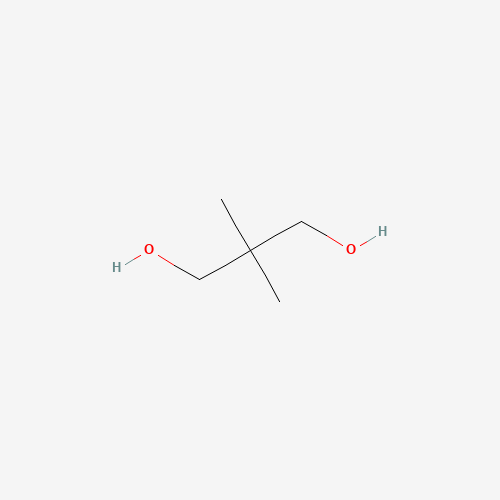
Physical Description | 2,2-dimethylpropane-1,3-diol is a white crystalline solid. Melting point 130 °C.
科学粮草官-词典编辑部,修订于:2026-07-06
Toxicity
ToxicityFate Summary
ATMOSPHERIC FATE: According to a model of gas/particle partitioning of semivolatile organic compounds in the atmosphere(1), neopentyl glycol, which has a estimated vapor pressure of 1.27X10⁻² mm Hg at 25 °C(2), is expected to exist solely as a vapor in the ambient atmosphere. Vapor-phase neopentyl glycol is degraded in the atmosphere by reaction with photochemically-produced hydroxyl radicals(SRC); the half-life for this reaction in air is estimated to be 44 hrs(SRC), calculated from its rate constant of 8.7X10⁻¹² cu cm/molecule-sec at 25 °C(SRC) that was derived using a structure estimation method(3). Neopentyl glycol does not contain chromophores that absorb at wavelengths >290 nm(4) and, therefore, is not expected to be susceptible to direct photolysis by sunlight(SRC).
Soil Adsorption / Mobility
Using a structure estimation method based on molecular connectivity indices(1), the Koc of neopentyl glycol can be estimated to be 1(SRC). According to a classification scheme(2), this estimated Koc value suggests that neopentyl glycol is expected to have very high mobility in soil(SRC).
Environmental Biodegradation
ANAEROBIC: Neopentyl glycol was 1% biodegraded following a lag of >60 days when incubated with an anaerobic digesting sludge from the Reading Sewage Works, Berkshire, UK(1).
Environmental Bioconcentration
A BCF range of 0.3-0.5 was calculated in fish for neopentyl glycol at 10 ppm using carp (Cyprinus carpio) which were exposed over an 6-week period(1). According to a classification scheme(2), this BCF suggests the potential for bioconcentration in aquatic organisms is low(SRC).
Volatilization from Water / Soil
The Henry's Law constant for neopentyl glycol is estimated as 3.1X10⁻⁷ atm-cu m/mole(SRC) developed using a fragment constant estimation method(1). This Henry's Law constant indicates that neopentyl glycol is expected to volatilize from water surfaces(2). Based on this Henry's Law constant, the volatilization half-life from a model river (1 m deep, flowing 1 m/sec, wind velocity of 3 m/sec)(2) is estimated as 122 days(SRC). The volatilization half-life from a model lake (1 m deep, flowing 0.05 m/sec, wind velocity of 0.5 m/sec)(2) is estimated as 890 days(SRC). Neopentyl glycol's Henry's Law constant indicates that volatilization from moist soil surfaces may occur(SRC). Neopentyl glycol is is not expected to volatilize from dry soil surfaces(SRC) based upon a vapor pressure of 1.27X10⁻²...
Environmental Abiotic Degradation
The rate constant for the vapor-phase reaction of neopentyl glycol with photochemically-produced hydroxyl radicals has been estimated as 8.7X10⁻¹² cu cm/molecule-sec at 25 °C(SRC) using a structure estimation method(1). This corresponds to an atmospheric half-life of about 44 hours at an atmospheric concentration of 5X10+5 hydroxyl radicals per cu cm(1). Neopentyl glycol is expected to undergo hydrolysis in the environment due to the presence of functional groups that hydrolyze under environmental conditions(2). Neopentyl glycol does not contain chromophores that absorb at wavelengths >290 nm(2) and, therefore, is not expected to be susceptible to direct photolysis by sunlight(SRC).
Effluent Concentrations
Neopentyl glycol was detected at a concentraiton of 14.7 ug/L in an industrial landfill leachate sampled Decemeber 1996. It was not detected in in an industrial effluent from a petrochemical plant taken in July 1996, January 1997, or March 1997 (landfill leachate); detection limit = 1.0 ug/L(1).
Artificial Pollution Sources
Neopentyl glycol's production and use in the production of plasticizers and polyesters and as a modifier of alkyd resins(1) may result in its release to the environment through various waste streams(SRC).
Probable Routes of Human Exposure
NIOSH (NOES Survey 1981-1983) has statistically estimated that 6957 workers (1200 of these are female) were potentially exposed to neopentyl glycol in the US(1). Occupational exposure to neopentyl glycol may occur through inhalation and dermal contact with this compound at workplaces where neopentyl glycol is produced or used. Use data indicate that the general population is not likely to be exposed to neopentyl glycol(SRC).
Other Environmental Concentrations
Plasticizers in 101 samples of polyvinyl chloride (PVC) toys on the Japanese market were surveyed. No phthalates were detected in designated toys, though bis(2-ethylhexyl)phthalate, diisononyl phthalate, diisobutyl phthalate, dibutyl phthalate, diisodecyl phthalate and benzyl butyl phthalate were detected in more than half of other toys. 2,2,4-Tributyl-1,3-pentanediol diisobutylate, o-acetyl tributyl citrate, adipates and diacetyl lauroyl glycerol, which are alternative plasticizers to phthalates, were detected. The results of structural analysis confirmed the presence of di(2-ethylhexyl)terephthalate, tributyl citrate, diisononyl 1,2-cyclohexanedicarboxylate and neopentyl glycol esters; these have not previonsly been reported in Japan. There appears to be a shift in plasticizers used f...
Environmental Fate / Exposure Summary
Neopentyl glycol's production and use in the production of plasticizers and polyesters and as a modifier of alkyd resins may result in its release to the environment through various waste streams. If released to air, a vapor pressure of 1.27X10⁻² mm Hg at 25 °C indicates neopentyl glycol will exist solely as a vapor in the atmosphere. Vapor-phase neopentyl glycol will be degraded in the atmosphere by reaction with photochemically-produced hydroxyl radicals; the half-life for this reaction in air is estimated to be 44 hours. Neopentyl glycol does not contain chromophores that absorb at wavelengths >290 nm and, therefore, is not expected to be susceptible to direct photolysis by sunlight. If released to soil, neopentyl glycol is expected to have very high mobility based upon an estimated...
Symptoms
Ingestion Exposure: Burning sensation.
Toxicity Data
LCLo (rat) = 39,000 ppm/6hr
Exposure Routes
The substance can be absorbed into the body by inhalation of its aerosol and by ingestion.
Toxicity Summary
IDENTIFICATION AND USE: Neopentyl glycol (NPG) is a solid. It is used in chemical synthesis, and in polyester manufacture. An insect repellent. HUMAN STUDIES: There are no data available. ANIMAL STUDIES: NPG was not irriating to skin in rabbits, and non sensitizing to the skin in the Murine Local Lymph Node Assay. NPG was practically non-toxic in acute studies in rats and guinea pigs. No treatment-related, adverse findings were observed at clinical examinations, clinical pathology and pathology up to a dose level of 1000 mg/kg bw/d in 90 day oral gavage studies in rats. In other rat study reproductive performance of the parent generation and development of the F1 generation were not affected after oral application of dose levels up to 1000 mg/kg bw/day. In male rats single i.p. injectio...
Human Toxicity Excerpts
/BIOMONITORING/ Patients attending a general hospital for various reasons were screened for raised serum gamma glutamyltransferase (gamma-GT) and positive blood alcohol concentration (BAC). The results served as objective biochemical tests of heavy drinking. Among 419 individuals, 50 (11.9%) met these requirements and blood samples were used to determine the presence of low molecular mass aliphatic diols. 1,2-Propanediol, 2,3-butanediol and 2,2-dimethyl-1,3-propanediol were determined by gas liquid chromatography-mass spectrometry (GC-MS). In patients with blood ethanol concentration less than 2 mmol/L, 1,2-propanediol and 2,2-dimethyl-1, 3-propanediol mainly occurred together at median concentrations of about 200 umol/L. When blood ethanol was 2-42 mmol/L, 2,3-butanediol was also prese...
Non-Human Toxicity Values
LD50 Rat oral 6400 - 7120 mg/kg bw
Antidote and Emergency Treatment
/SRP:/ Advanced treatment: Consider orotracheal or nasotracheal intubation for airway control in the patient who is unconscious, has severe pulmonary edema, or is in severe respiratory distress. Positive-pressure ventilation techniques with a bag-valve-mask device may be beneficial. Consider drug therapy for pulmonary edema ... . Monitor cardiac rhythm and treat arrhythmias if necessary ... . Start IV administration of D5W /SRP: "To keep open", minimal flow rate/. Use 0.9% saline (NS) lactated Ringer's (LR) if signs of hypovolemia are present. For hypotension with signs of hypovolemia, administer fluid cautiously. Consider vasopressors if patient is hypotensive with a normal fluid volume. Watch for signs of fluid overload ... . Treat seizures with diazepam or lorazepam ... . Use propara...