


 一键配货
一键配货
化合物详情
CAS126-33-0
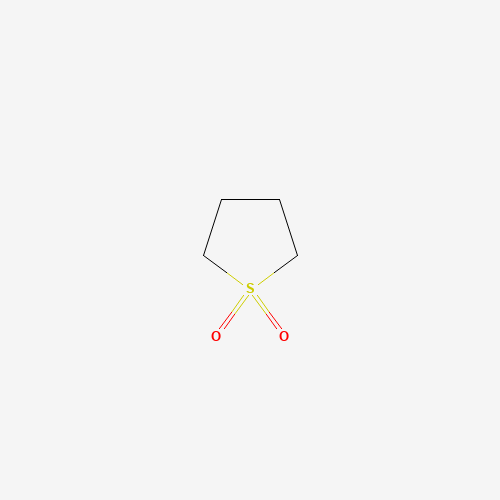
分子式C4H8O2S
分子量120.17 g/mol g/mol
危化品
Physical Description | Sulfolane is a colorless oily liquid with a weak oily odor. Solidifies (freezing point is 79 °F) and sinks on first contact with water, then mixes with water. (USCG, 1999)
科学粮草官-词典编辑部,修订于:2026-07-06
Toxicity
ToxicityFate Summary
ATMOSPHERIC FATE: According to a model of gas/particle partitioning of semivolatile organic compounds in the atmosphere(1), sulfolane, which has a vapor pressure of 0.0062 mm Hg at 25 °C (2), is expected to exist solely as a vapor in the ambient atmosphere. Vapor-phase sulfolane is degraded in the atmosphere by reaction with photochemically-produced hydroxyl radicals(SRC); the half-life for this reaction in air is estimated to be 29 hours(SRC), calculated from its rate constant of 1.3X10⁻¹¹ cu cm/molecule-sec at 25 °C(SRC) that was derived using a structure estimation method(3).
Soil Adsorption / Mobility
Sulfolane exhibited very high mobility in batch adsorption experiments using aquifer material from 3 natural gas plants in Canada(1). In each experiment, the soil adsorption isotherms were linear and the soil adsorption coefficient (Kd) of sulfolane was very low (Kd < 1). The corresponding Koc values in these low organic (0.2-0.9% organic carbon) materials were in the range of 4-35. The Koc value of sulfolane using a humus rich soil (pH = 6.9, 3.6% organic carbon) was 3(1). According to a classification scheme(2), this range of Koc values suggests that sulfolane is expected to have very high mobility in soil(SRC).
Environmental Biodegradation
ANAEROBIC: Under anaerobic conditions, little or no sulfolane degradation was observed at both 8 and 26 degrees C using aquifer sediments from sour natural gas plants(1).
Environmental Bioconcentration
BCFs of <1.3 and <13 were measured for sulfolane at concentrations of 2.5 mg/L and 0.25 mg/L, respectively, using carp which were exposed over a 6-week period(1). According to a classification scheme(2), these BCF data suggest that bioconcentration in aquatic organisms is low(SRC).
Volatilization from Water / Soil
The Henry's Law constant for sulfolane is estimated as 4.8X10⁻⁶ atm-cu m/mole(SRC) using a fragment constant estimation method(1). This Henry's Law constant indicates that sulfolane is expected to volatilize from water surfaces(2). Based on this Henry's Law constant, the volatilization half-life from a model river (1 m deep, flowing 1 m/sec, wind velocity of 3 m/sec)(2) is estimated as 6 days(SRC). The volatilization half-life from a model lake (1 m deep, flowing 0.05 m/sec, wind velocity of 0.5 m/sec)(2) is estimated as 64 days(SRC). Sulfolane's Henry's Law constant indicates that volatilization from moist soil surfaces may occur(SRC). Sulfolane is not expected to volatilize from dry soil surfaces(SRC) based upon a vapor pressure 0.0062 mm Hg(3).
Environmental Abiotic Degradation
The rate constant for the vapor-phase reaction of sulfolane with photochemically-produced hydroxyl radicals has been estimated as 1.3X10⁻¹¹ cu cm/molecule-sec at 25 °C(SRC) using a structure estimation method(1). This corresponds to an atmospheric half-life of about 29 hours at an atmospheric concentration of 5X10+5 hydroxyl radicals per cu cm(1). Sulfolane is not expected to undergo hydrolysis in the environment due to the lack of hydrolyzable functional groups(2) nor to directly photolyze due to the lack of absorption in the environmental UV spectrum (>290 nm).
Effluent Concentrations
Sulfolane was detected in effluents of advanced waste water treatment plants in Orange county, CA(1). Sulfolane was detected in landfill leachate from municipal waste in Japan at 1200 ug/L(2).
Artificial Pollution Sources
Sulfolane's use as a solvent for the extraction of benzene, toluene, and xylene from mixtures with aliphatic hydrocarbons and its use in the extraction of acidic components, eg, hydrogen sulfide, carbon dioxide, carbonyl sulfide, carbon dioxide and mercaptans, from sour gas streams(1), may result in its release to the environment through various waste streams(SRC).
Probable Routes of Human Exposure
NIOSH (NOES Survey 1981-1983) has statistically estimated that 6,461 workers (315 of these are female) are potentially exposed to sulfolane in the US(1). Occupational exposure to sulfolane may occur through inhalation and dermal contact with this compound at workplaces where sulfolane is produced or used(SRC).
Environmental Fate / Exposure Summary
Sulfolane's use as a solvent for the extraction of benzene, toluene, and xylene from mixtures with aliphatic hydrocarbons and its use in the extraction of acidic components, such as hydrogen sulfide, carbon dioxide, carbonyl sulfide, carbon dioxide and mercaptans, from sour gas streams, may result in its release to the environment through various waste streams. If released to the atmosphere, a vapor pressure of 0.0062 mm Hg at 25 °C indicates that sulfolane will exist solely in the vapor phase. Vapor phase sulfolane is degraded in the atmosphere by reaction with photochemically-produced hydroxyl radicals; the half-life for this reaction in air is estimated to be 29 hours. If released to soil, sulfolane is expected to have very high mobility based upon Koc values in the range of 4-35. Vo...
Interactions
Rats receiving sulfolane at 240-300 mg/kg, ip, 20 min before irradiation showed 3 times as many bone marrow karyocytes as did control animals after receiving 300-900 rads gamma-irradiation. Mice receiving 120-240 mg/kg showed twice as many as controls.
Toxicity Data
LC50 (rat) > 12,000 mg/m3/4h
Adverse Effects
Neurotoxin - Other CNS neurotoxin
RAIS Toxicity Values
Oral Subchronic Chronic Reference Dose Reference: PPRTV Current
1 or Cancer Risk Level 1E-06
Fraction of Contaminant Absorbed Dermally from Soil: 0.1
Antidote and Emergency Treatment
Advanced treatment: Consider orotracheal or nasotracheal intubation for airway control in the patient who is unconscious, has severe pulmonary edema, or is in respiratory arrest. Positive pressure ventilation techniques with a bag valve mask device may be beneficial. Monitor cardiac rhythm and treat arrhythmias as necessary ... . Start an IV with D5W /SRP: "To keep open", minimal flow rate/. Use lactated Ringer's if signs of hypovolemia are present. Watch for signs of fluid overload. Consider drug therapy for pulmonary edema ... . For hypotension with signs of hypovolemia, administer fluid cautiously. Watch for signs of fluid overload ... . Treat seizures with diazepam (Valium) ... . Use proparacaine hydrochloride to assist eye irrigation ... . /Poison A and B/
Hazard Quotient Level 3 or Cancer Risk Level 1E-04
Fraction of Contaminant Absorbed Dermally from Soil: 0.1









