


 一键配货
一键配货
化合物详情
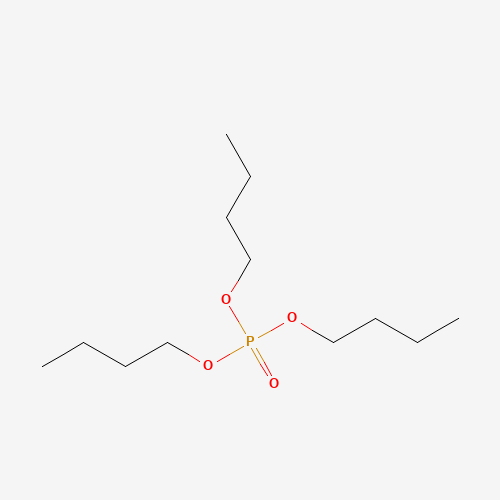
CAS126-73-8
分子式C12H27O4P
分子量266.32 g/mol g/mol
危化品
Physical Description | Tributyl phosphate is an odorless colorless to yellow liquid. Toxic by ingestion and inhalation.
科学粮草官-词典编辑部,修订于:2026-07-06
Toxicity
ToxicityBody Burden
In EPA's National Human Monitoring Program's National Human Adipose Tissue Survey, broad scan survey for 1982, tributyl phosphate was detected at 120 ng/g in 1 of 46 composite samples analyzed(1). The sample came from the 0-14 age group of the east north central census region(1). Tributyl phosphate was detected at 10 ppb in plaque from the aorta of one of two autopsied heart attack victims(2).
Fate Summary
ATMOSPHERIC FATE: According to a model of gas/particle partitioning of semivolatile organic compounds in the atmosphere(1), tributyl phosphate, which has a vapor pressure of 1.13X10⁻³ mm Hg at 25 °C(2), is expected to exist solely as a vapor in the ambient atmosphere. Vapor-phase tributyl phosphate is degraded in the atmosphere by reaction with photochemically-produced hydroxyl radicals(SRC); the half-life for this reaction in air is estimated to be 4.4 hours(SRC), calculated from its rate constant of 7.9X10⁻¹¹ cu cm/molecule-sec at 25 °C(SRC) that was derived using a structure estimation method(3). Tributyl phosphate does not contain chromophores that absorb at wavelengths >290 nm(4) and, therefore, is not expected to be susceptible to direct photolysis by sunlight(SRC).
Soil Adsorption / Mobility
Using a structure estimation method based on molecular connectivity indices(1), the Koc of tributyl phosphate can be estimated to be 2400(SRC). According to a classification scheme(2), this estimated Koc value suggests that tributyl phosphate is expected to have slight mobility in soil.
Environmental Biodegradation
ANAEROBIC: Tributyl phosphate was reported to biodegrade slowly even after acclimation under anaerobic conditions(1). No degradation of tributyl phosphate in leachate from Maxey Flats, KY occurred when incubated with sewage under anaerobic conditions for 24-30 days(2).
Environmental Bioconcentration
BCFs of 7.1-20 and 5.5-10 were reported in carp (Cyprinus carpio) which were exposed to tributyl phosphate at 6 and 60 ppb, respectively, over a 6-week period(1). The BCF of tributyl phosphate (exposure concentration of 3-4 ug/L) in killifish (Oryzias latipes) was found to be 30-35 and in goldfish (Carassius auratus) was found to be 6-11(2). According to a classification scheme(3), these BCFs suggest bioconcentration in aquatic organisms is low to moderate(SRC).
Volatilization from Water / Soil
The Henry's Law constant for tributyl phosphate is estimated as 1.4X10⁻⁶ atm-cu m/mole(SRC) derived from its vapor pressure, 1.13X10⁻³ mm Hg(1), and water solubility, 280 mg/L(2). This Henry's Law constant indicates that tributyl phosphate is expected to volatilize from water surfaces(3). Based on this Henry's Law constant, the volatilization half-life from a model river (1 m deep, flowing 1 m/sec, wind velocity of 3 m/sec)(3) is estimated as 40 days(SRC). The volatilization half-life from a model lake (1 m deep, flowing 0.05 m/sec, wind velocity of 0.5 m/sec)(3) is estimated as 300 days(SRC). Tributyl phosphate's estimated Henry's Law constant indicates that volatilization from moist soil surfaces may occur(SRC). Tributyl phosphate is not expected to volatilize from dry soil surfaces(S...
Environmental Abiotic Degradation
The rate constant for the vapor-phase reaction of tributyl phosphate with photochemically-produced hydroxyl radicals has been estimated as 7.9X10⁻¹¹ cu cm/molecule-sec at 25 °C(SRC) using a structure estimation method(1). This corresponds to an atmospheric half-life of about 4.4 hours at an atmospheric concentration of 5X10+5 hydroxyl radicals per cu cm(1). Tributyl phosphate is not expected to undergo hydrolysis in the environment(SRC) due to estimated hydrolysis half-lives of 9.9 to 11.5 years at pH 9 to 5(1). Tributyl phosphate does not contain chromophores that absorb at wavelengths >290 nm(2) and, therefore, is not expected to be susceptible to direct photolysis by sunlight(SRC).
Food Survey Values
According to FDA Total Diet studies in FY 1980, tributyl phosphate was found only in grain and cereal products composites at concentrations of 0.003-0.080 ppm (avg 0.0086 ppm), 0.003-0.104 ppm (avg 0.0158 ppm), 0.003-0.031 ppm (avg 0.0068 ppm), for infants, toddlers, and adult samples, respectively(1-2). According to FDA Total Diet studies in FY 1981/82, tributyl phosphate was found in grain and cereal products composites at concentrations of 0.003-0.032 ppm (avg 0.0053 ppm), 0.006-0.092 ppm (avg 0.0091 ppm), 0.003-0.060 ppm (avg 0.0091 ppm) for infants, toddlers, and adult samples, respectively and one adult composite of garden fruit at 0.0004 ppm(3-4). In the FDA's Revised Market Basket Study operated from 1982 to 1991, tributyl phosphate was detected 73 times in 25 different foods wi...
Ecotoxicity Excerpts
/AQUATIC SPECIES/ ... Rainbow trout did not show any obvious effects at water concentrations below 5.6 mg tributyl phosphate/L but behaved very calmly when trapped in a hand-net at a concentration of 1 mg/L (all concentrations are nominal value). At 10 mg/L, the fish started showing severe balance disturbances, which included highly atypical movements like darting, coiling swimming, and backward somersaults, but they recovered after 24-72 hr at this concentration. On the other hand, the balance disturbances persisted until the end of the experiment at a concentration of 11.5 mg/L. At 13.5 mg/L, the fish were immobilized, lying on their sides at the bottom of the water, and some of them died.
Effluent Concentrations
Tributyl phosphate was not detected in three European petrochemical plant effluent samples collected in July 1996, January 1997, and March 1997(1). It was detected in one of two samples of industrial landfill leachate collected in December 1996 and March 1997 with a concentration of 0.66 ug/L(1). Effluent wastewater samples collected in July 2001 from three municipal sewage treatment plants and one industrial sewage treatment plant that discharge their treated wastewater into the Oder River in Germany had mean tributyl phosphate concentrations of 622 ng/L and 235 ng/L, respectively(2). Flue gas samples collected in September 1992 from a hazardous waste incinerator in Biebesheim, Germany contained 80.00 and 70.00 ng/N-cu m tributyl phosphate(3). Tributyl phosphate concentration ranges in...
ICSC Environmental Data
The substance is toxic to aquatic organisms.
Atmospheric Concentrations
INDOOR: Tributyl phosphate was detected with a median concentration of 12 ng/cu m in indoor air samples collected from 22 houses in Tokyo, Japan(1). Tributyl phosphate was detected in one theater collected in Zurich, Switzerland at 29 ng/cu m(2). Tributyl phosphate was detected in ten homes and three garages at 5-80 and 2-4 ng/cu m, respectively(3).
Artificial Pollution Sources
Tributyl phosphate's production and use as an extraction agent for rare earths, uranium, plutonium, and metal ions(1); heat-exchange medium, solvent, plasticizer, pigment grinding assistant, antifoam agent and dielectric(2) may result in its release to the environment through various waste streams(SRC).
Sediment/Soil Concentrations
SEDIMENT: Tributyl phosphate was not reported in sediment in EPA's STORET database between 1978-1987(1). Tributyl phosphate was not detected in 18 sediment samples from the Great Lakes basin sampled 1994 to 2006, detection limit 12.5 ng/g dry weight(2). Tributyl phosphate was detected at concentrations ranging from 15 to 170 ng/g dry matter in sediment samples collected 1993 to 1994 from 11 sampling sites in the Havel and Spree Rivers in Germany(3). No tributyl phosphate was found in sediment (6 sites) from an industrial area of Japan (detection limit 2 ng/g)(4). Surveys by the Japanese Environmental Agency in 1977-78 found 8-130, 3-24, and 2-240 ng/g (dry wt) in 6 of 9 river, 11 of 18 estuary, and 31 of 78 sea sediment samples, respectively(4).
Probable Routes of Human Exposure
NIOSH (NOES Survey 1981-1983) has statistically estimated that 109,402 workers (19,015 of these are female) were potentially exposed to tributyl phosphate in the US(1). Occupational exposure to tributyl phosphate may occur through inhalation and dermal contact with this compound at workplaces where tributyl phosphate is produced or used(SRC). Tributyl phosphate was detected in 12 indoor air samples collected from the dismantling hall of a electronic products recycling plant with a concentration of 9-18 ng/cu m(2). Potentially 43,000 aircraft mechanics and another 300 aircraft industry employees are exposed to aircraft hydraulic fluid containing tributyl phosphate(3). In addition, 500 tributyl phosphate manufacturing, processing, and distribution workers are potentially exposed to tribut...
Other Environmental Concentrations
Tributyl phosphate was detected at 230 ng/sq m/day in atmospheric deposition samples from Pallas, Finland; dry and wet depostion samples were collected Jul 2004(1). Tributyl phosphate was detected in three cars at 2.5-14 ng/cu m; samples were collected in Zurich, Switzerland(2). Tributyl phosphate was detected in one car, two buses and one subway car at 15, 6-7 and 5 ng/cu m, respectively(3).
Environmental Fate / Exposure Summary
Tributyl phosphate's production and use as an extraction agent for rare earths, uranium, plutonium, and metal ions; heat-exchange medium, solvent, plasticizer, pigment grinding assistant, antifoam agent and dielectric may result in its release to the environment through various waste streams. If released to air, a vapor pressure of 1.13X10⁻³ mm Hg at 25 °C indicates tributyl phosphate will exist solely as a vapor in the atmosphere. Vapor-phase tributyl phosphate will be degraded in the atmosphere by reaction with photochemically-produced hydroxyl radicals; the half-life for this reaction in air is estimated to be 4.4 hours. Tributyl phosphate does not contain chromophores that absorb at wavelengths >290 nm and, therefore, is not expected to be susceptible to direct photolysis by sunligh...
Symptoms
irritation eyes, skin, respiratory system, headache; nausea
Interactions
... A mixture composed principally of dibutyl phenyl phosphate and tributyl phosphate ... was evaluated in an inhalation toxicity study /using/ Sprague-Dawley rats. Target exposure levels used ... were 0, 5, 100 and 300 mg/cu m, and exposures were maintained for 6 hr/day, 5 days/week. ... The only clinical sign of chemical toxicity was the observation of a reddish nasal discharge with accompanying oral salivation in mid and high exposure animals of both sexes, indicative of an irritant response. Statistically significant reduced body weights; increased absolute and relative liver weights; and decreased erythrocyte counts, hemoglobin levels, and hematocrit values were observed in high-exposure female rats euthanized after 13 weeks ... exposure. High-exposure male rats also had increased...
Target Organs
Eyes, skin, respiratory system
Toxicity Data
LC50 (rat) = 28,000 mg/m3/1H
Adverse Effects
ACGIH Carcinogen - Confirmed Animal.
Exposure Routes
inhalation, ingestion, skin and/or eye contact
Toxicity Summary
IDENTIFICATION AND USE: Tributyl phosphate is a colorless to pale-yellow odorless liquid. It is used as a plasticizer for cellulose esters, lacquers, plastics, and vinyl resins. Used in fire-resistant aircraft hydraulic fluids. Other uses include heat-exchange medium, solvent extraction of metal ions from solution of reactor products, solvent for nitrocellulose, cellulose acetate, pigment grinding assistant, antifoaming agent, dielectric. HUMAN EXPOSURE AND TOXICITY: Breathing vapors of tributyl phosphate causes irritation of mucous membranes and if inhalation is prolonged there can be general poisoning with paralysis. In contact with skin tributyl phosphate can cause irritation. Tributyl phosphate may cause irritation of the eyes, nose, and throat. It may also cause nausea and headache...
RAIS Toxicity Values
Oral Slope Factor Reference: PPRTV Current
Human Toxicity Values
3= Moderately toxic: probable oral lethal dose (human) 0.5-5 g/kg, between 1 oz & 1 pint (or 1 lb) for 70 kg person (150 lb).
1 or Cancer Risk Level 1E-06
Fraction of Contaminant Absorbed Dermally from Soil: 0.1
Antidote and Emergency Treatment
/SRP:/ Advanced treatment: Consider orotracheal or nasotracheal intubation for airway control in the patient who is unconscious, has severe pulmonary edema, or is in severe respiratory distress. Positive-pressure ventilation techniques with a bag valve mask device may be beneficial. Consider drug therapy for pulmonary edema ... . Consider administering a beta agonist such as albuterol for severe bronchospasm ... . Monitor cardiac rhythm and treat arrhythmias as necessary ... . Start IV administration of D5W TKO /SRP: "To keep open", minimal flow rate/. Use 0.9% saline (NS) or lactated Ringer's (LR) if signs of hypovolemia are present. For hypotension with signs of hypovolemia, administer fluid cautiously. Watch for signs of fluid overload ... . Treat seizures with diazepam or lorazepam...
Hazard Quotient Level 3 or Cancer Risk Level 1E-04
Fraction of Contaminant Absorbed Dermally from Soil: 0.1
USGS Health-Based Screening Levels for Evaluating Water-Quality
Reference: Smith, C.D. and Nowell, L.H., 2024. Health-Based Screening Levels for evaluating water-quality data (3rd ed.). DOI:10.5066/F71C1TWP









