


 一键配货
一键配货
化合物详情
CAS126-98-7
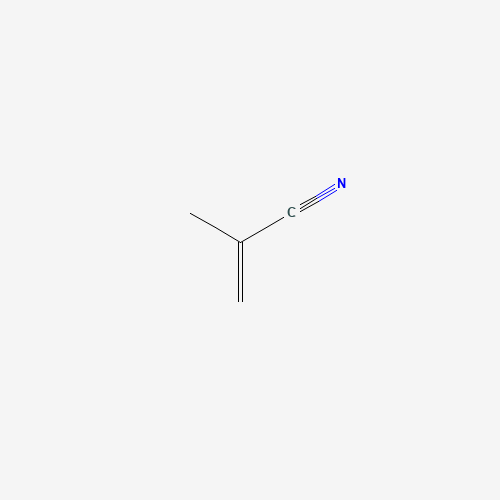
分子式C4H5N
分子量67.09 g/mol
危化品
Physical Description | Methacrylonitrile, stabilized appears as a clear colorless liquid. Less dense than water. Flash point 55 °F. Boiling point 195 °F. Very be toxic by ingestion, inhalation and skin absorption. Used to make plastics and coatings.
科学粮草官-词典编辑部,修订于:2026-07-06
Toxicity
ToxicityFate Summary
ATMOSPHERIC FATE: According to a model of gas/particle partitioning of semivolatile organic compounds in the atmosphere(1), methylacrylonitrile, which has a vapor pressure of 71.2 mm Hg at 25 °C(2), is expected to exist solely as a vapor in the ambient atmosphere(SRC). Vapor-phase methylacrylonitrile is degraded in the atmosphere by reaction with photochemically-produced hydroxyl radicals(SRC); the half-life for this reaction in air is estimated to be 46 hours(SRC), calculated from its rate constant of 8.36X10⁻¹² cu cm/molecule-sec at 25 °C(SRC) determined using a structure estimation method(3). The rate constant for the vapor-phase reaction of methylacrylonitrile with ozone is 3.52X10⁻¹⁹ cu cm/molecule-sec (temperature unspecified)(4). This corresponds to an atmospheric half-life of ab...
Soil Adsorption / Mobility
The Koc of methylacrylonitrile is estimated as 56(SRC), using a measured log Kow of 0.68(1) and a regression-derived equation(2). According to a classification scheme(3), this estimated Koc value suggests that methylacrylonitrile is expected to have high mobility in soil(SRC).
Environmental Biodegradation
Microorganisms hydrolyze nitriles predominately to ammonia and carboxylic acids(1). A bacterium isolated from soil (Pseudomonas putida) was able to utilize methylacrylonitrile as a sole source of carbon and nitrogen(2). In another study, a mixed microbial culture, isolated from an environment contaminated with organic cyanides and PCBs, utilized methylacrylonitrile as the sole source of carbon and nitrogen(1). The mixed microbial culture was grown for 48 hrs at pH 7 with 1 g/l of methylacrylonitrile; the final pH and ammonia concn were determined to be 8.17 and 40.9 umol/ml, respectively(1).
Environmental Bioconcentration
An estimated BCF of 3 was calculated for methylacrylonitrile(SRC), using a log Kow of 0.68(1) and a regression-derived equation(2). According to a classification scheme(3), this BCF suggests the potential for bioconcentration in aquatic organisms is low(SRC).
Volatilization from Water / Soil
The Henry's Law constant for methylacrylonitrile is estimated as 2.47X10⁻⁴ atm-cu m/mole(SRC) based upon its vapor pressure, 71.2 mm Hg(1), and water solubility, 2.54X10+4 mg/l(2). This Henry's Law constant indicates that methylacrylonitrile is expected to volatilize from water surfaces(3). Based on this Henry's Law constant, the volatilization half-life from a model river (1 m deep, flowing 1 m/sec, wind velocity of 3 m/sec)(3) is estimated as 3 hours (SRC). The volatilization half-life from a model lake (1 m deep, flowing 0.05 m/sec, wind velocity of 0.5 m/sec)(3) is estimated as 4 days(SRC). Methylacrylonitrile's estimated Henry's Law constant(1,2) indicates that volatilization from moist soil surfaces may occur(SRC). The potential for volatilization of methylacrylonitrile from dry s...
Environmental Abiotic Degradation
The rate constant for the vapor-phase reaction of methylacrylonitrile with photochemically-produced hydroxyl radicals has been estimated as 8.36X10⁻¹² cu cm/molecule-sec at 25 °C(SRC) using a structure estimation method(1). This corresponds to an atmospheric half-life of about 46 hours at an atmospheric concentration of 5X10+5 hydroxyl radicals per cu cm(1). The rate constant for the vapor-phase reaction of methylacrylonitrile with ozone is 3.52X10⁻¹⁹ cu cm/molecule-sec (temperature unspecified)(2). This corresponds to an atmospheric half-life of about 33 days at an atmospheric concentration of 7X10+11 ozone molecules per cu cm(3). Methylacrylonitrile is not expected to undergo hydrolysis in the environment based on the negligible hydrolysis of acrylonitrile between pH 4 and 10(4) nor t...
Environmental Water Concentrations
SURFACE WATERS: Methylacrylonitrile was qualitatively detected in only 1 surface water sample collected from 204 sites near heavily industrialized areas across the US(1).
Effluent Concentrations
Trace amounts of methylacrylonitrile (concn or detection limit not reported) were detected in an aqueous process effluent from a coal gasification facility in Gillette, WY(1).
Artificial Pollution Sources
Methylacrylonitrile's production and use in polymers and coatings(1,2) may result in its release to the environment through various waste streams(SRC).
Probable Routes of Human Exposure
NIOSH (NOES Survey 1981-1983) has statistically estimated that 213 workers are potentially exposed to methylacrylonitrile in the US(1). Occupational exposure to methylacrylonitrile may occur through inhalation and dermal contact with this compound at workplaces where methylacrylonitrile is produced or used(SRC).
Environmental Fate / Exposure Summary
Methylacrylonitrile's production and use in polymers and coatings may result in its release to the environment through various waste streams. If released to air, a vapor pressure of 71.2 mm Hg at 25 °C indicates methylacrylonitrile will exist solely as a vapor in the ambient atmosphere. Vapor-phase methylacrylonitrile will be degraded in the atmosphere by reaction with photochemically-produced hydroxyl radicals and ozone; the half-life for these reactions in air are estimated to be 46 hours and 33 days, respectively. If released to soil, methylacrylonitrile is expected to have high mobility based upon an estimated Koc of 56. Volatilization from moist soil surfaces is expected to be an important fate process based upon an estimated Henry's Law constant of 2.47X10⁻⁴ atm-cu m/mole. Methyla...
Symptoms
irritation eyes, skin; lacrimation (discharge of tears); In Animals: convulsions, loss of motor control in hind limbs
Interactions
The toxic mechanism of nitriles (including propionitrile) and the effect of metabolic modifiers in mice were studied in relation to their physicochemical properties. All the test nitriles liberated cyanide both in vivo and in vitro, with the exception of benzonitrile, although the extent of liberation and the effect of carbon tetrachloride pretreatment on the mortality of animals differed among nitriles. From these results, test compounds were tentatively divided into 3 groups. In group 1, acute toxicity was greatly reduced by carbon tetrachloride pretreatment, in group 2, toxicity was not significantly changed or was somewhat enhanced, and in group 3, benzonitrile only, toxicity was clearly enhanced. The amount of cyanide was higher at death in the brains of mice given group 1 compound...
Target Organs
Eyes, skin, central nervous system
Toxicity Data
LC50 (rat) = 328 ppm/4h
Adverse Effects
ACGIH Carcinogen - Not Classifiable.
Exposure Routes
inhalation, skin absorption, ingestion, skin and/or eye contact
RAIS Toxicity Values
Oral Subchronic Chronic Reference Dose Reference: PPRTV Current
Human Toxicity Excerpts
TOXIC BY INGESTION, INHALATION, & SKIN ABSORPTION.
Carcinogen Classification
Summary: In male and female rats, methacrylonitrile administration caused significant increases in the incidences of nonneoplastic lesions of the nose and liver.
1 or Cancer Risk Level 1E-06
Soil Saturation Concentration (mg/kg): 4.58e+03
Hazard Quotient Level 3 or Cancer Risk Level 1E-04
Soil Saturation Concentration (mg/kg): 4.58e+03
USGS Health-Based Screening Levels for Evaluating Water-Quality
Reference: Smith, C.D. and Nowell, L.H., 2024. Health-Based Screening Levels for evaluating water-quality data (3rd ed.). DOI:10.5066/F71C1TWP









