


 一键配货
一键配货
化合物详情
CAS128-08-5
分子式C4H4BrNO2
分子量177.98 g/mol g/mol
危化品
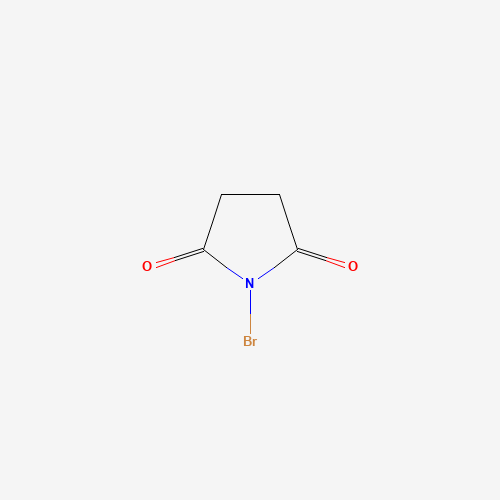
N-bromosuccinimide is a five-membered cyclic dicarboximide compound having a bromo substituent on the nitrogen atom. It has a role as a reagent. It is a dicarboximide, an organobromine compound and a pyrrolidinone. It is functionally related to a succinimide.
科学粮草官-词典编辑部,修订于:2026-07-06
Toxicity
ToxicityEcotoxicity Values
USDA APHIS Chemical Effects: collection=usda_chemeffect&query_type=synonym&query='^128-08-5$'
Fate Summary
ATMOSPHERIC FATE: According to a model of gas/particle partitioning of semivolatile organic compounds in the atmosphere(1), N-bromosuccinimide, which has an estimated vapor pressure of 6.9X10⁻⁶ mm Hg at 25 °C(SRC), determined from a fragment constant method(2), will exist in both the vapor and particulate phases in the ambient atmosphere. Vapor-phase N-bromosuccinimide is degraded in the atmosphere by reaction with photochemically-produced hydroxyl radicals(SRC); the half-life for this reaction in air is estimated to be 0.9 days(SRC), calculated from its rate constant of 1.9X10⁻¹¹ cu cm/molecule-sec at 25 °C(SRC) that was derived using a structure estimation method(3). Particulate-phase N-bromosuccinimide may be removed from the air by wet and dry deposition(SRC). N-Bromosuccinimide con...
Soil Adsorption / Mobility
Using a structure estimation method based on molecular connectivity indices(1), the Koc of N-bromosuccinimide can be estimated to be 3(SRC). According to a classification scheme(2), this estimated Koc value suggests that N-bromosuccinimide is expected to have very high mobility in soil(SRC).
Environmental Biodegradation
AEROBIC: N-Bromosuccinimide, present at 40 mg/L, was 93% biodegraded using an activated sludge incubated at 22.2 °C for 35 days in the OECD DOC Die Away Test. The abiotic degradation measured as DOC (mg/L) was 7% after 28 days and 3% at the end of the test(1).
Environmental Bioconcentration
An estimated BCF of 3 was calculated in fish for N-bromosuccinimide(SRC), using an estimated log Kow of -1.19(1) and a regression-derived equation(1). According to a classification scheme(2), this BCF suggests the potential for bioconcentration in aquatic organisms is low(SRC).
Volatilization from Water / Soil
The Henry's Law constant for N-bromosuccinimide is estimated as 3.9X10⁻⁷ atm-cu m/mole(SRC) using a fragment constant estimation method(1). This Henry's Law constant indicates that N-bromosuccinimide is expected to be essentially nonvolatile from water and moist soil surfaces(2). N-Bromosuccinimide is not expected to volatilize from dry soil surfaces(SRC) based upon an estimated vapor pressure of 6.9X10⁻⁹ mm Hg(SRC), determined from a fragment constant method(3).
Environmental Abiotic Degradation
The rate constant for the vapor-phase reaction of N-bromosuccinimide with photochemically-produced hydroxyl radicals has been estimated as 1.9X10⁻¹¹ cu cm/molecule-sec at 25 °C(SRC) using a structure estimation method(1). This corresponds to an atmospheric half-life of about 0.9 days at an atmospheric concentration of 5X10+5 hydroxyl radicals per cu cm(1). N-Bromosuccinimide is expected to undergo hydrolysis in the environment due to the presence of functional groups that hydrolyze under environmental conditions(2). N-Bromosuccinimide contains chromophores that absorb at wavelengths >290 nm(2) and, therefore, may be susceptible to direct photolysis by sunlight(SRC).
Artificial Pollution Sources
N-Bromosuccinimide's production and use as a chemical reagent(1) may result in its release to the environment through various waste streams(SRC).
Probable Routes of Human Exposure
Occupational exposure to N-bromosuccinimide may occur through inhalation and dermal contact with this compound at workplaces where N-bromosuccinimide is produced or used. Use data suggest that the general population is not likely to be exposed to N-bromosuccinimide. (SRC)
Environmental Fate / Exposure Summary
N-Bromosuccinimide's production and use as a chemical reagent may result in its release to the environment through various waste streams. If released to air, an estimated vapor pressure of 6.9X10⁻⁶ mm Hg at 25 °C indicates N-bromosuccinimide will exist in both the vapor and particulate phases in the atmosphere. Vapor-phase N-bromosuccinimide will be degraded in the atmosphere by reaction with photochemically-produced hydroxyl radicals; the half-life for this reaction in air is estimated to be 0.9 days. Particulate-phase N-bromosuccinimide will be removed from the atmosphere by wet and dry deposition. N-Bromosuccinimide contains chromophores that absorb at wavelengths >290 nm and, therefore, may be susceptible to direct photolysis by sunlight. If released to soil, N-bromosuccinimide is e...
Symptoms
Causes severe eye and skin burns. Irritating to eyes, skin, and respiratory system. Acute exposure (ingestion or inhalation) can lead to nausea, vomiting and coma.
Treatment
EYES: irrigate opened eyes for several minutes under running water. INGESTION: do not induce vomiting. Rinse mouth with water (never give anything by mouth to an unconscious person). Seek immediate medical advice. SKIN: should be treated immediately by rinsing the affected parts in cold running water for at least 15 minutes, followed by thorough washing with soap and water. If necessary, the person should shower and change contaminated clothing and shoes, and then must seek medical attention. INHALATION: supply fresh air. If required provide artificial respiration.
Effect Level
collection=toxvaldb&kind=^EL$
Interactions
N-Bromosuccinimide (NBS) is a known protein reagent able to modify amino acids and proteins, resulting in oxidation of tryptophan, tyrosine and histidine residues, as well as sulfhydryl, alcohol and phenol groups. These properties make NBS a suitable reagent to selectively block certain amino acid residues in biochemistry, and also permit the histochemical detection of proteins by oxidative deamination followed by the Schiff reaction. In this paper we show that, under ultraviolet excitation, NBS selectively reveals the cytoplasmic granules of mammalian eosinophils and chicken heterophils, rendering considerable white--blue fluorescence, in a remarkable fluorogenic reaction which rapidly increases at the beginning of the observation. This emission slightly decays afterwards and then rema...
Lethal Dose
collection=toxvaldb&kind=^LD$
Health Effects
Strong lachrymator. Strong irritant to eyes, skin and soft tissues. Toxic if inhaled, swallowed or absorbed through skin. It is extremely destructive to the tissue of the mucous membranes and upper respiratory tract.
Adverse Effects
Toxic Pneumonitis - Inflammation of the lungs induced by inhalation of metal fumes or toxic gases and vapors.
Exposure Routes
Oral (L626); inhalation (L626); dermal (L626)
Toxicity Summary
Organobromide compounds such as n-Bromosuccinimide are strong alkylating agents. Consequently they can readily modify free thiols (cysteines), methionines as well as tryptophan and histidine residues on the surfaces of proteins leading to the disruption of enzyme, transporter or membrane functions. One of the most probable protein targets is the TRPA1 ion channel that is expressed in sensory nerves (trigeminal nerve) of the eyes, nose, mouth and lungs
Human Toxicity Excerpts
/OTHER TOXICITY INFORMATION/ N-bromosuccinimide is classified as irritating to skin: Causes skin irritation. Red skin on arms.
Carcinogen Classification
No indication of carcinogenicity to humans (not listed by IARC).
Non-Human Toxicity Values
LD50 Rat oral >2000 mg/kg bw
Reference and Risk Values
collection=toxvaldb&kind=^RRV$
Non-Human Toxicity Excerpts
/ALTERNATIVE and IN VITRO TESTS/ We have investigated the ion permeability properties of sodium channels purified from eel electroplax and reconstituted into liposomes. Under the influence of a depolarizing diffusion potential, these channels appear capable of occasional spontaneous openings. Fluxes which result from these openings are sodium selective and blocked (from opposite sides of the membrane) by tetrodotoxin (TTX) and moderate concentrations of the lidocaine analogue QX-314. Low concentrations of QX-314 paradoxically enhance this channel-mediated flux. N-bromoacetamide (NBA) and N-bromosuccinimide (NBS), reagents which remove inactivation gating in physiological preparations, transiently stimulate the sodium permeability of inside-out facing channels to high levels. The rise an...
Antidote and Emergency Treatment
/SRP:/ Advanced treatment: Consider orotracheal or nasotracheal intubation for airway control in the patient who is unconscious, has severe pulmonary edema, or is in severe respiratory distress. Positive-pressure ventilation techniques with a bag valve mask device may be beneficial. Consider drug therapy for pulmonary edema ... . Consider administering a beta agonist such as albuterol for severe bronchospasm ... . Monitor cardiac rhythm and treat arrhythmias as necessary ... . Start IV administration of D5W TKO /SRP: "To keep open", minimal flow rate/. Use 0.9% saline (NS) or lactated Ringer's (LR) if signs of hypovolemia are present. For hypotension with signs of hypovolemia, administer fluid cautiously. Watch for signs of fluid overload ... . Treat seizures with diazepam or lorazepam...









