


 一键配货
一键配货
化合物详情
CAS128-09-6
分子式C4H4ClNO2
分子量133.53 g/mol
非危品
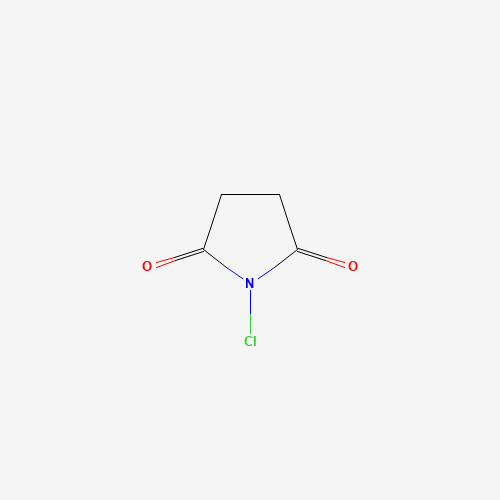
N-chlorosuccinimide is a five-membered cyclic dicarboximide compound having a chloro substituent on the nitrogen atom. It is a dicarboximide and a pyrrolidinone. It is functionally related to a succinimide.
科学粮草官-词典编辑部,修订于:2026-07-06
Toxicity
ToxicityFate Summary
ATMOSPHERIC FATE: According to a model of gas/particle partitioning of semivolatile organic compounds in the atmosphere(1), N-chlorosuccinimide, which has an estimated vapor pressure of 7.8X10⁻³ mm Hg at 25 °C(SRC), determined from a fragment constant method(2), is expected to exist solely as a vapor in the ambient atmosphere. Vapor-phase N-chlorosuccinimide is degraded in the atmosphere by reaction with photochemically-produced hydroxyl radicals(SRC); the half-life for this reaction in air is estimated to be 0.9 days(SRC), calculated from its rate constant of 1.9X10⁻¹¹ cu cm/molecule-sec at 25 °C(SRC) that was derived using a structure estimation method(3). N-Chlorosuccinimide contains chromophores that absorb at wavelengths >290 nm(4) and, therefore, may be susceptible to direct photo...
Soil Adsorption / Mobility
Using a structure estimation method based on molecular connectivity indices(1), the Koc of N-chlorosuccinimide can be estimated to be 3(SRC). According to a classification scheme(2), this estimated Koc value suggests that N-chlorosuccinimide is expected to have very high mobility in soil(SRC).
Environmental Bioconcentration
An estimated BCF of 3 was calculated in fish for N-chlorosuccinimide(SRC), using an estimated log Kow of -1.19(1) and a regression-derived equation(1. According to a classification scheme(2), this BCF suggests the potential for bioconcentration in aquatic organisms is low(SRC).
Volatilization from Water / Soil
The Henry's Law constant for N-chlorosuccinimide is estimated as 4.9X10⁻⁷ atm-cu m/mole(SRC) using a fragment constant estimation method(1). This Henry's Law constant indicates that N-chlorosuccinimide is expected to volatilize slowly from water surfaces(2). Based on this Henry's Law constant, the volatilization half-life from a model river (1 m deep, flowing 1 m/sec, wind velocity of 3 m/sec)(2) is estimated as 87 days(SRC). The volatilization half-life from a model lake (1 m deep, flowing 0.05 m/sec, wind velocity of 0.5 m/sec)(2) is estimated as 640 days(SRC). N-Chlorosuccinimide's Henry's Law constant indicates that volatilization from moist soil surfaces may occur(SRC). N-Chlorosuccinimide is not expected to volatilize from dry soil surfaces(SRC) based upon an estimated vapor press...
Environmental Abiotic Degradation
The rate constant for the vapor-phase reaction of N-chlorosuccinimide with photochemically-produced hydroxyl radicals has been estimated as 1.9X10⁻¹¹ cu cm/molecule-sec at 25 °C(SRC) using a structure estimation method(1). This corresponds to an atmospheric half-life of about 0.9 days at an atmospheric concentration of 5X10+5 hydroxyl radicals per cu cm(1). N-Chlorosuccinimide is expected to undergo hydrolysis in the environment due to the presence of functional groups that hydrolyze under environmental conditions(2). A quantitative chemical hydrolysis constant (K) of 6.6X10⁻⁵ has been reported(3). N-Chlorosuccinimide contains chromophores that absorb at wavelengths >290 nm(2) and, therefore, may be susceptible to direct photolysis by sunlight(SRC).
Artificial Pollution Sources
N-Chlorosuccinimide's production and use as a chlorinating agent in organic synthesis(1-3), bactericide(3) and to a lesser extent as a bleaching agent(4) may result in its release to the environment through various waste streams(SRC). It's use in disinfectants for drinking water(5) will result in its direct release to the environment; its former use in swimming pools(3) may have resulted in its direct release to the environment(SRC).
Probable Routes of Human Exposure
Occupational exposure to N-chlorosuccinimide may occur through inhalation and dermal contact with this compound at workplaces where N-chlorosuccinimide is produced or used. The general population may have been exposed to N-chlorosuccinimide through the use of some swimming pool disinfection products. (SRC)
Environmental Fate / Exposure Summary
N-Chlorosuccinimide's production and use as a chlorinating agent in organic synthesis, bactericide and bleaching agent may result in its release to the environment through various waste streams. If released to air, an estimated vapor pressure of 7.9X10⁻³ mm Hg at 25 °C indicates N-chlorosuccinimide will exist solely as a vapor in the atmosphere. Vapor-phase n-chlorosuccinimide will be degraded in the atmosphere by reaction with photochemically-produced hydroxyl radicals; the half-life for this reaction in air is estimated to be 0.9 days. N-Chlorosuccinimide contains chromophores that absorb at wavelengths >290 nm and, therefore, may be susceptible to direct photolysis by sunlight. If released to soil, N-chlorosuccinimide is expected to have very high mobility based upon an estimated Koc...
Interactions
The lethal activity of Clostridium perfringens epsilon toxin was inactivated by N-bromosuccinimide and N-chlorosuccinimide. Amino acid analysis of N-bromosuccinimide-treated prototoxin indicated that the one tryptophan residue present in the protein was abolished, and methionine and tyrosine reduced markedly. N-Chloro-succinimide-treated prototoxin lost completely both tryptophan and methionine residues. The toxin was not inactivated by chloramine T, but all of methionine residues present in the protein was found to be oxidized by the agent. The data suggest that the one tryptophan residue present in the toxin is important for the lethal activity.
Adverse Effects
Toxic Pneumonitis - Inflammation of the lungs induced by inhalation of metal fumes or toxic gases and vapors.
Toxicity Summary
IDENTIFICATION AND USE: N-Chlorosuccinimide is used as a chlorinating agent, disinfectant for swimming pools, and bactericide. It is also used as titrant in microdetermination of hydrazine salts and derivatives. HUMAN STUDIES: There are no data available. ANIMAL STUDIES: The effect of N-chlorosuccinimide was studied on electrophysiological responses in the hippocampal slice isolated from the brains of guinea pigs. It decreased a population postsynaptic potential in a dose-dependent manner. The effect of N-chlorosuccinimide on the contractile responses to electrical field stimulation and acetylcholine was studied in isolated rat tracheal smooth muscle segments. Active staining showed that both acetylcholinesterase (EC 3.1.1.7) and butyrylcholinesterase (EC 3.1.1.8) activities were found...
Non-Human Toxicity Values
MLD orally in rats: 2.7 g/kg
Non-Human Toxicity Excerpts
/OTHER TOXICITY INFORMATION/ Exposure of protein kinase C to low concentrations of either N-chlorosuccinimide or hydrogen peroxide resulted in rapid and parallel loss of phosphotransferase activity and phorbol ester binding. ...
Antidote and Emergency Treatment
/SRP:/ Advanced treatment: Consider orotracheal or nasotracheal intubation for airway control in the patient who is unconscious, has severe pulmonary edema, or is in severe respiratory distress. Positive-pressure ventilation techniques with a bag valve mask device may be beneficial. Consider drug therapy for pulmonary edema ... . Monitor cardiac rhythm and treat arrhythmias if necessary ... . Start IV administration of D5W /SRP: "To keep open", minimal flow rate/. Use 0.9% saline (NS) or lactated Ringer's (LR) if signs of hypovolemia are present. For hypotension with signs of hypovolemia, administer fluid cautiously. Consider vasopressors if patient is hypotensive with a normal fluid volume. Watch for signs of fluid overload ... . Use proparacaine hydrochloride to assist eye irrigation...









