


 一键配货
一键配货
化合物详情
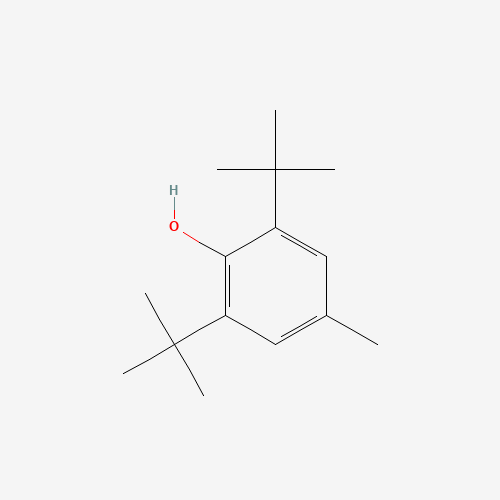
CAS128-37-0
分子式C15H24O
分子量220.35 g/mol g/mol
危化品
Physical Description | Butylated hydroxytoluene is a white crystalline solid. (NTP, 1992)
科学粮草官-词典编辑部,修订于:2026-07-06
Toxicity
ToxicityBody Burden
2,6-Di-t-butyl-p-cresol was detected not quantified in 1 of 12 expired air samples from nine residents of Bayonne and Elizabeth, NJ and 3 volunteers in Research Triangle Park, NC, collected between July and December 1980(1).
Ecotoxicity Values
USDA APHIS Chemical Effects: collection=usda_chemeffect&query_type=synonym&query='^128-37-0$'
Fate Summary
ATMOSPHERIC FATE: According to a model of gas/particle partitioning of semivolatile organic compounds in the atmosphere(1), 2,6-di-t-butyl-p-cresol, which has a vapor pressure of 5.16X10⁻³ mm Hg at 25 °C(2), is expected to exist solely as a vapor in the ambient atmosphere. Vapor-phase 2,6-di-t-butyl-p-cresol is degraded in the atmosphere by reaction with photochemically-produced hydroxyl radicals(SRC); the half-life for this reaction in air is estimated to be 0.6 days(SRC), calculated from its rate constant of 1.8X10⁻¹¹ cu cm/molecule-sec at 25 °C(SRC) that was derived using a structure estimation method(3). 2,6-Di-t-butyl-p-cresol absorbs at wavelengths >290 nm(4) and, therefore, may be susceptible to direct photolysis by sunlight(SRC).
Soil Adsorption / Mobility
Using a structure estimation method based on molecular connectivity indices(1), the Koc of 2,6-di-t-butyl-p-cresol can be estimated to be 1.5X10+4(SRC). According to a classification scheme(2), this estimated Koc value suggests that 2,6-di-t-butyl-p-cresol is expected to be immobile in soil.
Environmental Biodegradation
AEROBIC: 2,6-Di-t-butyl-p-cresol, present at 50 mg/L, reached 4.5% of its theoretical BOD in 4 weeks using a sludge inocula at 50 ppm(1). Using a Kodaira (sandy clay loam; pH 5.5, 31% sand, 40% silt, 29% clay; 15.3% organic matter; Tokoyo), Azuchi (light clay; pH 6.3, 65% sand, 18% silt, 17% clay; 2.5% organic matter; Shiga Pref) and Takarazuka (sandy loam; pH 7.0, 95% sand, 3% silt, 2% clay; 2.7% organic matter; Hyogo Pref) soils in Japan, 14C-labeled 2,6-di-t-butyl-p-cresol was degraded 57.3, 55.8 and 48.4% degraded, respectively, after 24 days(2).
Environmental Bioconcentration
BCF values 330-1800, 230-2500 and 220-2800 were measured for 2,6-di-t-butyl-p-cresol present at 5, 50 and 500 ppb, respectively, using rice fish (Cyprinus carpio) which were exposed over a 6 to 8-week period(1). According to a classification scheme(2), these BCF values suggest that bioconcentration in aquatic organisms is high to very high(SRC), provided the compound is not metabolized by the organism(SRC).
Volatilization from Water / Soil
The Henry's Law constant for 2,6-di-t-butyl-p-cresol is estimated as 2.5X10⁻³ atm-cu m/mole(SRC) using a fragment constant estimation method(1). Based on this Henry's Law constant, the volatilization half-life from a model river (1 m deep, flowing 1 m/sec, wind velocity of 3 m/sec)(2) is estimated as 5 hours(SRC). The volatilization half-life from a model lake (1 m deep, flowing 0.05 m/sec, wind velocity of 0.5 m/sec)(2) is estimated as 6 days(SRC). However, volatilization from water surfaces is expected to be attenuated by adsorption to suspended solids and sediment in the water column. The volatilization half-life from a model pond is about 120 days when adsorption is considered(3). 2,6-Di-t-butyl-p-cresol's Henry's Law constant indicates that volatilization from moist soil surfaces m...
Environmental Abiotic Degradation
The rate constant for the vapor-phase reaction of 2,6-di-t-butyl-p-cresol with photochemically-produced hydroxyl radicals has been estimated as 1.8X10⁻¹¹ cu cm/molecule-sec at 25 °C(SRC) using a structure estimation method(1). This corresponds to an atmospheric half-life of about one days at an atmospheric concentration of 5X10+5 hydroxyl radicals per cu cm(1). 2,6-Di-t-butyl-p-cresol is not expected to undergo hydrolysis in the environment due to the lack of functional groups that hydrolyze under environmental conditions(2). 2,6-Di-t-butyl-p-cresol absorbs UV light at wavelengths >290 nm(3) and, therefore, maybe susceptible to direct photolysis by sunlight(SRC). 14C-Labelled 2,6-di-t-butyl-p-cresol photodegraded to approximately 6% in 30 days in distilled water. However, 2,6-di-t-butyl...
Environmental Water Concentrations
SEAWATER: 2,6-Di-t-butyl-p-cresol was detected, not quantified in water samples from the coasts of Barcelona and Vilanova-Sitges, and in La Pineda, beach, Spain, collected from March 1985 - March 1986(1).
Food Survey Values
2.6-Di-t-butyl-p-cresol was detected in raw beef volatiles (volatile fraction 7.82%)(1). It was detected, not quantified in volatiles from roasted filbrets(2).
Ecotoxicity Excerpts
/AQUATIC SPECIES/ The aim of the present study was to test the effects of butylated hydroxytoluene (BHT) on the cryopreservation of common carp spermatozoa. ... After sampling, common carp spermatozoa were diluted with an extender composed of modified Kurokura's extender, 10% DMSO, and 10% egg yolk containing 0.0001, 0.001, 0.01, 0.1, 1, 2.5, 5, or 10 mM BHT and subsequently frozen in liquid nitrogen. The post-thaw spermatozoa characteristics (i.e., progressive motility percentage (%), duration of progressive motility (s), fertilization rate (%), and eyed-eggs rate (%)) were evaluated and compared with those of the control group. There were significant increases in the percentage of progressive motility and the duration of progressive motility at the concentrations of 0.1 and 0.001 mM B...
Effluent Concentrations
2,6-Di-t-butyl-p-cresol was present at 2.53 and 0.61 ug/L in the influent and effluent respectively, of the Kaellby Sewage Treatment Plant on the Hoje River, Sweden, representing a removal efficiency of 76%. Sampling was conducted on October 21, 2002(1). The compound was detected at <2800 ng/L in agricultural runoff from vegetable fields irrigated with treated wastewater effluent. Fields were located in the Callaguas Creek watershed, Ventura Co, southern California and sampled from July 1999 - April 2000(2).
ICSC Environmental Data
The substance is harmful to aquatic organisms.
Atmospheric Concentrations
INDOOR: 2,6-Di-t-butyl-p-cresol was detected in 50% of samples of indoor air from 26 houses in Helsinki, Finland at a low relative occurrence(1).
Artificial Pollution Sources
2,6-Di-t-butyl-p-cresol's production and use as an antioxidant(1) for food, animal feed, petroleum products, synthetic rubbers, plastics, animal and vegetable oils, soaps, as well as an antiiskinning agent in paints and inks(2) and in aviation gasoline(3) may result in its release to the environment through various waste streams(SRC).
Probable Routes of Human Exposure
NIOSH (NOES Survey 1981-1983) has statistically estimated that 591,238 workers (163,774 of these are female) were potentially exposed to 2,6-di-t-butyl-p-cresol in the US(1). Occupational exposure to 2,6-di-t-butyl-p-cresol may occur through inhalation and dermal contact with this compound at workplaces where 2,6-di-t-butyl-p-cresol is produced or used. 2,6-Di-t-butyl-p-cresol was detected not quantified in 1 of 8 breathing zone samples from Bayonne/ Elizabeth, NJ, collected between July and December 1980(2). Monitoring data indicate that the general population may be exposed to 2,6-di-t-butyl-p-cresol via inhalation of ambient air, ingestion of food and drinking water, and dermal contact with consumer products containing 2,6-di-t-butyl-p-cresol(SRC).
Other Environmental Concentrations
2,6-Di-t-butyl-p-cresol was detected in emissions from 10 of 44 tested lacquers and foils used for furniture coatings(1). The compound was present at concentrations of 54.1 ug/cu m in the air from a new parked motor vehicle; it was not detected in air from a parked used vehicle(2).
Environmental Fate / Exposure Summary
2,6-Di-t-butyl-p-cresol's production and use as an antioxidant for food, animal feed, petroleum products, synthetic rubbers, plastics, animal and vegetable oils, soaps, as well as an antiiskinning agent in paints and inks and in aviation gasoline may result in its release to the environment through various waste streams. If released to air, a vapor pressure of 5.16X10⁻³ mm Hg at 25 °C indicates 2,6-di-t-butyl-p-cresol will exist solely as a vapor in the atmosphere. Vapor-phase 2,6-di-t-butyl-p-cresol will be degraded in the atmosphere by reaction with photochemically-produced hydroxyl radicals; the half-life for this reaction in air is estimated to be one day. 2,6-Di-t-butyl-p-cresol absorbs UV light at wavelengths >290 nm and, therefore, may be susceptible to direct photolysis by sunli...
Symptoms
irritation eyes, skin; In Animals: decreased growth rate, increased liver weight
Treatment
For acute exposure: EYES: irrigate opened eyes for several minutes under running water. INGESTION: do not induce vomiting. Rinse mouth with water (never give anything by mouth to an unconscious person). Seek immediate medical advice. SKIN: should be treated immediately by rinsing the affected parts in cold running water for at least 15 minutes, followed by thorough washing with soap and water. If necessary, the person should shower and change contaminated clothing and shoes, and then must seek medical attention. INHALATION: supply fresh air. If required provide artificial respiration.
Target Organs
Eyes, skin
Health Effects
BHT is of low acute toxicity. Acute exposure to BHT can cause coughs and sore throat (inhalation), redness on the skin (via contact) and abdominal pain, confusion, dizziness and nausea (via ingestion). Long-term exposure to high doses of BHT is toxic in mice and rats, causing liver, thyroid and kidney problems and affecting lung function and blood coagulation. BHT can act as a tumour promoter in certain situations (A15353) although it is not a genotoxic carcinogen. Limited evidence suggests that high doses of BHT may mimic estrogen (A15354), the primary female sex hormone, and prevent expression of male sex hormones, resulting in adverse reproductive affects. On chronic oral exposure of rats, liver and thyroid are the main targets. Doses above 25 mg/kg bw/day BHT resulted in thyroid hyp...
Adverse Effects
ACGIH Carcinogen - Not Classifiable.
Exposure Routes
Ingestion; Inhalation
Toxicity Summary
BHT is metabolized to quinone methides (QMs) which are responsible for promoting tumor formation in many animal models. One example of a QM is 2,6-di-tert-butyl-4-methylenecyclohexa-2,5-dienone (BHT-QM). QMs are strongly electrophilic and readily form adducts with proteins. Some of the QM targets include redox proteins such as glutathione S-transferase P1 (GST-P1), peroxiredoxin 6 (Prx6), Cu,Zn-superoxide dismutase (SOD1), carbonyl reductase, and selenium-binding protein 1, which have direct or indirect antioxidant functions. (A15087, A15355). The modification of these proteins leads to decreased cellular protection from electrophiles and oxidants. Alkylation also may interfere with GSTP1 regulation of stress kinases, thereby influencing phosphorylation and cell growth. BHT also binds t...
Minimum Risk Level
25 mg/kg/day for thyroid and liver damage. 100 mg/kg/day for cancer.
Average Daily Intake
The estimated average daily intake does not exceed a few milligrams/day or approximately 0/2 mg/kg body wieght(1).
RAIS Toxicity Values
Oral Slope Factor Reference: PPRTV Current
Human Toxicity Excerpts
/SIGNS AND SYMPTOMS/ Potential symptoms of overexposure are irritation of eyes and skin.
Acceptable Daily Intakes
0-0.5 MG/KG BODY WT
Carcinogen Classification
3, not classifiable as to its carcinogenicity to humans. (L135)
1 or Cancer Risk Level 1E-06
Fraction of Contaminant Absorbed Dermally from Soil: 0.1
Evidence for Carcinogenicity
A4; Not classifiable as a human carcinogen.
Antidote and Emergency Treatment
/SRP:/ Advanced treatment: Consider orotracheal or nasotracheal intubation for airway control in the patient who is unconscious, has severe pulmonary edema, or is in severe respiratory distress. Positive-pressure ventilation techniques with a bag-valve-mask device may be beneficial. Consider drug therapy for pulmonary edema ... . Monitor cardiac rhythm and treat arrhythmias if necessary ... . Start IV administration of D5W TKO. Use 0.9% saline (NS) or lactated Ringer's (LR) if signs of hypovolemia are present. For hypotension with signs of hypovolemia, administer fluid cautiously. Consider vasopressors if patient is hypotensive with a normal fluid volume. Watch for signs of fluid overload ... . Administer 1% solution methylene blue if patient is symptomatic with severe hypoxia, cyanosis...
Hazard Quotient Level 3 or Cancer Risk Level 1E-04
Fraction of Contaminant Absorbed Dermally from Soil: 0.1









