

 一键配货
一键配货
化合物详情
CAS128-39-2
分子式C14H22O
分子量206.33 g/mol g/mol
危化品
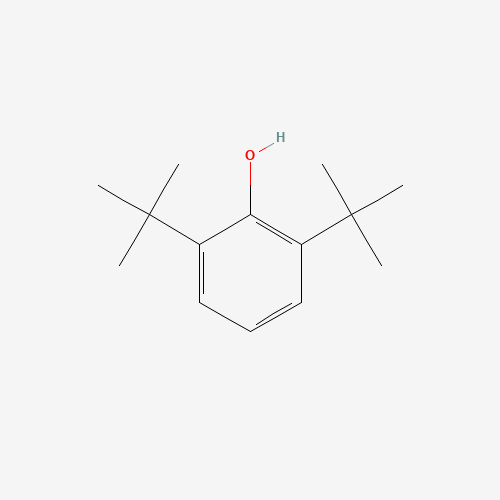
Physical Description | 2,6-di-tert-butylphenol appears as odorless colorless to light yellow solid or liquid. Floats on water. Freezing point is 97 °F. (USCG, 1999)
科学粮草官-词典编辑部,修订于:2026-07-06
Toxicity
ToxicityFate Summary
ATMOSPHERIC FATE: According to a suggested classification scheme(1), an estimated vapor pressure of 7.3X10⁻³ mm Hg at 25 °C(2,SRC) indicates that 2,6-di-tert-butylphenol will mainly exist in the vapor phase in the ambient atmosphere. Vapor-phase 2,6-di-tert-butylphenol is degraded in the atmosphere by reaction with photochemically produced hydroxyl radicals(SRC); the half-life for this reaction in air is estimated to be about 7.8 hours(3,SRC).
Soil Adsorption / Mobility
A Koc of 3600 was measured in river sediment(1). The Koc of 2,6-di-tert-butylphenol is estimated as approximately 11,000(SRC), using an experimental log Kow of 4.92(2) and a regression-derived equation(3,SRC). According to a recommended classification scheme(4), these Koc values suggest that 2,6-di-tert-butylphenol will have slight to no mobility in soil(SRC). Following 5 days incubation, 31.9% of the initial concentration of 2,6-di-tert-butylphenol was present in the non-extractable residue fraction in sludge(5).
Environmental Biodegradation
Conversion of 1.1% of the initial concentration of 2,6-di-tert-butylphenol (50 ug) (a further 44.9% was metabolized, but not to completion)(1), 3.5%(2), and 7.7%(3) of the parent compound to CO2 by an activated sludge inoculum was reported over a 5 day time period.
Environmental Bioconcentration
Chlorella, a green algae, had a measured bioaccumulation factor of 800 after exposure to 50 ug/L 2,6-di-tert-butylphenol for 24 hours(1). In fish (Golden Orfe), a bioaccumulation factor of 660 was measured following exposure to 37 ug/L 2,6-di-tert-butylphenol for 3 days(2). An estimated BCF value of 3230 was calculated for 2,6-di-tert-butylphenol(SRC), using an experimental log Kow of 4.92(3) and a recommended regression-derived equation(4). According to a recommended classification scheme(5), these BCF values indicate that bioconcentration in aquatic organisms is an important fate process(SRC).
Volatilization from Water / Soil
The Henry's Law constant for 2,6-di-tert-butylphenol is estimated as 3.15X10⁻⁶ atm-cu m/mole(SRC) using a fragment constant estimation method(1). This value indicates that 2,6-di-tert-butylphenol will volatilize from water surfaces(2,SRC). Based on this Henry's Law constant, the volatilization half-life from a model river (1 m deep, flowing 1 m/sec, wind velocity of 3 m/sec) is estimated as approximately 17 hours(2,SRC). The volatilization half-life from a model lake (1 m deep, flowing 0.05 m/sec, wind volocity of 0.5 m/sec) is estimated as approximately 130 days(2,SRC). Following 5 days incubation with sludge, 7.7% of the initial 2,6-di-tert-butylphenol had volatilized(3). 2,6-Di-tert-butylphenol's Henry's Law constant(1,SRC) indicates that volatilization from moist soil may occur slow...
Environmental Abiotic Degradation
The rate constant for the vapor-phase reaction of 2,6-di-tert-butylphenol with photochemically produced hydroxyl radicals has been estimated as 4.9X10⁻¹¹ cu cm/molecule-sec at 25 °C(SRC) using a structure estimation method(1,SRC). This corresponds to an atmospheric half-life of about 7.8 hours at an atmospheric concentration of 5X10+5 hydroxyl radicals per cu cm(1,SRC). 29.5% of the applied amount of 2,6-di-tert-butylphenol was photomineralized after 17 hours of irradiation using the GSF test(absorbed phase, artificial light source)(2). 2,6-Di-tert-butylphenol was readily oxidized to 2,6-di-tert-butylbenzoquinone in river water(3). 2,6-Di-tert-butylphenol is also oxidized to 2,6-di-tert-butylbenzoquinone in river sediment at the depth where oxidizing conditions changes to reducing condi...
Environmental Water Concentrations
SURFACE WATER: 2,6-Di-tert-butylphenol was detected in Po River, Italy at unreported concentrations(1). Rhine River water was collected in The Netherlands delta in 1989; 2,6-di-tert-butylphenol was detected at 3 of 6 locations (concentrations ranged from 0.027-0.053 ug/L)(2). River water collected downstream from a chemical manufacturing plant in Rhode Island contained 2,6-di-tert-butylphenol at concentrations of 0.001-0.006 ppm(3).
Effluent Concentrations
Wastewater from a chemical manufacturing plant in Rhode Island contained 2,6-di-tert-butylphenol at concentrations of 0.6-0.8 ppm(1).
ICSC Environmental Data
The substance is very toxic to aquatic organisms. Bioaccumulation of this chemical may occur along the food chain, for example in fish.
Artificial Pollution Sources
2,6-Di-tert-butylphenol's production and use as an antioxidant in oils, petrol, and aviation fuels(1) or as a chemical intermediate(2) may result in its release to the environment through various waste streams(SRC).
Sediment/Soil Concentrations
2,6-Di-tert-butylphenol was detected in sediment cores taken downstream from a chemical manufacturing plant in Rhode Island(1). Two cores taken from near the plant had concentrations of this compound from 0.5 to 180 ppm. Two cores taken 1 km downstream had concentrations ranging from 4-760 ppm(1).
Probable Routes of Human Exposure
NIOSH (NOES Survey 1981-1983) has statistically estimated that 9624 workers (245 of these are female) are potentially exposed to 2,6-di-tert-butylphenol in the USA(1).
Environmental Fate / Exposure Summary
2,6-Di-tert-butylphenol's production and use as an antioxidant in oils, petrol, and aviation fuels or as a chemical intermediate may result in its release to the environment through various waste streams. If released to the atmosphere, 2,6-di-tert-butylphenol should mainly exist in the vapor phase based on an estimated vapor pressure of 7.3X10⁻³ mm Hg. Vapor-phase 2,6-di-tert-butylphenol is degraded in the atmosphere by reaction with photochemically produced hydroxyl radicals with an estimated half-life of about 7.8 hours. A measured Koc of 3600 indicates that 2,6-di-tert-butylphenol will have slight mobility in soil. It may volatilize from moist soils, based on its estimated Henry's Law constant. Photooxidation may be an important fate process on the soil surface. Based on limited data...
Symptoms
Ingestion Exposure: Sore throat. Burning sensation in the throat and chest.
Non-Human Toxicity Values
LD50 MOUSE ORAL 2995 MG/KG
Non-Human Toxicity Excerpts
PROSTAGLANDIN E FORMATION BY RABBIT KIDNEY SLICES WAS INHIBITED BY 2,6-DI-TERT-BUTYLPHENOL, SUGGESTING A REQUIREMENT FOR LIPID PEROXIDASE IN ACTIVITY OF PROSTAGLANDIN CYCLOOXYGENASE.
USGS Health-Based Screening Levels for Evaluating Water-Quality
Reference: Smith, C.D. and Nowell, L.H., 2024. Health-Based Screening Levels for evaluating water-quality data (3rd ed.). DOI:10.5066/F71C1TWP