


 一键配货
一键配货
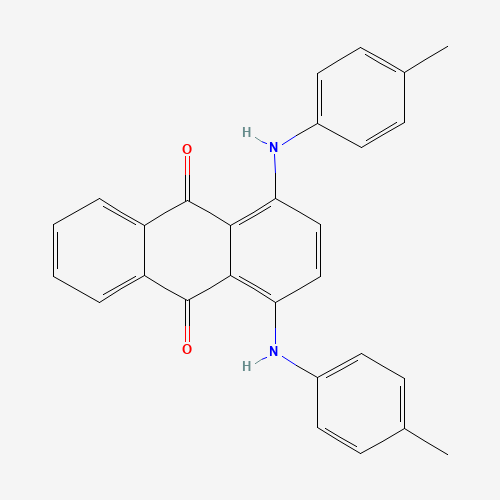
化合物详情
CAS128-80-3
分子式C28H22N2O2
分子量418.49 g/mol
非危品
科学粮草官-词典编辑部,修订于:2026-07-06
Toxicity
ToxicityFate Summary
ATMOSPHERIC FATE: According to a model of gas/particle partitioning of semivolatile organic compounds in the atmosphere(1), D&C Green No. 6, which has an estimated vapor pressure of 7.0X10⁻¹³ mm Hg at 25 °C(SRC), determined from a fragment constant method(2), is expected to exist solely in the particulate phase in the ambient atmosphere. Particulate-phase D&C Green No. 6 may be removed from the air by wet or dry deposition(SRC). D&C Green No. 6 absorbs light at wavelengths 644 nm(3), and therefore may be susceptible to direct photolysis by sunlight(SRC).
Soil Adsorption / Mobility
Using a structure estimation method based on molecular connectivity indices(1), the Koc of D&C Green No. 6 can be estimated to be 4.8X10+6(SRC). According to a classification scheme(2), this estimated Koc value suggests that D&C Green No. 6 is expected to be immobile mobility in soil.
Environmental Bioconcentration
An estimated BCF of 500 was calculated in fish for D&C Green No. 6(SRC), using an estimated log Kow of 8.69(1) and a regression-derived equation(2). According to a classification scheme(3), this BCF suggests the potential for bioconcentration in aquatic organisms is high(SRC), provided the compound is not metabolized by the organism(SRC).
Volatilization from Water / Soil
The Henry's Law constant for D&C Green No. 6 is estimated as 1.5X10⁻¹⁶ atm-cu m/mole(SRC) using a fragment constant estimation method(1). This Henry's Law constant indicates that D&C Green No. 6 is expected to be essentially nonvolatile from water and moist soil surfaces(2). D&C Green No. 6 is not expected to volatilize from dry soil surfaces(SRC) based upon an estimated vapor pressure of 7.0X10⁻¹³ mm Hg(SRC), determined from a fragment constant method(3).
Environmental Abiotic Degradation
D&C Green No. 6 is not expected to undergo hydrolysis in the environment due to the lack of functional groups that hydrolyze under environmental conditions(1). D&C Green No. 6 absorbs light at wavelengths 644 nm(2), and therefore may be susceptible to direct photolysis by sunlight(SRC). The compound is susceptible to photodegradation depending on the surrounding conditions(3). D&C Green No. 6 was shown to be susceptible to photolysis on soil, with two photoproducts detected, not identified(4).
Ecotoxicity Excerpts
/AQUATIC SPECIES/ Solvent Yellow 33 and a Solvent Green 3 mixture (30:70 mixture of Solvent Yellow 33 and Solvent Green 3) were not acutely toxic to seven of nine freshwater species when tested at the solubility limits of the dyes in freshwater. A solubility limit solution of the Solvent Green 3 mixture killed 50% of the rainbow trout tested for 96 hr but was non-toxic when diluted by 50%. Both dyes caused a reduction in green algal growth at solubility limits. The Solvent Green 3 mixture was the most detrimental causing a 98-99% reduction in growth after 5 days of exposure.
Artificial Pollution Sources
D&C Green No. 6's production and use in coloring fats, oils, waxes, hydrocarbon solvents, hydrocarbon-base wood stains, cellulose acetate, polystyrene and soap, in the preparation of oleic or stearic rotogravure inks(1) and for sutures(2) may result in its release to the environment through various waste streams(SRC). Its use in smoke formulations for military communication grenades(3) will result in its direct release to the environment(SRC).
Probable Routes of Human Exposure
NIOSH (NOES Survey 1981-1983) has statistically estimated that 55,064 workers (41,703 of these were female) were potentially exposed to D&C Green No. 6 in the US(1). Occupational exposure to D&C Green No. 6 may occur through inhalation and dermal contact with this compound at workplaces where D&C Green No. 6 is produced or used. Use data indicate that the general population may be exposed to D&C Green No. 6 via dermal contact with consumer products containing D&C Green No. 6(SRC).
Environmental Fate / Exposure Summary
D&C Green No. 6's production and use in coloring fats, oils, waxes, hydrocarbon solvents, hydrocarbon-base wood stains, cellulose acetate, polystyrene and soap, in the preparation of oleic or stearic rotogravure inks and for sutures may result in its release to the environment through various waste streams. Its use in smoke formulations for military communication grenades will result in its direct release to the environment. If released to air, an estimated vapor pressure of 7.0X10⁻¹³ mm Hg at 25 °C indicates D&C Green No. 6 will exist solely in the particulate phase in the atmosphere. Particulate-phase D&C Green No. 6 will be removed from the atmosphere by wet or dry deposition. D&C Green No. 6 absorbs light at wavelengths 644 nm, and therefore may be susceptible to direct photolysis b...
Non-Human Toxicity Values
LD50 Rabbit oral >10 g/kg bw
Non-Human Toxicity Excerpts
/GENOTOXICITY/ Solvent green 3 is not mutagenic in the Salmonella typhimurium strains with or without activation, according to one report, but ... positive results /were reported/ in both the S. typhimurium assay and the thymidine kinase locus mouse lymphoma assay.
Antidote and Emergency Treatment
/SRP:/ Advanced treatment: Consider orotracheal or nasotracheal intubation for airway control in the patient who is unconscious, has severe pulmonary edema, or is in severe respiratory distress. Positive-pressure ventilation techniques with a bag valve mask device may be beneficial. Consider drug therapy for pulmonary edema ... . Consider administering a beta agonist such as albuterol for severe bronchospasm ... . Monitor cardiac rhythm and treat arrhythmias as necessary ... . Start IV administration of D5W /SRP: "To keep open", minimal flow rate/. Use 0.9% saline (NS) or lactated Ringer's if signs of hypovolemia are present. For hypotension with signs of hypovolemia, administer fluid cautiously. Watch for signs of fluid overload ... . Treat seizures with diazepam or lorazepam ... . Use...









