

 一键配货
一键配货
化合物详情
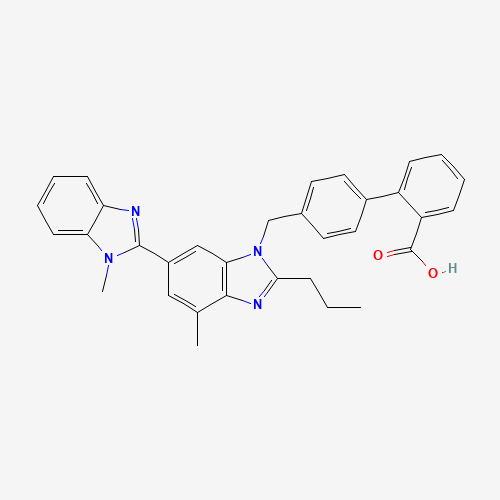
CAS144701-48-4
分子式C33H30N4O2
分子量514.62 g/mol g/mol
危化品
Telmisartan is a member of the class of benzimidazoles used widely in the treatment of hypertension. It has a role as an EC 3.4.15.1 (peptidyl-dipeptidase A) inhibitor, an antihypertensive agent, a xenobiotic, an angiotensin receptor antagonist and an environmental contaminant. It is a carboxybiphenyl, a member of benzimidazoles and a member of biphenyls.
科学粮草官-词典编辑部,修订于:2026-07-06
Toxicity
ToxicityMilk Concentrations
EXPERIMENTAL: It is not known whether telmisartan is excreted in human milk, but telmisartan was shown to be present in the milk of lactating rats.
Effect Level
collection=toxvaldb&kind=^EL$
Interactions
Co-administration of telmisartan 80 mg once daily and ramipril 10 mg once daily to healthy subjects increases steady-state Cmax and AUC of ramipril 2.3- and 2.1-fold, respectively, and Cmax and AUC of ramiprilat 2.4- and 1.5-fold, respectively. In contrast, Cmax and AUC of telmisartan decrease by 31% and 16%, respectively. When co-administering telmisartan and ramipril, the response may be greater because of the possibly additive pharmacodynamic effects of the combined drugs, and also because of the increased exposure to ramipril and ramiprilat in the presence of telmisartan. Concomitant use of Micardis and ramipril is not recommended.
Hepatotoxicity
Likelihood score: E* (Unproved but suspected rare cause of clinically apparent liver injury).
Toxicity Summary
IDENTIFICATION AND USE: Telmisartan is a white to slightly yellowish solid that is formulated into oral tablets. Telmisartan is an angiotensin II type 1 (AT1) receptor antagonist. It is used alone or in combination with other classes of antihypertensive in the management of hypertension. It is also indicated for reduction of the risk of myocardial infarction, stroke, or death from cardiovascular causes in patients 55 years of age or older at high risk of developing major cardiovascular events who are unable to take ACE inhibitors. HUMAN EXPOSURE AND TOXICITY: The most likely manifestations of telmisartan overdose include hypotension, dizziness and tachycardia; bradycardia could occur from parasympathetic (vagal) stimulation. The use of telmisartan during pregnancy is contraindicated. Wh...
Human Toxicity Excerpts
/OTHER TOXICITY INFORMATION/ In July 2010, the US Food and Drug Administration (FDA) initiated a safety review of angiotensin II receptor antagonists after a published meta-analysis suggested a possible association between the use of these agents and an increased risk of cancer. The meta-analysis, which combined cancer-related findings from 5 randomized, controlled trials in over 60,000 patients, found a modest but significant increase in the risk of new cancer occurrence in patients receiving an angiotensin II receptor antagonist (mostly telmisartan) compared with those in control groups (7.2 versus 6%, respectively; risk ratio 1.08). However, because of several limitations of the study (e.g., trials included in the meta-analysis were not specifically designed to evaluate cancer outcom...
Drug Induced Liver Injury
References: DOI:10.1016/j.drudis.2019.09.022
Non-Human Toxicity Excerpts
/OTHER TOXICITY INFORMATION/ ... In the present study, ... the effect of the angiotensin II type 1 receptor antagonist telmisartan on the development of NASH in a rat model /is examined/. Telmisartan, but not the angiotensin receptor antagonist valsartan, markedly attenuated hepatic steatosis, inflammation, and fibrosis in these rats. The quantitative parameters of steatosis, inflammation, and fibrosis were also ameliorated by treatment with telmisartan. Compared with telmisartan, the peroxisome proliferator-activated receptor-gamma agonist pioglitazone attenuated hepatic steatosis and fibrosis of the liver to a similar degree. However, telmisartan, but not pioglitazone, dramatically decreased both subcutaneous and visceral fat. In conclusion, these results indicated that telmisartan sh...
Populations at Special Risk
Use of drugs that act on the renin-angiotensin system during the second and third trimesters of pregnancy reduces fetal renal function and increases fetal and neonatal morbidity and death.
Antidote and Emergency Treatment
Treatment and supportive measures. Monitor blood pressure and heart rate for 6 hours after ingestion. If symptomatic or significant hypotension develops, observe for at least 24 hours. 1. If hypotension occurs, treat it with supine positioning and IV fluids. Vasopressors are rarely necessary. 2. Treat angioedema with usual measures (eg, diphenhydramine, corticosteroids) and discontinue the ACE inhibitors. Switching to an AR blocker may not be appropriate as angioedema has also been reported with these agents. 3. Treat hyperkalemia if it occurs. /Angiotensin blockers and ACE inhibitors/
Effects During Pregnancy and Lactation
◉ Effects on Lactation and Breastmilk