


 一键配货
一键配货
化合物详情
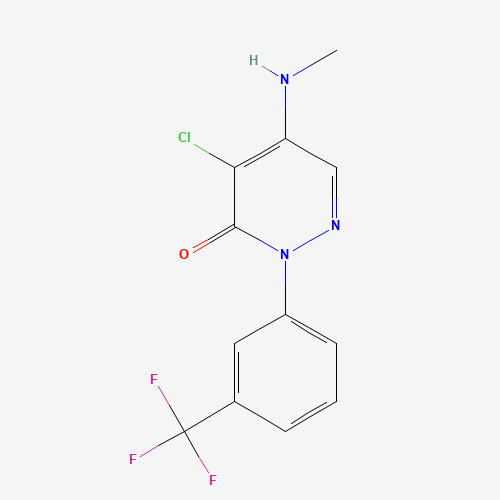
CAS27314-13-2
分子式C12H9ClF3N3O
分子量303.668 g/mol
非危品
Physical Description | Norflurazon appears as colorless odorless crystals. Non corrosive. Used as an herbicide.
科学粮草官-词典编辑部,修订于:2026-07-06
Toxicity
ToxicityEPA Ecotoxicity
Pesticide Ecotoxicity Data from EPA: 48
Soil Adsorption / Mobility
The trifluoromethyl group may enhance the mobility of norflurazon(1). Norflurazon adsorption increases, thereby decreasing mobility with increasing soil organic matter and clay content(2). Sorption of norflurazon on Candler fine sand increases with increasing ionic strength of electrolyte(3). Sorption of norflurazon also varies with the cation species in the electrolyte in the following order: Fe >> Al = Cu > K = Ca = Mg = Na(3). The adsorption isotherm of norflurazon appears to be curvilinear(4). It is suggested that the adsorption mechanism may be due primarily to hydrophobic association of the organic molecule with the soil organic matter surface(4). The sorption coefficient (0.63-2.2 mL/g in Citrus soils indicating weak to moderate binding to soil) is strongly related to organic C c...
Environmental Biodegradation
ANAEROBIC: Norflurazon has a reported biodegradation half-life of 8 months under anaerobic conditions(1).
Environmental Bioconcentration
An estimated BCF of 12 was calculated in fish for norflurazon(SRC), using a log Kow of 2.30(1) and a regression-derived equation(2). According to a classification scheme(3), this BCF suggests the potential for bioconcentration in aquatic organisms is low(SRC).
Volatilization from Water / Soil
The Henry's Law constant for norflurazon is estimated as 3.4X10⁻¹⁰ atm-cu m/mole(SRC) derived from its vapor pressure, 2.89X10⁻⁸ mm Hg(1), and water solubility, 33.7 mg/L(1). This Henry's Law constant indicates that norflurazon is expected to be essentially nonvolatile from water surfaces(2). Norflurazon is not expected to volatilize from dry soil surfaces(SRC) based upon its vapor pressure(1).
Environmental Abiotic Degradation
The rate constant for the vapor-phase reaction of norflurazon with photochemically-produced hydroxyl radicals has been estimated as 9.93X10⁻¹² cu cm/molecule-sec at 25 °C(SRC) using a structure estimation method(1). This corresponds to an atmospheric half-life of about 39 hours at an atmospheric concentration of 5X10+5 hydroxyl radicals per cu cm(1). The rate constant for the vapor-phase reaction of norflurazon with ozone has been estimated as 1.6X10⁻¹⁶ cu cm/molecule-sec at 25 °C(SRC) that was derived using a structure estimation method(1). This corresponds to an atmospheric half-life of about 7 days at an atmospheric concentration of 7X10+11 ozone molecules per cu cm(2). Norflurazon is stable to hydrolysis in the environment(4) due to the lack of functional groups that hydrolyze under...
Environmental Water Concentrations
SURFACE WATER: In a study of the Mississippi River, norflurazon was detected in the Yazoo River (Mississippi) going into the Mississippi at concentrations of 0.3 ug/L, 0.15 ug/L and 0.32 ug/L for Jul-Aug, 1991, Oct-Nov, 1991, and Mar-Apr, 1992, respectively; in the Mississippi River below Vicksburg, MS - 0.2 ug/L, 0.3 ug/L and not detected for Jul-Aug, 1991, Oct-Nov, 1991, and Mar-Apr, 1992, respectively; 0.3 ug/L, 0.3 ug/L and 0.2 ug/L near St. Francisville, LA for Jul-Aug, 1991, Oct-Nov, 1991, and Mar-Apr, 1992, respectively; below Belle Chasse, LA 0.3 ug/L, 0.4 ug/L and not detected for Jul-Aug, 1991, Oct-Nov, 1991, and Mar-Apr, 1992, respectively(1). It is estimated that the annual mass transport of norflurazon in the dissolved phase from the Mississippi River into the Gulf of Mexic...
Artificial Pollution Sources
Norflurazon's production may result in its release to the environment through various waste streams; it's use as a herbicide(1) will result in its direct release to the environment(SRC).
Sediment/Soil Concentrations
SEDIMENT: Norflurazon was not detected in sediment samples from a survey of south Florida canals conducted from November 1991 to June 1995 (detection limit 10 ug/kg)(1).
Probable Routes of Human Exposure
Occupational exposure to norflurazon may occur through inhalation. Monitoring data indicate that the general population may be exposed to norflurazon via dermal contact with contaminated surface water. (SRC)
Other Environmental Concentrations
Norflurazon runoff following 3.8 cm of rainfall applied at 24 hours after application of both norflurazon and fluometuron as 0.4 kg active ingredient/ha from non-crop runoff trays with Bosket sandy loam soil at 1.1% slope was 6.0 mg/L of first liter of runoff, 4.4% of applied compounds(1). No loss was noted from crop-residue trays(1).
Environmental Fate / Exposure Summary
Norflurazon's production may result in its release to the environment through various waste streams; it's use as a herbicide will result in its direct release to the environment. If released to air, a vapor pressure of 2.89X10⁻⁸ mm Hg at 25 °C indicates norflurazon will exist in both the vapor and particulate phases in the atmosphere. Vapor-phase norflurazon will be degraded in the atmosphere by reaction with photochemically-produced hydroxyl radicals; the half-life for this reaction in air is estimated to be 39 hrs. Particulate-phase norflurazon will be removed from the atmosphere by wet or dry deposition. Norflurazon is primarily dissipated by photodegradation, with a direct photolysis half-life of less than 3 days in water, 12-15 days in soil. If released to soil, norflurazon is expe...
Target Organs
Hepatic
RAIS Toxicity Values
Oral Chronic Reference Dose Reference: OPP
Human Toxicity Excerpts
/CASE REPORTS/ This report concerned a 53 year old professional weed sprayer who was referred for patch testing. He had an acute episode that resembled sunburn and caused his eyes to almost completely close, followed several days later by urticaria like lesions. He had been using the Predict formulation of norflurazon around that time. Patch testing with Predict at 1.0% and 0.1% produced a ++ reaction at 2 and 4 days after dosing. Tests in 20 control subjects were negative. The concentration of norflurazon in the preparation was 78.6%, but information on inert ingredients was not available.
Carcinogen Classification
No indication of carcinogenicity to humans (not listed by IARC).
Non-Human Toxicity Values
LD50 Rat oral >8000 mg/kg
1 or Cancer Risk Level 1E-06
Fraction of Contaminant Absorbed Dermally from Soil: 0.1
Hazard Quotient Level 3 or Cancer Risk Level 1E-04
Fraction of Contaminant Absorbed Dermally from Soil: 0.1
USGS Health-Based Screening Levels for Evaluating Water-Quality
Reference: Smith, C.D. and Nowell, L.H., 2024. Health-Based Screening Levels for evaluating water-quality data (3rd ed.). DOI:10.5066/F71C1TWP









