


 一键配货
一键配货
化合物详情
CAS64091-91-4
分子式C10H13N3O2
分子量207.23 g/mol g/mol
危化品
4-(N-Nitrosomethylamino)-1-(3-pyridyl)1-butanone can cause cancer according to The World Health Organization's International Agency for Research on Cancer (IARC).
科学粮草官-词典编辑部,修订于:2026-07-06
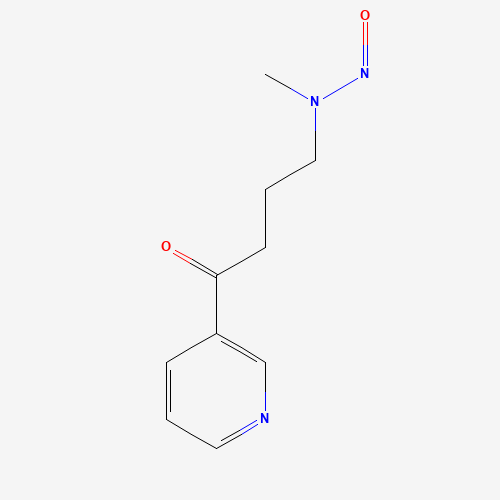
Toxicity
ToxicityBody Burden
4-(N-Nitrosomethylamino)-1-(3-pyridyl)-1-butanone is formed by oxidation and nitrosation of nicotine and is produced during the curing of tobacco and in smoking. 4-(N-Nitrosomethylamino)-1-(3-pyridyl)-1-butanone is extracted from snuff by the saliva of users, and as much as 0.2 g/g of saliva has been measured(1).
Fate Summary
ATMOSPHERIC FATE: According to a model of gas/particle partitioning of semivolatile organic compounds in the atmosphere(1), 4-(N-nitrosomethylamino)-1-(3-pyridyl)-1-butanone, which has an estimated vapor pressure of 6.8X10⁻⁵ mm Hg at 25 °C(SRC), determined from a fragment constant method(2), will exist in both the vapor and particulate phases in the ambient atmosphere. Vapor-phase 4-(N-nitrosomethylamino)-1-(3-pyridyl)-1-butanone is degraded in the atmosphere by reaction with photochemically-produced hydroxyl radicals(SRC); the half-life for this reaction in air is estimated to be 22 hours(SRC), calculated from its rate constant of 1.8X10⁻¹¹ cu cm/molecule-sec at 25 °C(SRC) that was derived using a structure estimation method(3). Particulate-phase 4-(N-nitrosomethylamino)-1-(3-pyridyl)-...
Soil Adsorption / Mobility
Using a structure estimation method based on molecular connectivity indices(1), the Koc of 4-(N-nitrosomethylamino)-1-(3-pyridyl)-1-butanone can be estimated to be 320(SRC). According to a classification scheme(2), this estimated Koc value suggests that 4-(N-nitrosomethylamino)-1-(3-pyridyl)-1-butanone is expected to have moderate mobility in soil.
Environmental Bioconcentration
An estimated BCF of 3.2 was calculated in fish for 4-(N-nitrosomethylamino)-1-(3-pyridyl)-1-butanone(SRC), using an estimated log Kow of 0.0(1) and a regression-derived equation(2). According to a classification scheme(3), this BCF suggests the potential for bioconcentration in aquatic organisms is low(SRC).
Volatilization from Water / Soil
The Henry's Law constant for 4-(N-nitrosomethylamino)-1-(3-pyridyl)-1-butanone is estimated as 8.3X10⁻¹⁴ atm-cu m/mole(SRC) using a fragment constant estimation method(1). This Henry's Law constant indicates that 4-(N-nitrosomethylamino)-1-(3-pyridyl)-1-butanone is expected to be essentially nonvolatile from water surfaces(2). 4-(N-Nitrosomethylamino)-1-(3-pyridyl)-1-butanone's Henry's Law constant indicates that volatilization from moist soil surfaces will not occur(SRC). 4-(N-Nitrosomethylamino)-1-(3-pyridyl)-1-butanone is not expected to volatilize from dry soil surfaces(SRC) based upon an estimated vapor pressure of 6.7X10⁻⁵ mm Hg(SRC), determined from a fragment constant method(3).
Environmental Abiotic Degradation
The rate constant for the vapor-phase reaction of 4-(N-nitrosomethylamino)-1-(3-pyridyl)-1-butanone with photochemically-produced hydroxyl radicals has been estimated as 1.8X10⁻¹¹ cu cm/molecule-sec at 25 °C(SRC) using a structure estimation method(1). This corresponds to an atmospheric half-life of about 22 hours at an atmospheric concentration of 5X10+5 hydroxyl radicals per cu cm(1). 4-(N-Nitrosomethylamino)-1-(3-pyridyl)-1-butanone is not expected to undergo hydrolysis in the environment due to the lack of functional groups that hydrolyze under environmental conditions(2). 4-(N-Nitrosomethylamino)-1-(3-pyridyl)-1-butanone does not contain chromophores that absorb at wavelengths >290 nm(2) and therefore is not expected to be susceptible to direct photolysis by sunlight(SRC).
Artificial Pollution Sources
4-(N-Nitrosomethylamino)-1-(3-pyridyl)-1-butanone's formation during curing of tobacco leaves, and subsequent presence in cigarette smoke and snuff(1), formation during various manufacturing processes(2), and limited application as a laboratory reagent(3) may result in its release into the environment through various waste streams(SRC).
Probable Routes of Human Exposure
4-(N-Nitrosomethylamino)-1-(3-pyridyl)-1-butanone is formed by oxidation and nitrosation of nicotine and is produced during the curing of tobacco and in smoking. Common cigarette filters considerably reduce the amount of this compound that reaches the smoker(1).
Other Environmental Concentrations
4-(N-Nitrosomethylamino)-1-(3-pyridyl)-1-butanone is formed by oxidation and nitrosation of nicotine and is produced during the curing of tobacco and in smoking. The compound has been found in tobacco at levels up to 35 mg/kg, in snuff up to 8.3 mg/kg, and in cigarette smoke up to 0.5 g per cigarette(1).
Environmental Fate / Exposure Summary
4-(N-Nitrosomethylamino)-1-(3-pyridyl)-1-butanone's formation during curing of tobacco leaves, and subsequent presence in cigarette smoke and snuff, formation during various manufacturing processes, and limited application as a laboratory reagent may result in its release into the environment through various waste streams. If released to air, an estimated vapor pressure of 6.8X10⁻⁵ mm Hg at 25 °C indicates 4-(N-nitrosomethylamino)-1-(3-pyridyl)-1-butanone will exist in both the vapor and particulate phases in the atmosphere. Vapor-phase 4-(N-nitrosomethylamino)-1-(3-pyridyl)-1-butanone will be degraded in the atmosphere by reaction with photochemically-produced hydroxyl radicals; the half-life for this reaction in air is estimated to be 22 hours. Particulate-phase 4-(N-nitrosomethylamin...
Interactions
The NNK/mouse lung model has been used extensively by numerous investigators to determine factors, conditions, drugs or chemopreventive compounds that can modulate the formation of lung tumors in mice. One of these studies is summarized below. A study was conducted to determine the capacity of cigarette smoke to induce lung tumors and promote lung tumorigenesis induced by NNK. Groups of 20 female A/J mice, 7 weeks of age, were exposed for 6 hr per day on 5 days per week for 26 weeks to filtered air (FA), cigarette smoke (CS; diluted mainstream smoke (target concentration, 250 mg total particulate matter/cu m) from IR3 research cigarettes), NNK or NNK plus CS. Mice were exposed for 3 days to 50% of the target concentration of CS and for 4 days to 75% of the target concentration of CS bef...
Adverse Effects
NTP Carcinogen - Reasonably anticipated to be a human carcinogen.
Toxicity Summary
Exposure: Tobacco-specific N-nitrosamines, including 4-(methylnitrosamino)-1-(3-pyridyl)-1- butanone (NNK), N'-nitrosonornicotine (NNN), N'-nitrosoanabasine (NAB) and N'-nitrosoanatabine (NAT), occur widely in tobacco and tobacco smoke. They are formed by the nitrosation of nicotine and other tobacco alkaloids and have been detected in green tobacco leaves from Nicotiana tabacum and N. rustica species; however, the largest quantities of tobacco-specific N-nitrosamines are formed during tobacco curing and processing and additional amounts are formed during smoking. Tobacco-specific N-nitrosamines occur in all commercially and non-commercially prepared tobacco products including cigarettes, cigars, bidis, pipe tobacco and smokeless tobacco products. N-Nitrosamines occur in a wide variety...
Human Toxicity Excerpts
/EPIDEMIOLOGY STUDIES/ Native Hawaiian smokers are at higher risk and Japanese-American smokers at lower risk of lung cancer (LC), compared with white smokers, even after accounting for smoking history. Because variation in carcinogen exposure/metabolism may occur separately of smoking amount, ... urinary biomarkers of uptake and detoxification of 4-(methylnitrosamino)-1-(3-pyridyl)-1-butanone (NNK) ... /were compared/ among 578 smokers in these ethnic/racial groups in Hawaii. ... The NNK metabolite 4-(methylnitrosamino)-1-(3-pyridyl)-1-butanol (NNAL) and its glucuronide (NNAL-Gluc) /were measured/ and ... total NNAL (NNAL + NNAL-Gluc) and the NNAL detoxification ratio (NNAL-Gluc:NNAL) /were examined/. Native Hawaiians and Japanese-Americans had lower age- and sex-adjusted mean total NN...
Non-Human Toxicity Values
LD50 Mouse ip 1 g/kg
Non-Human Toxicity Excerpts
/LABORATORY ANIMALS: Chronic Exposure or Carcinogenicity/ Groups of 25 female strain A/J mice mice [age unspecified] received thrice-weekly intraperitoneal injections of NNK (99% pure by HPLC and gas chromatography-mass spectrometry) in 0.1 mL saline for a total of 20 injections (total dose, 20 umol/mouse). Animals were held for 30 weeks after the final injection and statistical significance wasevaluated using Student's t-test. Controls consisted of animals injected over the same schedule with saline only. NNK induced a lung tumor incidence of 100% (25/25) and a multiplicity of 15.7 +/- 4.1 tumours per mouse (saline control: 20% incidence (5/25); tumor multiplicity of 0.20 +/- 0.40 tumours per mouse; [p < 0.0001]). Twenty-three treated mice had adenomas only and two had both adenomas an...
Populations at Special Risk
Native Hawaiian smokers are at higher risk ... of lung cancer (LC), compared with white smokers, even after accounting for smoking history.
Evidence for Carcinogenicity
4-(N-Nitrosomethylamino)-1-(3-pyridyl)-1-butanone (NNK) is reasonably anticipated to be a human carcinogen based on sufficient evidence of carcinogenicity in experimental animals.
Antidote and Emergency Treatment
/SRP:/ Advanced treatment: Consider orotracheal or nasotracheal intubation for airway control in the patient who is unconscious or is in severe respiratory distress. Monitor cardiac rhythm and treat arrhythmias if necessary. Start IV administration of D5W /SRP: "To keep open", minimal flow rate/. Use 0.9% saline (NS) or lactated Ringer's (LR) if signs of hypovolemia are present. For hypotension with signs of hypovolemia, administer fluid cautiously. If unresponsive to these measures, vasopressors may be helpful. Watch for signs of fluid overload ... . Treat seizures with diazepam or lorazepam ... . Administer 1% solution methylene blue if patient is symptomatic with severe hypoxia, cyanosis, and cardiac compromise not responding to oxygen. DIRECT PHYSICIAN ORDER ONLY ... . Use proparaca...









