


 一键配货
一键配货
化合物详情
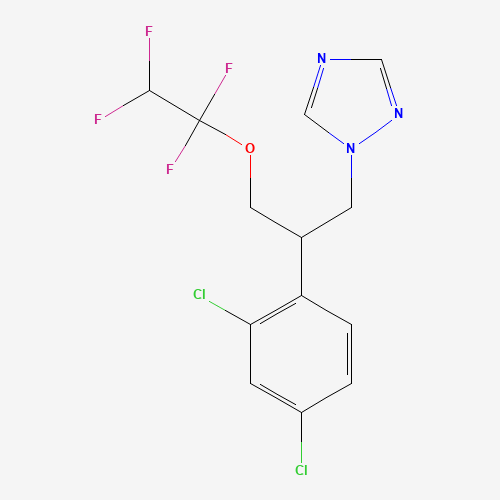
CAS112281-77-3
分子式C13H11Cl2F4N3O
分子量372.146 g/mol
非危品
1-[2-(2,4-dichlorophenyl)-3-(1,1,2,2-tetrafluoroethoxy)propyl]1,2,4-triazole is a member of the class of triazoles that is 1,2,4-triazole substituted at position 1 by a 2-(2,4-dichlorophenyl)-3-(1,1,2,2-tetrafluoroethoxy)propyl group. It is a dichlorobenzene, an ether, a member of triazoles and an organofluorine compound.
科学粮草官-词典编辑部,修订于:2026-07-06
Toxicity
ToxicityEPA Ecotoxicity
Pesticide Ecotoxicity Data from EPA: 86
Ecotoxicity Values
LC50 Colinus virginianus (Bobwhite quail) diet 637 mg/kg diet/5 days
Fate Summary
ATMOSPHERIC FATE: According to a model of gas/particle partitioning of semivolatile organic compounds in the atmosphere(1), tetraconazole, which has a vapor pressure of 1.35X10⁻⁶ mm Hg at 25 °C(2), will exist in both the vapor and particulate phases in the ambient atmosphere. Vapor-phase tetraconazole is degraded in the atmosphere by reaction with photochemically-produced hydroxyl radicals(SRC); the half-life for this reaction in air is estimated to be 35 hours(SRC), calculated from its rate constant of 1.1X10⁻¹¹ cu cm/molecule-sec at 25 °C(SRC) that was derived using a structure estimation method(3). Particulate-phase tetraconazole may be removed from the air by wet or dry deposition(SRC). Tetraconazole is stable in light(2) and therefore is not expected to be susceptible to direct pho...
Soil Adsorption / Mobility
A Koc range for tetraconazole of 531 through 1,922 in four soil types has been reported(1). According to a classification scheme(2), this Koc range suggests that tetraconazole is expected to have low mobility in soil.
Environmental Bioconcentration
An estimated BCF of 110 was calculated in fish for tetraconazole(SRC), using a log Kow of 3.56(1) and a regression-derived equation(2). According to a classification scheme(3), this BCF suggests the potential for bioconcentration in aquatic organisms is high(SRC), provided the compound is not metabolized by the organism(SRC).
Volatilization from Water / Soil
The Henry's Law constant for tetraconazole is estimated as 4.2X10⁻⁹ atm-cu m/mole(SRC) derived from its vapor pressure, 1.35X10⁻⁶ mm Hg(1), and water solubility, 156 mg/L(1). This Henry's Law constant indicates that tetraconazole is not expected to volatilize from water surfaces(2). Tetraconazole is not expected to volatilize from dry soil surfaces(SRC) based upon its vapor pressure(1).
Environmental Abiotic Degradation
Tetraconazole exhibited half-lives of 5.7 and 5.1 days on leaves at low and high recommended application levels of 0.05 and 0.10 kg active ingredient/ha, respectively, to experimental field plots of sugar beets; half-lives of 5.7 and 5.2 days, respectively, were noted in the roots; detection limits of 0.002 mg/kg (foliage) and 0.001 mk/kg (roots)(1).
Ecotoxicity Excerpts
/AQUATIC SPECIES/ Four freshwater fish toxicity studies /(using bluegill sunfish (Lepomis macrochirus) and rainbow trout (Orcorhynchus mykiss))/ were submitted /to EPA's Office of Pesticides/ with reported LC50's 3.85, 3.91, >3, and >5.2 mg a.i./L, which classifies tetraconazole as moderately toxic to freshwater fish on an acute exposure basis. ...Sublethal effects in all four studies were similar and included increased pigmentation, loss of equilibrium, fish at the bottom of the test chamber, and/or distended abdomen.
Artificial Pollution Sources
Tetraconazole's production may result in its release to the environment through various waste streams; its use as a fungicide(1) will result in its direct release to the environment(SRC).
Probable Routes of Human Exposure
Occupational exposure to tetraconazole may occur through inhalation and dermal contact with this compound at workplaces where tetraconazole is produced or used. (SRC)
Environmental Fate / Exposure Summary
Tetraconazole's production may result in its release to the environment through various waste streams; its use as a fungicide will result in its direct release to the environment. If released to air, a vapor pressure of 1.35X10⁻⁶ mm Hg at 25 °C indicates tetraconazole will exist in both the vapor and particulate phases in the atmosphere. Vapor-phase tetraconazole will be degraded in the atmosphere by reaction with photochemically-produced hydroxyl radicals; the half-life for this reaction in air is estimated to be 35 hours. Particulate-phase tetraconazole will be removed from the atmosphere by wet or dry deposition. Tetraconazole is stable in light and therefore is not expected to be susceptible to direct photolysis by sunlight. If released to soil, tetraconazole is expected to have low...
Effect Level
collection=toxvaldb&kind=^EL$
Lethal Dose
collection=toxvaldb&kind=^LD$
Human Toxicity Excerpts
/GENOTOXICITY/ Hela S3 cells were exposed to M 14360 technical (purity: 94.6%) at concentrations ranging of 0.25 to 512 ug/mL for 3 hours at 37 °C under conditions of non-activation and activation. Two trials were performed with duplicate plates for each treatment level. An S9 fraction derived from the liver of rats pretreated with Aroclor 1254 was used to metabolize the test material. There was no apparent treatment-related increase in the net grain count under conditions of either nonactivation or activation.
Carcinogen Classification
No indication of carcinogenicity to humans (not listed by IARC).
Non-Human Toxicity Values
LD50 Rat (female) oral 1248 mg a.i./kg bw
Reference and Risk Values
collection=toxvaldb&kind=^RRV$
Non-Human Toxicity Excerpts
/LABORATORY ANIMALS: Subchronic or Prechronic Exposure/ Ten Crl:CD male rats/group received 0, 2, 5, 15 or 40 ppm of M 14360 Technical (purity: 90.9% (8/10/87), 90.4% (1/26/88)) in the diet for 4 weeks (0, 0.21, 0.52, 1,57, 4.19 mg/kg/day). No deaths resulted from the treatment. The mean body weights and food consumption were not affected by the treatment through out the study. Although the serum GOT and GDH activities of the 40 ppm group were elevated above those of the control, these effects were not toxicologically significant. There were no treatment-related effects upon liver weights or the incidence of lesions in the liver. ...4-Week Rat Dietary NOEL: (M) 40 ppm (4.2 mg/kg/day) (based upon the lack of treatment-related effects at the highest dose tested).
Evidence for Carcinogenicity
Tetraconazole was classified as likely to be carcinogenic to humans based on the occurrence of liver tumors in male and female mice. The Carcinogenicity Assessment Review Committee recommended that a low dose extrapolation model be applied to the experimental animal tumor data and that quantification of risk be estimated for male and female mouse liver tumors for Tetraconazole. The most potent unit risk will be used for the purpose of lifetime cancer risk assessment by the Agency. In this case, the most potent unit risk, Q1*, is that for male mouse liver benign and/or malignant combined tumor rates at 2.30 x 10⁻² in human equivalents.
USGS Health-Based Screening Levels for Evaluating Water-Quality
Reference: Smith, C.D. and Nowell, L.H., 2024. Health-Based Screening Levels for evaluating water-quality data (3rd ed.). DOI:10.5066/F71C1TWP









