


 一键配货
一键配货
化合物详情
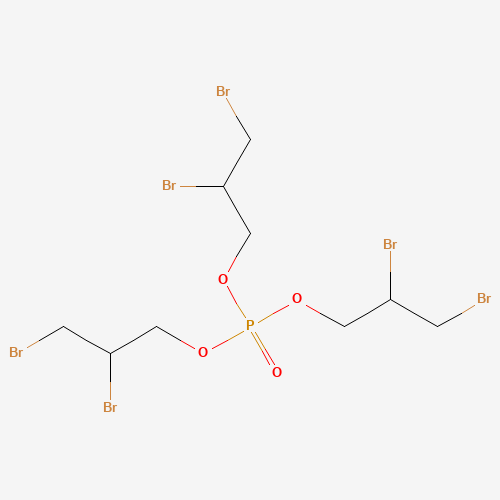
CAS126-72-7
分子式C9H15Br6O4P
分子量697.611 g/mol
危化品
Tris(2,3-dibromopropyl)phosphate can cause cancer according to an independent committee of scientific and health experts.
科学粮草官-词典编辑部,修订于:2026-07-06
Toxicity
ToxicityFate Summary
ATMOSPHERIC FATE: According to a model of gas/particle partitioning of semivolatile organic compounds in the atmosphere(1), tris(2,3-dibromo-1-propyl) phosphate, which has a vapor pressure of 2.25X10⁻⁴ mm Hg at 25 °C(2), is expected to exist solely as a vapor in the ambient atmosphere. Vapor-phase tris(2,3-dibromo-1-propyl) phosphate is degraded in the atmosphere by reaction with photochemically-produced hydroxyl radicals(SRC); the half-life for this reaction in air is estimated to be 13 hours(SRC), calculated from its rate constant of 2.8X10⁻¹¹ cu cm/molecule-sec at 25 °C(SRC) that was derived using a structure estimation method(3). Tris(2,3-dibromo-1-propyl) phosphate does not contain chromophores that absorb at wavelengths >290 nm(4) and, therefore, is not expected to be susceptible...
Soil Adsorption / Mobility
Using a structure estimation method based on molecular connectivity indices(1), the Koc of tris(2,3-dibromo-1-propyl) phosphate can be estimated to be 9700(SRC). According to a classification scheme(2), this estimated Koc value suggests that tris(2,3-dibromo-1-propyl) phosphate is expected to be immobile in soil.
Environmental Biodegradation
AEROBIC: In general the biodegradability of haloalkyl phosphates is not well understood. Limited evidence suggest that tris(2,3-dibromo-1-propyl) phosphate may be susceptible to biodegradation(1). Tris(2,3-dibromo-1-propyl) phosphate, present at 100 mg/L, reached 2% of its theoretical BOD in 2 weeks using an activated sludge inoculum at 30 mg/L in the Japanese MITI test(2). However, approximately 50% of tris(2,3-dibromo-1-propyl) phosphate at an initial concentration of 2 ppm was degraded in a laboratory activated sludge system at 21 °C, with the major metabolite being bis(2,3-dibromo-1-propyl) phosphate(3).
Environmental Bioconcentration
BCF of 2.75 was determined for tris(2,3-dibromo-1-propyl) phosphate using fathead minnows exposed to the chemical for 32 days(1). According to a classification scheme(2), this BCF suggests the potential for bioconcentration in aquatic organisms is low(SRC).
Volatilization from Water / Soil
The Henry's Law constant for tris(2,3-dibromo-1-propyl) phosphate is estimated as 2.6X10⁻⁵ atm-cu m/mole(SRC) derived from its vapor pressure, 2.25X10⁻⁴ mm Hg(1), and water solubility, 8 mg/L(2). This Henry's Law constant indicates that tris(2,3-dibromo-1-propyl) phosphate is expected to volatilize from water surfaces(3). Based on this Henry's Law constant, the volatilization half-life from a model river (1 m deep, flowing 1 m/sec, wind velocity of 3 m/sec)(3) is estimated as 4 days(SRC). The volatilization half-life from a model lake (1 m deep, flowing 0.05 m/sec, wind velocity of 0.5 m/sec)(3) is estimated as 38 days(SRC). However, volatilization from water surfaces is expected to be attenuated by adsorption to suspended solids and sediment in the water column. The estimated volatiliz...
Environmental Abiotic Degradation
The rate constant for the vapor-phase reaction of tris(2,3-dibromo-1-propyl) phosphate with photochemically-produced hydroxyl radicals has been estimated as 2.8X10⁻¹¹ cu cm/molecule-sec at 25 °C(SRC) using a structure estimation method(1). This corresponds to an atmospheric half-life of about 13 hours at an atmospheric concentration of 5X10+5 hydroxyl radicals per cu cm(1). Tris(haloalkyl) phosphates, such as tris(2,3-dibromo-1-propyl) phosphate, are generally stable to hydrolysis at neutral pH and undergo moderate hydrolysis in acidic or basic solutions(2). Hydrolysis involving the bromides on the propyl groups may occur, especially under basic conditions. At pH 7 and 25 °C, for example, the hydrolysis half-lives of isopropyl and n-propyl bromides are 2.1 and 26 days, respectively(3)....
Effluent Concentrations
Studies conducted on polyester and cellulose acetate fabrics treated with tris(2,3-dibromo-1-propyl) phosphate have shown that it can leach into wash and rinse water during laundering. When sheets treated with tris(2,3-dibromo-1-propyl) phosphate were washed, up to 6 mg/L were found in the combined wash and rinse water(1).
ICSC Environmental Data
The substance is toxic to aquatic organisms.
Atmospheric Concentrations
SOURCE DOMINATED: Tris(2,3-dibromo-1-propyl) phosphate was detected in 5 of 10 air samples collected on plant property of two industrial organo-bromine synthesis facilities in Dec 1976 and Sept 1977 at concentrations ranging from 44 to 85 ng/cu m(1).
Artificial Pollution Sources
Tris(2,3-dibromopropyl) phosphate's former production and use as a flame retardant for plastics and synthetic fibers(1) may result in its release to the environment through various waste streams(SRC). In the past, it was estimated that as much as 10% of USA production reached the environment from textile finishing plants and laundries and that most of the rest reached the environment as solid waste(2). Tris(2,3-dibromo-1-propyl) phosphate was used as a flame-retardant in polyester fabric such as children's sleepwear and bed sheets(3,4). The use of tris(2,3-dibromopropyl) phosphate was banned in 1977 by the Consumer Product Safety Commision as a potential carcinogen(5).
Sediment/Soil Concentrations
SOIL: Tris(2,3-dibromo-1-propyl) phosphate was identified, not quantified, in Arkansas soil(1).
Environmental Fate / Exposure Summary
Tris(2,3-dibromo-1-propyl) phosphate's former production and use as a flame retardant for plastics and synthetic fibers may have resulted in its release to the environment through various waste streams. The use of tris(2,3-dibromo-1-propyl) phosphate was banned in 1977 by the Consumer Product Safety Commission because it is a potential carcinogen. If released to air, a vapor pressure of 2.25X10⁻⁴ mm Hg at 25 °C indicates tris(2,3-dibromo-1-propyl) phosphate will exist solely as a vapor in the atmosphere. Vapor-phase tris(2,3-dibromo-1-propyl) phosphate will be degraded in the atmosphere by reaction with photochemically-produced hydroxyl radicals; the half-life for this reaction in air is estimated to be 13 hours. Tris(2,3-dibromo-1-propyl) phosphate does not contain chromophores that ab...
Symptoms
Ingestion Exposure: See Effects of long-term or repeated exposure.
Adverse Effects
NTP Carcinogen - Reasonably anticipated to be a human carcinogen.
Exposure Routes
The substance can be absorbed into the body by inhalation, through the skin and by ingestion.
RAIS Toxicity Values
Oral Slope Factor Reference: CALEPA
Human Toxicity Excerpts
/OTHER TOXICITY INFORMATION/ The routes of potential human exposure to tris(2,3-dibromopropyl) phosphate are inhalation, dermal contact, and ingestion. Because tris(2,3-dibromopropyl) phosphate is no longer reported to be produced in the United States, the potential for exposure should be small. The chemical was widely used in children's sleepwear and mattresses in the past.
Carcinogen Classification
Summary: It is concluded that under the conditions of this study orally administered TBP was carcinogenic to B6C3F1 mice, causing increased incidences of tumors in livers, lungs, and stomachs of female mice and in kidneys, lungs, and stomachs of male mice. TBP was also carcinogenic in Fischer 344 rats, causing an increased incidence of kidney tumors in both sexes.
Non-Human Toxicity Values
LD50 Mouse ip 300 mg/kg
1 or Cancer Risk Level 1E-06
Soil Saturation Concentration (mg/kg): 4.67e+02
Evidence for Carcinogenicity
Tris(2,3-dibromopropyl) phosphate is reasonably anticipated to be a human carcinogen based on sufficient evidence of carcinogenicity from studies in experimental animals.
Antidote and Emergency Treatment
/SRP:/ Advanced treatment: Consider orotracheal or nasotracheal intubation for airway control in the patient who is unconscious, has severe pulmonary edema, or is in severe respiratory distress. Positive-pressure ventilation techniques with a bag valve mask device may be beneficial. Consider drug therapy for pulmonary edema ... . Monitor cardiac rhythm and treat arrhythmias if necessary ... . Start IV administration of D5W /SRP: "To keep open", minimal flow rate/. Use 0.9% saline (NS) or lactated Ringer's (LR) if signs of hypovolemia are present. For hypotension with signs of hypovolemia, administer fluid cautiously. Watch for signs of fluid overload ... . Treat seizures with diazepam or lorazepam ... . Monitor for signs of hypoglycemia (decreased LOC, tachycardia, pallor, dilated pupil...
Hazard Quotient Level 3 or Cancer Risk Level 1E-04
Soil Saturation Concentration (mg/kg): 4.67e+02









