


 一键配货
一键配货
化合物详情
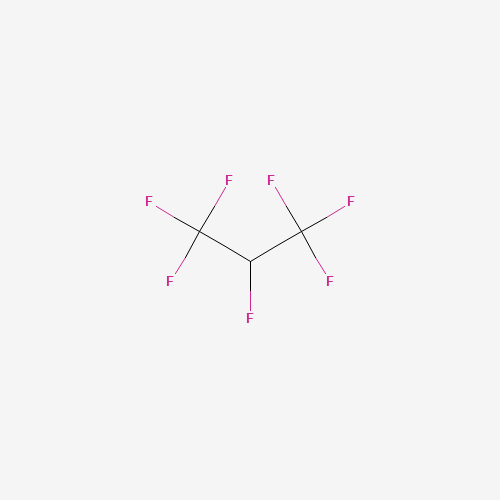
CAS431-89-0
分子式C3HF7
分子量170.03 g/mol
非危品
科学粮草官-词典编辑部,修订于:2026-07-06
Toxicity
ToxicityFate Summary
ATMOSPHERIC FATE: According to a model of gas/particle partitioning of semivolatile organic compounds in the atmosphere(1), 1,1,1,2,3,3,3-heptafluoropropane, which has a vapor pressure of 3410 mm Hg at 25 °C(2), is expected to exist solely as a gas in the ambient atmosphere. Gas-phase 1,1,1,2,3,3,3-heptafluoropropane is degraded in the atmosphere by reaction with photochemically-produced hydroxyl radicals(SRC); the half-life for this reaction in air is estimated to be 24 to 30 years(SRC), calculated from its rate constants of 1.4X10⁻¹⁵ to 1.8X10⁻¹⁵ cu cm/molecule-sec(3-5). 1,1,1,2,3,3,3-Heptafluoropropane does not contain chromophores that absorb at wavelengths >290 nm(6) and, therefore, is not expected to be susceptible to direct photolysis by sunlight(SRC). Atmospheric life-times for...
Soil Adsorption / Mobility
Using a structure estimation method based on molecular connectivity indices(1), the Koc of 1,1,1,2,3,3,3-heptafluoropropane can be estimated to be 580(SRC). According to a classification scheme(2), this estimated Koc value suggests that 1,1,1,2,3,3,3-heptafluoropropane is expected to have low mobility in soil. However, when released into the environment, 1,1,1,2,3,3,3-heptafluoropropane is expected to partition almost exclusively into the air(3).
Environmental Bioconcentration
An estimated BCF of 21 was calculated in fish for 1,1,1,2,3,3,3-heptafluoropropane(SRC), using an estimated log Kow of 2.51(1) and a regression-derived equation(1). According to a classification scheme(2), this BCF suggests the potential for bioconcentration in aquatic organisms is low(SRC).
Volatilization from Water / Soil
The Henry's Law constant for 1,1,1,2,3,3,3-heptafluoropropane is estimated as 16 atm-cu m/mole(SRC) using a fragment constant estimation method(1). This Henry's Law constant indicates that 1,1,1,2,3,3,3-heptafluoropropane is expected to volatilize rapidly from water surfaces(2). Based on this Henry's Law constant, the volatilization half-life from a model river (1 m deep, flowing 1 m/sec, wind velocity of 3 m/sec)(2) is estimated as 4 hours(SRC). The volatilization half-life from a model lake (1 m deep, flowing 0.05 m/sec, wind velocity of 0.5 m/sec)(2) is estimated as 5 days(SRC). 1,1,1,2,3,3,3-Heptafluoropropane's Henry's Law constant indicates that volatilization from moist soil surfaces will occur(SRC). 1,1,1,2,3,3,3-Heptafluoropropane is expected to volatilize from dry soil surface...
Environmental Abiotic Degradation
[Table#7533]: IjIwIHlyIEdXUCIsIjEwMCB5ciBHV1AiLCI1MDAgeXIgR1dQIiwiQUxUICh5cnMpIiwiUmVmIgoiNDUwMCIsIm5vdCByZXBvcnRlZCIsIjExMDAiLCI0MC44IiwiMSIKIjUzOTUiLCIzNTQzLTM4MDAiLCIxMTcyIiwiMzUuNjciLCIyIgoiNDUwMCIsIjMzMDAiLCIxMTAwIiwiNDEiLCIzIgoibm90IHJlcG9ydGVkIiwiMzUwMCIsIm5vdCByZXBvcnRlZCIsIjMzIiwiNCIKIm5vdCByZXBvcnRlZCIsIjMyMDAiLCJub3QgcmVwb3J0ZWQiLCIzNi41IiwiNSIK
Effluent Concentrations
1,1,1,2,3,3,3-Heptafluoropropane was not detected in the emissions from a hydroflurocarbon (HFC) packaging plant located in The Netherlands, sampled in 1990(1).
Natural Pollution Sources
There is no natural source for 1,1,1,2,3,3,3-heptafluoropropane(1).
Artificial Pollution Sources
1,1,1,2,3,3,3-Heptafluoropropane's production and use in refrigerants, high temperature heat pumps, air-conditioning systems, as a fire suppressant, and for pharmaceutical aerosols and metered-dose inhalers(1) may result in its release to the environment through various waste streams(SRC).
Probable Routes of Human Exposure
Occupational exposure to 1,1,1,2,3,3,3-heptafluoropropane may occur through inhalation and dermal contact with this compound at workplaces where 1,1,1,2,3,3,3-heptafluoropropane is produced or used. Use data indicate that the general population may be exposed to 1,1,1,2,3,3,3-heptafluoropropane primarily via inhalation when using pharmaceutical aerosols and metered-dose inhalers that contain 1,1,1,2,3,3,3-heptafluoropropane. (SRC)
Environmental Fate / Exposure Summary
1,1,1,2,3,3,3-Heptafluoropropane's production and use as a fire extinguisher, in refrigeration and in aerosol inhalers may result in its release to the environment through various waste streams. If released to air, a vapor pressure of 3410 mm Hg at 25 °C indicates 1,1,1,2,3,3,3-heptafluoropropane will exist solely as a gas in the atmosphere. Gas-phase 1,1,1,2,3,3,3-heptafluoropropane will be degraded in the atmosphere by reaction with photochemically-produced hydroxyl radicals; the half-life for this reaction in air is estimated to be 24-30 years. 1,1,1,2,3,3,3-Heptafluoropropane does not contain chromophores that absorb at wavelengths >290 nm and, therefore, is not expected to be susceptible to direct photolysis by sunlight. 1,1,1,2,3,3,3-Heptafluoropropane has an estimated atmospheric...
Toxicity Data
LC (rat) > 1,035,529 ppm/4h
Adverse Effects
Other Poison - Simple Asphyxiant
Toxicity Summary
IDENTIFICATION AND USE: 1,1,1,2,3,3,3-Heptafluoropropane (HFC 227) is a colorless gas. It is used in refrigerants, high temperature heat pumps, air-conditioning systems; as a fire suppressant; and for pharmaceutical aerosols and metered-dose inhalers. HUMAN EXPOSURE AND TOXICITY: Exposure of healthy volunteers to exposure levels up to 8000 ppm HFC 227 did not result in any adverse effects on pulse, blood pressure, electrocardiogram, or lung function. ANIMAL STUDIES: HFC 227 released into the eyes of rabbits did not induce any sign of irritation. Exposure to HFC 227 can induce cardiac sensitization in dogs at concentrations from 100,000 ppm (10% v/v) and higher after an exogenous epinephrine challenge. No deaths occurred when rats and mice were exposed by inhalation once to 300,000 and 5...
Human Toxicity Excerpts
/HUMAN EXPOSURE STUDIES/ The present study was conducted to describe and compare the in vivo performance (systemic exposure), clinical and laboratory safety of a fixed combinational product of inhaled reproterol (CAS 54063-54-6) plus disodium cromoglycate (DSCG; CAS 15826-37-6) using a novel freon (CFC)-free metered dose inhaler (MDI), which uses 1,1,1,2,3,3,3-heptafluoropropane (HFA-227; CAS 431-89-0) as propellant and polyoxyethylene glyceryl trioleate (Tagat TO; CAS 68958-64-5) as surfactant relative to the conventional freon-driven MDI Allergospasmin in healthy male and female volunteers. Twenty-four young male and female healthy subjects were randomly allocated in gender-balanced fashion to 4 parallel treatment groups with single and repeated dosing of either reproterol + DSCG by H...
Non-Human Toxicity Values
LC50 Rat inhalation 800,000 ppm/4 hr
Reference and Risk Values
collection=toxvaldb&kind=^RRV$
Non-Human Toxicity Excerpts
/LABORATORY ANIMALS: Chronic Exposure or Carcinogenicity/ When rats and mice were exposed by inhalation to concentrations of 0, 60,000, 120,000 and 240,000 ppm for 2 years at a regimen of 1 hour per day, no increased incidence of benign or malignant neoplasms were observed when compared to controls. Some alveolar histiocytosis was observed in the lungs of rats exposed to high doses of HFA 227. In view of its normal incidence in this strain of animals and its only very slightly increased severity compared to controls, this effect was considered of no biological significance.
Antidote and Emergency Treatment
/SRP:/ Immediate first aid: Ensure that adequate decontamination has been carried out. If patient is not breathing, start artificial respiration, preferably with a demand-valve resuscitator, bag-valve-mask device, or pocket mask, as trained. Perform CPR if necessary. Immediately flush contaminated eyes with gently flowing water. Do not induce vomiting. If vomiting occurs, lean patient forward or place on left side (head-down position, if possible) to maintain an open airway and prevent aspiration. Keep patient quiet and maintain normal body temperature. Obtain medical attention. /Halogenated aliphatic hydrocarbons and related compounds/









