


 一键配货
一键配货
化合物详情
CAS135158-54-2
分子式C8H6N2OS2
分子量210.28 g/mol g/mol
危化品
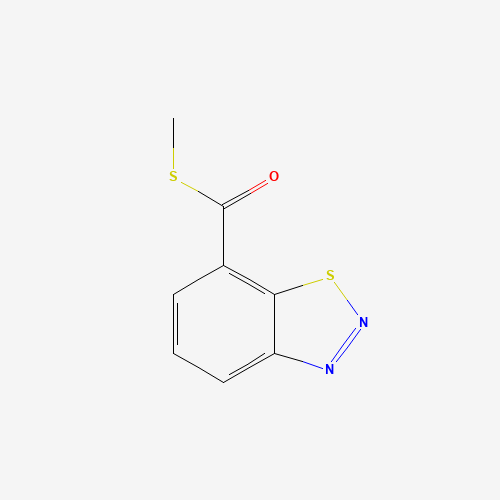
Acibenzolar-S-methyl is a benzothiadiazole that is the S-methyl thioester derivative of acibenzolar. A profungicide (by hydrolysis of the thioester group to give the corresponding carboxylic acid), it is used as a fungicide and plant activator on a variety of crops, including cotton, chili peppers, lettuce, onions, spinach, tobacco, and tomatoes. It has a role as a profungicide, a plant activator and an antifungal agrochemical. It is a benzothiadiazole and a thioester. It is functionally related to an acibenzolar.
科学粮草官-词典编辑部,修订于:2026-07-06
Toxicity
ToxicityEPA Ecotoxicity
Pesticide Ecotoxicity Data from EPA: 35
Ecotoxicity Values
LC50 Rainbow trout 0.88 ppm (98% a.i.) Studies were conducted under flow-through conditions.
Fate Summary
ATMOSPHERIC FATE: According to a model of gas/particle partitioning of semivolatile organic compounds in the atmosphere(1), acibenzolar-S-methyl, which has a vapor pressure of 3.30X10⁻⁶ mm Hg at 25 °C(2), will exist in both the vapor and particulate phases in the ambient atmosphere. Vapor-phase acibenzolar-S-methyl is degraded in the atmosphere by reaction with photochemically-produced hydroxyl radicals(SRC); the half-life for this reaction in air is estimated to be 48 hrs(SRC), calculated from its rate constant of 7.9X10⁻¹² cu cm/molecule-sec at 25 °C(SRC) that was derived using a structure estimation method(3). Particulate-phase acibenzolar-S- methyl may be removed from the air by wet and dry deposition(SRC).
Soil Adsorption / Mobility
The Koc of acibenzolar-S-methyl is estimated as 1,200(SRC), using a log Kow of 3.10(1) and a regression-derived equation(2). According to a classification scheme(3), this estimated Koc value suggests that acibenzolar-S-methyl is expected to have low mobility in soil.
Environmental Biodegradation
ANAEROBIC: Acibenzolar-S-methyl showed very little degradation in water under anaerobic conditions after 360 days(1).
Environmental Bioconcentration
An estimated BCF of 49 was calculated for acibenzolar-S-methyl(SRC), using a log Kow of 3.10(1) and a regression-derived equation(2). According to a classification scheme(3), this BCF suggests the potential for bioconcentration in aquatic organisms is moderate(SRC).
Volatilization from Water / Soil
The Henry's Law constant for acibenzolar-S-methyl is estimated as 1.2X10⁻⁷ atm-cu m/mole(SRC) derived from its vapor pressure, 3.30X10⁻⁶ mm Hg(1), and water solubility, 7.7 mg/l(1). This Henry's Law constant indicates that acibenzolar-S-methyl is expected to be essentially nonvolatile from water surfaces(2). Acibenzolar-S-methyl is not expected to volatilize from dry soil surfaces(SRC) based upon its vapor pressure(2).
Environmental Abiotic Degradation
The rate constant for the vapor-phase reaction of acibenzolar-S-methyl with photochemically-produced hydroxyl radicals has been estimated as 7.9X10⁻¹² cu cm/molecule-sec at 25 °C(SRC) using a structure estimation method(1). This corresponds to an atmospheric half-life of about 48 hours at an atmospheric concentration of 5X10+5 hydroxyl radicals per cu cm(1). The hydrolysis half-life in natural water was <1 day, with an 8 day half-life reported for the primary hydrolysis product(2). Acibenzolar-S-methyl is rapidly hydrolyzed in soils, with a half-life of 0.3 days; metabolites decome completly degraded and mineralized(2). The major metabolite was benzo(1,2,3)thiadiazole-7-carboxylic acid in hydrolysis and soil photolysis studies(3). Degradation by photolysis in water and on soil was rapid...
Artificial Pollution Sources
Acibenzolar-S-methyl's production may result in its release to the environment through various waste streams; it's use as a plant activator(1) will result in its direct release to the environment(SRC).
Probable Routes of Human Exposure
Occupational exposure to acibenzolar-S-methyl may occur through inhalation of dust and dermal contact with this compound at workplaces where acibenzolar-S-methyl is produced or used. (SRC)
Environmental Fate / Exposure Summary
Acibenzolar-S-methyl's production may result in its release to the environment through various waste streams; it's use as a plant activator will result in its direct release to the environment. If released to air, a vapor pressure of 3.30X10⁻⁶ mm Hg at 25 °C indicates acibenzolar-S-methyl will exist in both the vapor and particulate phases in the ambient atmosphere. Vapor-phase acibenzolar-S-methyl will be degraded in the atmosphere by reaction with photochemically-produced hydroxyl radicals; the half-life for this reaction in air is estimated to be 48 hrs. Particulate-phase acibenzolar-S-methyl will be removed from the atmosphere by wet and dry deposition. Photolysis in water and on soil is rapid at environmental pH's of 6 to 9. If released to soil, acibenzolar-S-methyl is expected to...
Effect Level
collection=toxvaldb&kind=^EL$
Lethal Dose
collection=toxvaldb&kind=^LD$
Adverse Effects
Skin Sensitizer - An agent that can induce an allergic reaction in the skin.
Average Daily Intake
The refined dietary exposure estimate for acibenzolar-S-methyl is 0.0029 mg/kg/day(1).
Effect Concentration
collection=toxvaldb&kind=^EC$
RAIS Toxicity Values
Oral Chronic Reference Dose Reference: OPP
Carcinogen Classification
No indication of carcinogenicity to humans (not listed by IARC).
Non-Human Toxicity Values
LD50 Rat oral >5000 mg/kg (90-day subchronic rat feeding)
Reference and Risk Values
collection=toxvaldb&kind=^RRV$
Antidote and Emergency Treatment
Advanced treatment: Consider orotracheal or nasotracheal intubation for airway control in the patient who is unconscious, has severe pulmonary edema, or is in respiratory arrest. Positive pressure ventilation techniques with a bag valve mask device may be beneficial. Monitor cardiac rhythm and treat arrhythmias as necessary ... . Start an IV with D5W /SRP: "To keep open", minimal flow rate/. Use lactated Ringer's if signs of hypovolemia are present. Watch for signs of fluid overload. Consider drug therapy for pulmonary edema ... . For hypotension with signs of hypovolemia, administer fluid cautiously. Watch for signs of fluid overload ... . Treat seizures with diazepam (Valium) ... . Use proparacaine hydrochloride to assist eye irrigation ... . /Poison A and B/









