

 一键配货
一键配货
化合物详情
CAS106-61-6
分子式C5H10O4
分子量134.1305 g/mol
非危品
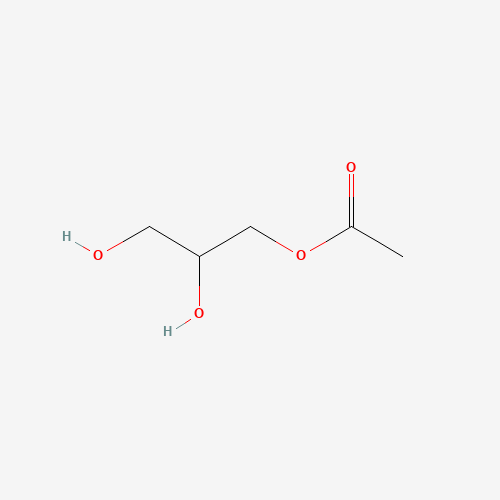
Physical Description | Acetin is a clear colorless to pale yellow viscous liquid with a characteristic odor. (NTP, 1992)
科学粮草官-词典编辑部,修订于:2026-07-06
Toxicity
ToxicityFate Summary
ATMOSPHERIC FATE: According to a model of gas/particle partitioning of semivolatile organic compounds in the atmosphere(1), acetin, which has an estimated vapor pressure of 3.9X10⁻³ mm Hg at 25 °C(2,SRC), is expected to exist solely as a vapor in the ambient atmosphere. Vapor-phase acetin is degraded in the atmosphere by reaction with photochemically-produced hydroxyl radicals(SRC); the half-life for this reaction in air is estimated to be 23 hours(3,SRC).
Soil Adsorption / Mobility
The Koc of acetin is estimated as approximately 5.0(SRC), using an estimated log Kow of -1.2(1,SRC) and a regression-derived equation(2,SRC). According to a classification scheme(3), this estimated Koc value suggests that acetin is expected to have very high mobility in soil(SRC).
Environmental Biodegradation
Glycerin acetate (comprised of acetin, approx 28%; diacetin, approx 50%; and triacetin, approx 18%) reached 91 to 94% of its theoretical BOD after 4 weeks incubation in an activated sludge inoculum(1).
Environmental Bioconcentration
An estimated BCF of 3.2 was calculated for acetin(SRC), using an estimated log Kow of - 1.2(1,SRC) and a regression-derived equation(2). According to a classification scheme(3), this BCF suggests the potential for bioconcentration in aquatic organisms is low(SRC).
Volatilization from Water / Soil
The Henry's Law constant for acetin is estimated as 4.1X10⁻¹⁰ atm-cu m/mole(SRC) using a fragment constant estimation method(1). This Henry's Law constant indicates that acetin is expected to be essentially nonvolatile from water surfaces(2,SRC). Acetin's Henry's Law constant(1,SRC) indicates that volatilization from moist soil surfaces is not expected to occur(SRC). Acetin is not expected to volatilize from dry soil surfaces based on an estimated vapor pressure of 3.9X10⁻³ mm Hg(SRC), determined from a fragment constant method(3).
Environmental Abiotic Degradation
The rate constant for the vapor-phase reaction of acetin with photochemically-produced hydroxyl radicals has been estimated as 1.6X10⁻¹¹ cu cm/molecule-sec at 25 °C(SRC) using a structure estimation method(1,SRC). This corresponds to an atmospheric half-life of about 23 hours at an atmospheric concentration of 5X10+5 hydroxyl radicals per cu cm(1,SRC). A base-catalyzed second-order hydrolysis rate constant of 0.12 L/mol-sec(SRC) was estimated using a structure estimation method(2); this corresponds to half-lives of 1.8 years and 66 days at pH values of 7 and 8, respectively(2,SRC).
Artificial Pollution Sources
Acetin's production and use in the manufacture of smokeless powder and dynamite, as a solvent for basic dyes, in leather tanning(1), and as a food additive(2) may result in its release to the environment through various waste streams.
Probable Routes of Human Exposure
NIOSH (NOES Survey 1981-1983) has statistically estimated that 1,223 workers (241 of these are female) are potentially exposed to acetin in the US(1). Occupational exposure to acetin may occur through dermal contact with this compound at workplaces where acetin is produced or used(SRC). The general population may be exposed to acetin via ingestion of food products containing acetin(SRC).
Environmental Fate / Exposure Summary
Acetin's production and use in the manufacture of smokeless powder and dynamite, as a solvent for basic dyes, in leather tanning, and as a food additive may result in its release to the environment through various waste streams. If released to air, an estimated vapor pressure of 3.9X10⁻³ mm Hg at 25 °C indicates acetin will exist solely as a vapor in the ambient atmosphere. Vapor-phase acetin will be degraded in the atmosphere by reaction with photochemically-produced hydroxyl radicals; the half-life for this reaction in air is estimated to be 23 hours. If released to soil, acetin is expected to have very high mobility based on an estimated Koc of 5.0. Volatilization from moist soil surfaces is not expected to occur based upon an estimated Henry's Law constant of 4.1X10⁻¹⁰ atm-cu m/mole...
Interactions
The effects of single and combined treatment with monoacetin and calcium-chloride against sodium-fluoroacetate poisoning was investigated in cats. Cats received a single intravenous injection of 3.3 mg /kg sodium fluoroacetate and 1% calcium-chloride or 0.5 mg/kg monoacetin every 30 min or combined monoacetin and calcium-chloride therapy. Controls received no treatment. Monoacetin alone extended average survival time of animals poisoned with sodium fluoroacetate from 94 to 166 minutes. The combined treatment with monoacetin and calcium-chloride did not prolong mean survival time above 166 minutes. Monoacetin therapy aggrevated the metabolic acidosis in sodium-fluoroacetate treated animals in groups that received monoacetin alone or in combination with calcium-chloride; the serum ionized...
Adverse Effects
Neurotoxin - Other CNS neurotoxin
Toxicity Summary
Cosmetic Ingredient Review Finding(s): Safe in the present practices of use and concentration. Ingredient, concentration, and use information are available in documents discoverable at https://cir-reports.cir-safety.org
Non-Human Toxicity Values
...LD50 RAT 5.5 ML/KG /6.633 G/ & IN MOUSE 3.5 ML/KG /4.221 G/.