


 一键配货
一键配货
化合物详情
CAS57960-19-7
分子式C24H32O4
分子量384.5085 g/mol
非危品
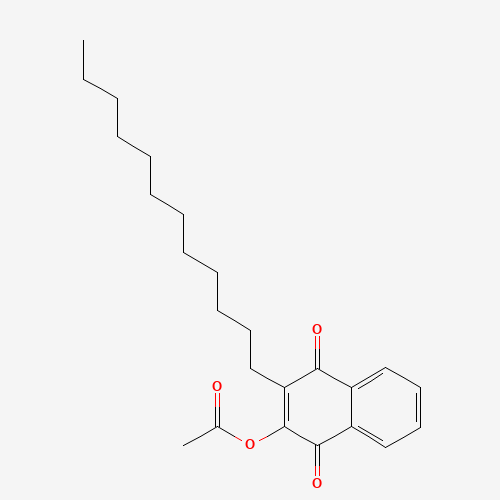
Acequinocyl is an acetate ester consisting of 1,4-naphthoquinone bearing acetoxy and dodecyl substituents at positions 2 and 3 respectively. It has a role as an acaricide and a mitochondrial cytochrome-bc1 complex inhibitor. It is a member of 1,4-naphthoquinones and an acetate ester.
科学粮草官-词典编辑部,修订于:2026-07-06
Toxicity
ToxicityEPA Ecotoxicity
Pesticide Ecotoxicity Data from EPA: 69
Ecotoxicity Values
LC50 Anas platyrhynchos (Mallard duck) dietary >5000 ppm (5 days)
Fate Summary
ATMOSPHERIC FATE: According to a model of gas/particle partitioning of semivolatile organic compounds in the atmosphere(1), acequinocyl, which has a vapor pressure of 1.27X10⁻⁸ mm Hg at 25 °C(2), is expected to exist solely in the particulate phase in the ambient atmosphere.
Soil Adsorption / Mobility
The Koc of acequinocyl is estimated as 56,000(SRC), using a log Kow of 6.2(1) and a regression-derived equation(2). According to a classification scheme(3), this estimated Koc value suggests that acequinocyl is expected to be immobile in soil.
Environmental Biodegradation
AEROBIC: Observed half-lives of acequinocyl in sandy loam and silt soils were less than 2 days(1). Deacetylated acequinocyl was reported as a major metabolite(1).
Environmental Bioconcentration
An estimated BCF of 33,000 was calculated for acequinocyl(SRC), using a log Kow of 6.2(1) and a regression-derived equation(2). According to a classification scheme(3), this BCF suggests the potential for bioconcentration in aquatic organisms is very high(SRC), provided the compound is not altered physically or chemically once released into the environment.
Volatilization from Water / Soil
The Henry's Law constant for acequinocyl is estimated as 9.7X10⁻⁷ atm-cu m/mole(SRC) derived from its vapor pressure, 1.27X10⁻⁸ mm Hg(1), and water solubility, 6.69X10⁻³ mg/L(1). This Henry's Law constant indicates that acequinocyl is expected to volatilize slowly from water surfaces(2). Based on this Henry's Law constant, the estimated volatilization half-life from a model river (1 m deep, flowing 1 m/sec, wind velocity of 3 m/sec)(2) is estimated as 50 days(SRC). The volatilization half-life from a model lake (1 m deep, flowing 0.05 m/sec, wind velocity of 0.5 m/sec)(2) is estimated as 550 days(SRC). However, volatilization from water surfaces is expected to be attenuated by adsorption to suspended solids and sediment in the water column. The estimated volatilization half-life from a...
Environmental Abiotic Degradation
Acequinocyl is expected to undergo hydrolysis based on measured half-lives of 86 days at pH 4, 52 hours at pH 7, and 76 minutes at pH 9 (all at 25 °C)(1). The half-life for the aqueous photolysis of this substance was measured to be 6 days at pH 5(1).
Artificial Pollution Sources
Acequinocyl's production may result in its release to the environment through various waste streams; it's use as a greenhouse miticide for the treatment of ornamental plants grown in commercial greenhouses and shadehouses(1) will result in its direct release to the environment(SRC).
Probable Routes of Human Exposure
Occupational exposure to acequinocyl may occur through inhalation and dermal contact with this compound at workplaces where acequinocyl is produced or used. The general population may be exposed to acequinocyl via dermal contact with ornamental plants that have been treated with this substance. (SRC)
Environmental Fate / Exposure Summary
Acequinocyl's production may result in its release to the environment through various waste streams; it's use as a greenhouse miticide will result in its direct release to the environment. If released to air, a vapor pressure of 1.27X10⁻⁸ mm Hg at 25 °C indicates acequinocyl will exist solely in the particulate phase in the ambient atmosphere. Particulate-phase acequinocyl will be removed from the atmosphere by wet and dry deposition. If released to soil, acequinocyl is expected to have no mobility based upon an estimated Koc of 56,000. Observed half-lives of acequinocyl in sandy loam and silt soils were less than 2 days, indicating that biodegradation may be an important environmental fate process in soil. Volatilization from moist soil surfaces is expected to be slow based upon an est...
Effect Level
collection=toxvaldb&kind=^EL$
Lethal Dose
collection=toxvaldb&kind=^LD$
Adverse Effects
Occupational hepatotoxin - Secondary hepatotoxins: the potential for toxic effect in the occupational setting is based on cases of poisoning by human ingestion or animal experimentation.
Lethal Concentration
collection=toxvaldb&kind=^LC$
RAIS Toxicity Values
Oral Chronic Reference Dose Reference: OPP
Non-Human Toxicity Values
LD50 Mouse oral >5000 mg/kg
Reference and Risk Values
collection=toxvaldb&kind=^RRV$
Non-Human Toxicity Excerpts
/LABORATORY ANIMALS: Chronic Exposure or Carcinogenicity/ Diets containing 0, 50, 200, 800, and 1600 ppm acequinocyl (97.1%) /were fed to F344 rats/. Reported mean test substance intakes were 2.25, 9.02, 36.4, and 74.0 mg/kg/day in males and 2.92, 11.6, 46.3, and 93.6 mg/kg/day in females. Fifty F344 rats/sex/group were assigned to the lifetime (2-yr) study. An additional 10/sex/group constituted interim sacrifice groups, terminated at weeks 26, 52, and 78. The latter rats were used for clinical chemistry, hematology, and urinalysis. Interim rats were all examined grossly, however histopathology of interim groups was limited to the 1-yr sacrifice rats. NOEL = 50 ppm (dose-related increases in "hypertrophy of the eyeball" in 200 ppm males). "Hypertrophy of the eyeball" and "corneal abnor...
Antidote and Emergency Treatment
/SRP:/ Advanced treatment: Consider orotracheal or nasotracheal intubation for airway control in the patient who is unconscious, has severe pulmonary edema, or is in respiratory arrest. Positive pressure ventilation techniques with a bag valve mask device may be beneficial. Monitor cardiac rhythm and treat arrhythmias as necessary ... . Start an IV with D5W /SRP: "To keep open", minimal flow rate/. Use lactated Ringer's if signs of hypovolemia are present. Watch for signs of fluid overload. Consider drug therapy for pulmonary edema ... . For hypotension with signs of hypovolemia, administer fluid cautiously. Watch for signs of fluid overload ... . Treat seizures with diazepam (Valium) ... . Use proparacaine hydrochloride to assist eye irrigation ... . /Poison A and B/









