

 一键配货
一键配货
化合物详情
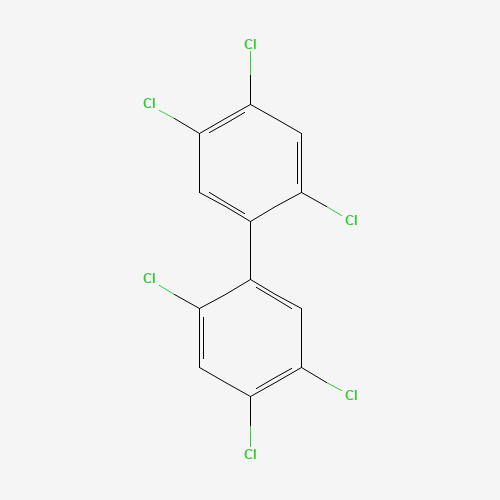
CAS35065-27-1
分子式C12H4Cl6
分子量360.88 g/mol g/mol
危化品
2,2',4,4',5,5'-hexachlorobiphenyl is a hexachlorobiphenyl.
科学粮草官-词典编辑部,修订于:2026-07-06
Toxicity
ToxicityBody Burden
... The percent found in human milk extract was 12. ...
Fate Summary
When uniformly (14)C-labeled ... 2,2',4,4',5,5'-hexachlorobiphenyl was incubated for 98 days in soil ... 0.1% (14)CO2 was evolved in a closed system. Biphenyl and the monochlorobiphenyls were moderately degraded whereas the polychlorinated cmpd were virtually inert.
Environmental Bioconcentration
BIOCONCENTRATION OF 2,4,5,2',4',5'-HEXACHLOROBIPHENYL (2,4,5-HCB) WAS EXAMINED IN THE GREAT LAKES (USA) ALGAE FRAGILARIA CROTONENSIS, ANKISTRODESMUS FALCATUS & MICROCYSTIS SPECIES. THE BIOCONCENTRATION FACTORS VARIED WITH SPECIES, WHETHER THEY WERE EXPRESSED IN TERMS OF CELL NUMBER, DRY WT, CELLULAR C, OR CELLULAR LIPID, THE FACTORS WERE IN RANGE OF 105-106 & INCREASED WITH DECREASING BIOMASS. SURFACE ADSORPTION APPARENTLY CONTRIBUTED ONLY SLIGHTLY TO BIOACCUMULATION OF 2,4,5-HCB. 2,4,5-HCB DESORBED FROM ALL SPECIES BUT AT A MUCH SLOWER RATE THAN ITS ADSORPTION.
Milk Concentrations
... The percent found in human milk extract was 12 ...
Animal Concentrations
A PCB CONCN OF 3608 PPM WAS FOUND IN FAT FROM SNAPPING TURTLE COLLECTED FROM UPPER HUDSON RIVER (HIGH POLLUTION LEVEL). THIS TURTLE REFLECTS THE HIGH PCB LEVELS FOUND IN THE REGION AS COMPARED TO THE 633 PPM PCB LEVEL FOUND IN FAT FROM SNAPPING TURTLE FROM LAKE ONTARIO (LOW POLLUTION LEVEL). 2,2'4,4'5,5'-HEXACHLOROBIPHENYL WAS THE MOST COMMON PCB FOUND IN BOTH TURTLES.
Artificial Pollution Sources
/SRP: THIS PCB HAS ENTERED THE USA ENVIRONMENT/ MAINLY THROUGH USE OF AROCLOR 1248, 1254, AND 1260 ... FROM MANUFACTURING PLANTS, DURING DESTRUCTION OF MANUFACTURED ARTICLES CONTAINING PCBS IN MUNICIPAL & INDUSTRIAL WASTE-DISPOSAL BURNERS, THROUGH GRADUAL WEAR & WEATHERING OF PCB-CONTAINING PRODUCTS, & THROUGH LEACHING FROM LAND-FILL DUMPS. /POLYCHLORINATED BIPHENYLS/
Symptoms
Chronic PCB exposure results in symptoms such as abdominal pain, nausea, vomiting, diarrhea, headache, dizziness, depression, nervousness, dermal and ocular lesions, fatigue, irregular menstrual cycles and a lowered immune response. (A3)
Treatment
There are no specific treatments for PCB poisoning, since it is not usually recognized until after substantial chronic exposure. Only preventing further exposure and treating the observed symptoms can be done. Acute inhalation can be treated by administering oxygen. (L4)
Interactions
Fecal excretion of 2,4,5,2',4',5'-hexachlorobiphenyl was followed for 19 weeks in rats fed a control diet, or a squalane-supplemented diet, for up to 17 weeks. In 3 days after a single oral dose of 8 mg/kg of 2,4,5,2',4',5'-hexachlorobiphenyl, 20% dose was excreted in feces as unchanged 2,4,5,2',4',5'-hexachlorobiphenyl, which probably represents that not absorbed. From day 4 to 133 only an additional 2-4% dose was excreted in feces by control animals. Addition of 8% squalene to the diet 2, 6 and 15 weeks after dosing resulted in a five-fold increase of daily 2,4,5,2',4',5'-hexachlorobiphenyl excretion in feces independent of the time of beginning the treatment. Total excretion of 2,4,5,2',4',5'-hexachlorobiphenyl in feces from day 4 to 133 was 3.6, 6-7 and 9.3% dose after 4, 13 and 17...
Toxicity Data
LD50: 1010 mg/kg (Oral, Rat) (T14) LD50: 880 mg/kg (Intraperitoneal, Mouse) (T14)
Health Effects
The most common health effects of PCBs are skin conditions such as chloracne and rashes. Chronic PCB exposure has also been shown to cause liver, stomach and kidney, damage, jaundice, edema, anemia, changes in the immune system, behavioral alterations, and impaired reproduction. (L4)
Adverse Effects
IARC Carcinogen - Class 1: International Agency for Research on Cancer classifies chemicals as established human carcinogens.
Exposure Routes
Oral (L4); inhalation (L4); dermal (L4)
Toxicity Summary
The mechanism of action varies with the specific PCB. Dioxin-like PCBs bind to the aryl hydrocarbon receptor, which disrupts cell function by altering the transcription of genes, mainly be inducing the expression of hepatic Phase I and Phase II enzymes, especially of the cytochrome P450 family. Most of the toxic effects of PCBs are believed to be results of Ah receptor binding. Other PBCs are believed to interfere with calcium channels and/or change brain dopamine levels. PCBs can also cause endocrine disurption by altering the production of thyroid hormones and binding to estrogen receptors, which can stimulate the growth of certain cancer cells and produce other estrogenic effects, such as reproductive dysfunction. They will bioaccumulate by binding to receptor proteins such as uterog...
Minimum Risk Level
Intermediate Oral: 0.03 ug/kg/day (L134)
Human Toxicity Excerpts
Nursing /by women exposed to PCB's/ ... should be discouraged because of the high amount of PCB's excreted with milk. ...
Carcinogen Classification
1, carcinogenic to humans. (L135)
Non-Human Toxicity Values
LD50 Mouse (C57B1/6J) male oral >64.3 mg/kg/28 day.