

 一键配货
一键配货
化合物详情
CAS132875-61-7
分子式C20H28N2O5
分子量412.908 g/mol
非危品
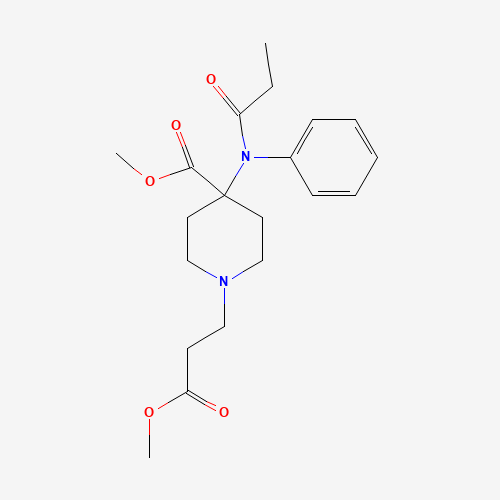
Remifentanil is a piperidinecarboxylate ester that is methyl piperidine-4-carboxylate in which the hydrogen attached to the nitrogen is substituted by a 3-methoxy-3-oxopropyl group and the hydrogen at position 4 is substituted the nitrogen of N-propanoylaniline. It has a role as an opioid analgesic, a sedative, an intravenous anaesthetic and a mu-opioid receptor agonist. It is an anilide, a monocarboxylic acid amide, an alpha-amino acid ester and a piperidinecarboxylate ester.
科学粮草官-词典编辑部,修订于:2026-07-06
Toxicity
ToxicityFate Summary
ATMOSPHERIC FATE: According to a model of gas/particle partitioning of semivolatile organic compounds in the atmosphere(1), remifentanil, which has an estimated vapor pressure of 1.2X10⁻⁸ mm Hg at 25 °C(SRC), determined from a fragment constant method(2), is expected to exist solely in the particulate phase in the ambient atmosphere. Particulate-phase remifentanil may be removed from the air by wet and dry deposition(SRC). Remifentanil contains chromophores that absorb at wavelengths >290 nm(3) and, therefore, may be susceptible to direct photolysis by sunlight(SRC).
Soil Adsorption / Mobility
Using a structure estimation method based on molecular connectivity indices(1), the Koc of remifentanil can be estimated to be 230(SRC). According to a classification scheme(2), this estimated Koc value suggests that remifentanil is expected to have moderate mobility in soil. The estimated pKa of remifentanil is 7.51(3), indicating that this compound will exist partially in the cation form in the environment and cations generally adsorb more strongly to soils containing organic carbon and clay than their neutral counterparts(4).
Environmental Bioconcentration
An estimated BCF of 4 was calculated in fish for remifentanil(SRC), using an estimated log Kow of 1.45(1) and a regression-derived equation(1). According to a classification scheme(2), this BCF suggests the potential for bioconcentration in aquatic organisms is low.
Volatilization from Water / Soil
An estimated pKa of 7.51(1) indicates remifentanil will exist partially in the cation form at pH values of 5 to 9 and, therefore, volatilization of the cation from water and moist soil surfaces is not expected to be an important fate process(SRC). The Henry's Law constant for remifentanil is estimated as 1.3X10⁻¹⁴ atm-cu m/mole(SRC) using a fragment constant estimation method(2). This Henry's Law constant indicates that neutral remifentanil is expected to be essentially nonvolatile from water and moist soil surfaces(3). Remifentanil is not expected to volatilize from dry soil surfaces(SRC) based upon an estimated vapor pressure of 1.2X10⁻⁸ mm Hg(SRC), determined from a fragment constant method(2).
Environmental Abiotic Degradation
A base-catalyzed second-order hydrolysis rate constant of 0.068 L/mole-sec(SRC) was estimated for remifentanil using a structure estimation method(1); this corresponds to half-lives of 3.2 years and 118 days at pH values of 7 and 8, respectively(1). Remifentanil contains chromophores that absorb at wavelengths >290 nm(2) and, therefore, may be susceptible to direct photolysis by sunlight(SRC).
Artificial Pollution Sources
Remifentanil's production and administration as an analgesic and anesthetic adjunct in humans(1) and animals(2) may result in its release to the environment through various waste streams(SRC). It is a Schedule II controlled substance(3).[(1) National Library of Medicine. PubMed Health. Available from, as of May 8, 2017: https://www.ncbi.nlm.nih.gov/pubmedhealth/ (2) Papich MG; Saunders Handbook of Veterinary Drugs Small and Large Animal. 3rd ed. St. Louis, MO: Elsevier Saunders, p. 681 (2011) (3) DEA; Title 21 Code Fed Reg. Part 1308 - Schedules of Controlled Substances. Schedules. Sec 1308.12 Schedule II.
Probable Routes of Human Exposure
Occupational exposure to remifentanil may occur through dermal contact with this compound at workplaces where remifentanil is produced or administered. Exposure to remifentanil among the general population may be limited to those administered the drug or its use as an illicit drug. (SRC)
Environmental Fate / Exposure Summary
Remifentanil's production and administration as an analgesic and anesthetic adjunct in humans and animals may result in its release to the environment through various waste streams. If released to air, an estimated vapor pressure of 1.2X10⁻⁸ mm Hg at 25 °C indicates remifentanil will exist in the particulate phase in the atmosphere. Particulate-phase remifentanil will be removed from the atmosphere by wet and dry deposition. Remifentanil contains chromophores that absorb at wavelengths >290 nm and, therefore, may be susceptible to direct photolysis by sunlight. If released to soil, remifentanil is expected to have moderate mobility based upon an estimated Koc of 230. The estimated pKa of remifentanil is 7.51, indicating that this compound will exist partially in the cation form in the e...
Interactions
[Table#8414]: IiIsIkNsaW5pY2FsIEltcGFjdCIsIkludGVydmVudGlvbiIsIkV4YW1wbGVzIgoiQmVuem9kaWF6ZXBpbmVzIGFuZCBPdGhlciBDZW50cmFsIE5lcnZvdXMgU3lzdGVtIChDTlMpIERlcHJlc3NhbnRzIiwiRHVlIHRvIGFkZGl0aXZlIHBoYXJtYWNvbG9naWMgZWZmZWN0LCB0aGUgY29uY29taXRhbnQgdXNlIG9mIGJlbnpvZGlhemVwaW5lcyBvciBvdGhlciBDTlMgZGVwcmVzc2FudHMgaW5jbHVkaW5nIGFsY29ob2wsIGluY3JlYXNlcyB0aGUgcmlzayBvZiBoeXBvdGVuc2lvbiwgcmVzcGlyYXRvcnkgZGVwcmVzc2lvbiwgcHJvZm91bmQgc2VkYXRpb24sIGNvbWEsIGFuZCBkZWF0aC4iLCJMaW1pdCBkb3NhZ2VzIGFuZCBkdXJhdGlvbnMgdG8gdGhlIG1pbmltdW0gcmVxdWlyZWQuIEZvbGxvdyBwYXRpZW50cyBjbG9zZWx5IGZvciBzaWducyBvZiByZXNwaXJhdG9yeSBkZXByZXNzaW9uIGFuZCBzZWRhdGlvbi4gUGF0aWVudHMgc2hvdWxkIGJlIGFkdmlzZWQgdG8gYXZvaWQgYWxjb2hvbCBmb3IgMjQgaG91cnMgYWZ0ZXIgc3VyZ2VyeS4iLCJCZW56b2RpYXplcGluZXMgYW5kIG90aGVyIHNlZGF0aXZlcy9oeXBub3RpY3MsIGFueGl...
Toxicity Summary
IDENTIFICATION AND USE: Remifentanil is an oil. It is a Schedule II Controlled Substance. It is approved in the US for intravenous administration as an analgesic agent for use during the induction and maintenance of general anesthesia. Remifentanil is also used as an anesthetic agent in animals. HUMAN STUDIES: Remifentanil is a selective mu-receptor agonist with similar potency to fentanyl; the drug shares the actions of the opiate agonists. Respiratory depression, if not immediately recognized and treated, may lead to respiratory arrest and death. Carbon dioxide retention from opioid-induced respiratory depression can exacerbate the sedating effects of opioids. While serious, life-threatening, or fatal respiratory depression can occur at any time during the use of the drug, the risk is...
Human Toxicity Excerpts
/HUMAN EXPOSURE STUDIES/ Remifentanil is a short-acting, esterase-metabolized opioid analgesic. This study compared the abuse liability of remifentanil with that of fentanyl and placebo in a randomized, double-blind, crossover study. Twelve recreational users of opioids received increasing doses of remifentanil (0.6, 1.2, 1.8, 2.4, and 3.0 ug/kg), fentanyl (0.4, 0.8, 1.3, 2.0, 3.0, and 4.5 ug/kg) and placebo via an intravenous infusion pump. Subjective measures (Cole/Addiction Research Center Inventory [ARCI] scales and visual analog scale [VAS] items such as "High" and "Good Effects") and physiologic variables (blood pressure, O2 saturation, pupil diameter) were recorded. For each measure, the differences from baseline were reduced to an area under the response curve (AUC) and a peak,...
Drug Induced Liver Injury
References: DOI:10.1016/j.drudis.2019.09.022
Non-Human Toxicity Excerpts
/LABORATORY ANIMALS: Developmental or Reproductive Toxicity/ Pregnant rabbits were treated from Gestation Day 6 to 18 with intravenous remifentanil doses of 0.1, 0.5, or 0.8 mg/kg/day (0.09, 0.4, or 0.7 times the human intravenous infusion of an induction dose of 1 ug/kg with a maintenance dose of 2 ug/kg/min based on body surface area for a surgical procedure lasting 3 hours based on body surface area, respectively). No malformations were reported in surviving fetuses despite clear maternal toxicity (decreased food consumption and body weights and increased mortality in all treatment groups).
Populations at Special Risk
As for all potent opioids, caution is required with use in morbidly obese patients because of alterations in cardiovascular and respiratory physiology.
Antidote and Emergency Treatment
/SRP:/ Advanced treatment: Consider orotracheal or nasotracheal intubation for airway control in the patient who is unconscious, has severe pulmonary edema, or is in severe respiratory distress. Positive-pressure ventilation techniques with a bag valve mask device may be beneficial. Consider drug therapy for pulmonary edema ... . Consider administering a beta agonist such as albuterol for severe bronchospasm ... . Monitor cardiac rhythm and treat arrhythmias as necessary ... . Start IV administration of D5W TKO /SRP: "To keep open", minimal flow rate/. Use 0.9% saline (NS) or lactated Ringer's (LR) if signs of hypovolemia are present. For hypotension with signs of hypovolemia, administer fluid cautiously. Watch for signs of fluid overload ... . Treat seizures with diazepam or lorazepam...
Effects During Pregnancy and Lactation
A double-blind, randomized study compared patient-controlled intravenous (IV) analgesia with remifentanil (n = 43) to a continuous meperidine infusion (n = 45) for labor analgesia. Patients receiving remifentanil used an average total dosage of 1035 mcg/kg and those receiving meperidine received an average total dosage of 150 mg/kg. Breastfeeding difficulties were experienced in 6.3% of the infants of mothers who received remifentanil and 12.8% of infants whose mothers received meperidine; however, this difference was not statistically significant.