


 一键配货
一键配货
化合物详情
CAS22936-86-3
分子式C9H14ClN5
分子量227.694 g/mol
非危品
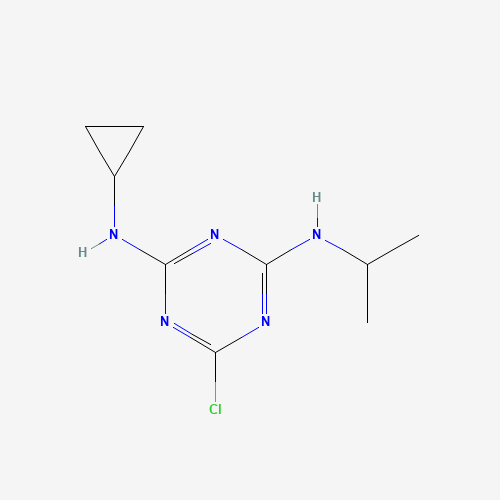
structure
科学粮草官-词典编辑部,修订于:2026-07-06
Toxicity
ToxicityEPA Ecotoxicity
Pesticide Ecotoxicity Data from EPA: 1
Ecotoxicity Values
TLM CARP 10-20 PPM/48 HR /CONDITIONS OF BIOASSAY NOT SPECIFIED/
Fate Summary
ATMOSPHERIC FATE: According to a model of gas/particle partitioning of semivolatile organic compounds in the atmosphere(1), cyprazine, which has a vapor pressure of 3X10⁻⁷ mm Hg at 20 °C(2), is expected to exist in both the vapor and particulate phases in the ambient atmosphere. Vapor-phase cyprazine is degraded in the atmosphere by reaction with photochemically-produced hydroxyl radicals(SRC); the half-life for this reaction in air is estimated to be 20 hours(SRC), from its rate constant of 1.9X10⁻¹¹ cu cm/molecule-sec at 25 °C(3) determined using a structure estimation method(3). Particulate-phase cyprazine may be removed from the air by wet and dry deposition(SRC). Cyprazine may be susceptible to photodegradation based upon photolysis data for s-triazines similar in structure to cypr...
Soil Adsorption / Mobility
The Koc of cyprazine is estimated as 1,100(SRC), using a log Kow of 3.06(1) and a regression-derived equation(2). According to a classification scheme(3), this estimated Koc value suggests that cyprazine is expected to have low mobility in soil.
Environmental Biodegradation
Cyprazine is expected to biodegrade slowly based on biodegradation studies of simazine, which showed no degradation in 3.5 months(1) in soils. The half-life of cyprazine in unfiltered river water was 191 days (6 °C) and 190 days (22 °C)(2). The half-life of cyprazine in filtered river water was 160 days (6 °C) and 254 days (22 °C)(2). The half-life in seawater was 260 days (6 °C) and 184 days (22 °C)(2). No biodegradation was observed in ultrapure water(2).
Environmental Bioconcentration
An estimated BCF of 22 was calculated for cyprazine(SRC), using a log Kow of 3.06(1) and a regression-derived equation(2). According to a classification scheme(3), this BCF suggests the potential for bioconcentration in aquatic organisms is low.
Volatilization from Water / Soil
The Henry's Law constant for cyprazine is estimated as 2.6X10⁻⁹ atm-cu m/mole(SRC) using a fragment constant estimation method(1). This Henry's Law constant indicates that cyprazine is essentially nonvolatile from water surfaces(2). Cyprazine's Henry's Law constant(1) indicates that volatilization from moist soil surfaces is not expected(SRC). Cyprazine is not expected to volatilize from dry soil surfaces(SRC) based upon a vapor pressure of 3X10⁻⁷ mm Hg(3).
Environmental Abiotic Degradation
The rate constant for the vapor-phase reaction of cyprazine with photochemically-produced hydroxyl radicals has been estimated as 1.9X10⁻¹¹ cu cm/molecule-sec at 25 °C(SRC) using a structure estimation method(1). This corresponds to an atmospheric half-life of about 20 hours at an atmospheric concentration of 5X10+5 hydroxyl radicals per cu cm(1). Cyprazine may be subject to hydrolysis in water based on comparison with structurally similar compounds(SRC). The hydrolysis half-life of simazine was reported as 70 days at pH 5(2). Cyprazine may be susceptible to photodegradation based upon photolysis data for s-triazines similar in structure to cyprazine such as simazine(3), but the kinetics of this reaction are unknown(SRC). The half-life of cyprazine was reported as 190 days and 184 days...
Environmental Water Concentrations
SURFACE WATER: Cyprazine was detected, not quantified, in 0.3% of creek water samples from the Hillman Creek watershed in southwestern Ontario, Canada(1). Cyprazine was found in 0.9% of samples of waters collected from 11 agricultural watersheds in Ontario, Canada during 1975-1976 at a max concn of 0.3 ng/l(2). The avg concn ranged from not detected to 0.16 ng/l and from not detected to 0.04 ng/l during May 1975-April 1976 and May 1976-April 1977, respectively, and the overall averages were 0.04 and 0.02 ng/l, respectively(2).
Effluent Concentrations
The concn of cyprazine in tile-drain runoff water from corn fields treated post-emergence with cyprazine ranged <0.01 to 0.57 ug/l and <0.01 to 4.13 ug/l (detection limit 0.01 ug/l) for the first and second seasons of treatment, respectively(1)
Artificial Pollution Sources
Cyprazine's former production and use as a herbicide(1) resulted in its direct release to the environment(SRC).
Probable Routes of Human Exposure
Occupational exposure to cyprazine may occur through inhalation and dermal contact with this compound at workplaces where cyprazine is still produced or used. (SRC)
Environmental Fate / Exposure Summary
Cyprazine's former production and use as a herbicide resulted in its direct release to the environment. If released to air, a vapor pressure of 3X10⁻⁷ mm Hg at 20 °C indicates cyprazine will exist in both the vapor and particulate phases in the ambient atmosphere. Vapor-phase cyprazine will be degraded in the atmosphere by reaction with photochemically-produced hydroxyl radicals; the half-life for this reaction in air is estimated to be 20 hours. Particulate-phase cyprazine will be removed from the atmosphere by wet and dry deposition. Cyprazine may also be degraded by direct photolysis, but the kinetics of this reaction are unknown. If released to soil, cyprazine is expected to have low mobility based upon an estimated Koc of 1,100. Volatilization from moist soil surfaces is not expect...
Non-Human Toxicity Excerpts
/TRIAZINES/ ... MAY EXERT ACTIVITY VIA EITHER FOLIAR UPTAKE OR SOIL APPLICATION OR BOTH. BROADER ACTIVITY APPEARS TO OCCUR VIA SOIL UPTAKE, WHILE THE FOLIAR ACTIVE CMPD ... TEND TO BE LIMITED IN THEIR ACTIVITY TO THE SIMPLE ANNUALS OR MERELY TO FOLIAGE KILL OF PERENNIALS. /TRIAZINES/









