


 一键配货
一键配货
化合物详情
CAS51481-10-8
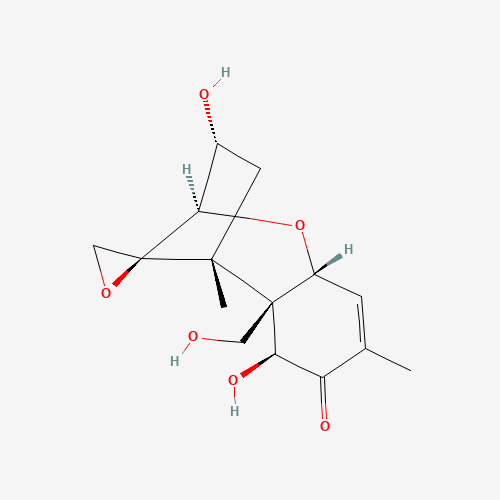
分子式C15H20O6
分子量296.32 g/mol g/mol
危化品
Deoxynivalenol is a trichothecene mycotoxin produced by Fusarium to which wheat, barley, maize (corn) and their products are susceptible to contamination. It has a role as a mycotoxin. It is a primary alcohol, a secondary alpha-hydroxy ketone, a triol, a cyclic ketone, an enone and a trichothecene.
科学粮草官-词典编辑部,修订于:2026-07-06
Toxicity
ToxicityFate Summary
ATMOSPHERIC FATE: According to a model of gas/particle partitioning of semivolatile organic compounds in the atmosphere(1), deoxynivalenol, which has an estimated vapor pressure of 6.8X10⁻¹¹ mm Hg at 25 °C(SRC), determined from a fragment constant method(2), is expected to exist solely in the particulate phase in the ambient atmosphere. Particulate-phase deoxynivalenol may be removed from the air by wet and dry deposition(SRC).
Soil Adsorption / Mobility
Using a structure estimation method based on molecular connectivity indices(1), the Koc of deoxynivalenol can be estimated to range from about 150 to 1500 when the variable effects of multiple functional groups are considered(SRC). According to a classification scheme(2), the estimated Koc values suggest that deoxynivalenol is expected to have moderate to low mobility in soil.
Environmental Biodegradation
PURE CULTURE: Thirteen bacterium isolated from field soils and wheat leaves were able to degrade deoxynivalenol(1). A bacterium capable of degrading deoxynivalenol was obtained from soil samples collected in wheat fields using an enrichment culture procedure(2); the isolated bacterium, designated strain WSN05-2, completely removed 1,000 g/mL of deoxynivalenol from the culture medium after incubation for 10 days(2).
Environmental Bioconcentration
An estimated BCF of 3 was calculated in fish for deoxynivalenol(SRC), using an estimated log Kow of -0.71(1) and a regression-derived equation(1). According to a classification scheme(2), this BCF suggests the potential for bioconcentration in aquatic organisms is low(SRC).
Volatilization from Water / Soil
The Henry's Law constant for deoxynivalenol is estimated as 2.0X10⁻¹⁴ atm-cu m/mole(SRC) using a fragment constant estimation method(1). This Henry's Law constant indicates that deoxynivalenol is expected to be essentially nonvolatile from water surfaces(2). Deoxynivalenol's Henry's Law constant indicates that volatilization from moist soil surfaces is not expected to occur(SRC). Deoxynivalenol is not expected to volatilize from dry soil surfaces(SRC) based upon an estimated vapor pressure of 6.8X10⁻¹¹ mm Hg(SRC), determined from a fragment constant method(1).
Environmental Abiotic Degradation
The rate constant for the vapor-phase reaction of deoxynivalenol with photochemically-produced hydroxyl radicals has been estimated as 1.4X10⁻¹⁰ cu cm/molecule-sec at 25 °C(SRC) using a structure estimation method(1). This corresponds to an atmospheric half-life of about 2.7 hours at an atmospheric concentration of 5X10+5 hydroxyl radicals per cu cm(1). The rate constant for the vapor-phase reaction of deoxynivalenol with ozone has been estimated as 7.4X10⁻¹⁷ cu cm/molecule-sec at 25 °C(SRC) that was derived using a structure estimation method(1). This corresponds to an atmospheric half-life of about 3.7 hours at an atmospheric concentration of 7X10+11 ozone molecules per cu cm(1). Epoxide functions are potentially susceptible to aqueous hydrolysis(2). However, based on the epoxide func...
Environmental Water Concentrations
SURFACE WATER: Mean deoxynivalenol concentration in Swiss rivers in July and August 2007 was 22 ng/L(1).
Food Survey Values
Mycotoxins are common dietary contaminants in most regions of the world. The frequency of exposure to the various families of mycotoxins is often dependent on geographic location, national wealth and related agricultural and regulatory infrastructure, combined with diversity of diet and degree of food sufficiency. Deoxynivalenol (DON) is a Fusarium mycotoxin that frequently contaminates wheat, corn and barley in temperate regions. A number of acute poisoning incidences have been linked to DON-contaminated foods and chronic exposure to lower levels of DON has been predicted in many regions. DON is a potent animal toxin and exposure in humans may cause gastroenteritis, growth faltering and immune toxicity. An ability to conduct accurate exposure assessment at the individual level is requi...
Ecotoxicity Excerpts
/PLANTS/ To understand further the role of deoxynivalenol (DON) in development of Fusarium head blight (FHB), .../the/ effects of the toxin on uninfected barley tissues /were investigated/. Leaf segments, 1 to 1.2 cm long, partially stripped of epidermis were floated with exposed mesophyll in contact with DON solutions. In initial experiments with the leaf segments incubated in light, DON at 30 to 90 ppm turned portions of stripped tissues white after 48 to 96 hr. The bleaching effect was greatly enhanced by addition of 1 to 10 mM Ca(2+), so that DON at 10 to 30 ppm turned virtually all stripped tissues white within 48 hr. Content of chlorophylls a and b and of total carotenoid pigment was reduced. Loss of electrolytes and uptake of Evans blue indicated that DON had a toxic effect, dama...
Plant Concentrations
Surveys for the presence of trichothecenes have revealed the world-wide occurrence of deoxynivalenol (DON), primarily in cereals, such as wheat and corn, at levels occasionally as high as 92 mg/kg, though average levels are considerably lower and vary with commodity. There are isolated reports of the occurrence of DON in barley, mixed feeds, potatoes, etc(1). /Trichothecenes/
Effluent Concentrations
Wastewaters from food production and bioethanol production may contribute to deoxynivalenol contamination of surface water(1).
Natural Pollution Sources
.../Trichothecene/ compounds are produced primarily by moulds belonging to the genus Fusarium, though other genera, including Trichoderma, Trichothecium, Myrothecium, and Stachybotrys, are also known to produce metabolites now characterized as trichothecenes. Only a few of the known trichothecenes have been found to contaminate food or animal feed including ... deoxynivalenol (DON)... by far the most commonly encountered in food and animal feed is DON(1). /Trichothecenes/
Atmospheric Concentrations
INDOOR AIR: Deoxynivalenol was rarely reported as a contaminant of indoor air due to mold-infested building material(1)..
Artificial Pollution Sources
Deoxynivalenol's production may result in its release to the environment through various waste streams(SRC). Wastewaters from food production and bioethanol production may contribute to deoxynivalenol contamination of surface water(1). Its use as a biological warfare agent(2,3) and mycoherbicide against drug crops(3) will result in its direct release to the environment(SRC).
Probable Routes of Human Exposure
Occupational exposure to deoxynivalenol may occur through inhalation and dermal contact with this compound at workplaces where deoxynivalenol is produced or used. There is a considerable occupational risk among farmers engaged in grain threshing due to inhalation(1). Potential human exposure to deoxynivalenol may occur from its frequent contamination of oats, corn, wheat, barley, rice, and other grains in the field used in consumer food products(1); it has been detected in buckwheat, popcorn, sorghum, triticale, flour, bread, breakfast cereals, noodles, infant foods, pancakes, malt, and beer(1).
Environmental Fate / Exposure Summary
Deoxynivalenol's production may result in its release to the environment through various waste streams. Wastewaters from grain processing and bioethanol production may contribute to deoxynivalenol contamination of surface water. Its use as a biological warfare agent and mycoherbicide against drug crops will result in its direct release to the environment. Deoxynivalenol is formed in nature as a metabolite of various fungi. The occurrence of deoxynivalenol in the environment is mainly linked with fungi species Fusarium graminearum and Fusarium culmorum. If released to air, an estimated vapor pressure of 6.8X10⁻¹¹ mm Hg at 25 °C indicates deoxynivalenol will exist solely in the particulate phase in the atmosphere. Particulate-phase deoxynivalenol will be removed from the atmosphere by wet...
Symptoms
After direct dermal application or oral ingestion, the trichothecene mycotoxins can cause rapid irritation to the skin or intestinal mucosa, including skin irritation, burning and itching, rash or blisters, and bleeding. Eye contact can cause tearing, eye pain, conjunctivitis, burning sensations about the eyes, and blurred vision for up to 1 week. Symptoms also include nausea, vomiting, fatigue, dyspnea, and acute vascular effects leading to hypotension and shock. (L1948, L1949)
Treatment
There are no known antidotes to trichothecene mycotoxins. Treatments are directed at supporting hemopoietic abnormalities, gastrointestinal damage, and skin damage. Administer charcoal as a slurry in case of acute oral exposure. In case of inhalation: Move patient to fresh air. Monitor for respiratory distress. If cough or difficulty breathing develops, evaluate for respiratory tract irritation, bronchitis, or pneumonitis. Administer oxygen and assist ventilation as required. Treat bronchospasm with inhaled beta2 agonist and oral or parenteral corticosteroids. In case of eye exposure, Irrigate exposed eyes with copious amounts of room temperature water for at least 15 minutes. In case of dermal exposure, Remove contaminated clothing and wash exposed area thoroughly with soap and water....
Toxicity Data
LD50: 70 mg/kg (Intraperitoneal, Mouse) (T312) LD50: 46 mg/kg (Oral, Mouse) (T313) LD50: 43 mg/kg (Subcutaneous, Mouse) (L1949)
Health Effects
Trichothecenes have multiorgan effects including anoerxia and weight loss, growth retardation, nervous disorders, cardiovascular alterations, immunodepression, hemostatic derangements, skin toxicity, decreased reproductive capacity, bone marrow damage, and alimentary toxic aleukia. (L1948, L1949, A2964)
Exposure Routes
Oral, dermal, inhalation, and parenteral (contaminated drugs). (A3101)
Toxicity Summary
Unlike many other mycotoxins, trichothecenes do not require metabolic activation to exert their biological activity, instead directly reacting with cellular components. Trichothecenes are cytotoxic to most eukaryotic cells due to their powerful ability to inhibit protein synthesis. They do this by freely moving across the plasma membrane and binding specifically to ribosomes with high-affinity. Specifically, they interfere with the active site of peptidyl transferase at the 3'-end of large 28S ribosomal RNA and inhibit the initiation, elongation or termination step of protein synthesis, as well as cause polyribosomal disaggregation. Protein synthesis is an essential function in all tissues, but tissues where cells are actively and rapidly growing and dividing are very susceptible to the...
Carcinogen Classification
3, not classifiable as to its carcinogenicity to humans. (L135)
Evidence for Carcinogenicity
Evaluation: There is inadequate evidence in humans for the carcinogenicity of toxins derived from Fusarium graminearum. There is inadequate evidence in experimental animals for the carcinogenicity of deoxynivalenol. Overall evaluation: Toxins derived from Fusarium graminearum, F. culmorum and F. crookwellense are not classifiable as to their carcinogenicity to humans (Group 3).
Antidote and Emergency Treatment
Emergency and supportive measures: Treat bronchospasm and hypoxemia if they are present. Specific drugs and antidotes: None. /Molds/









