


 一键配货
一键配货
化合物详情
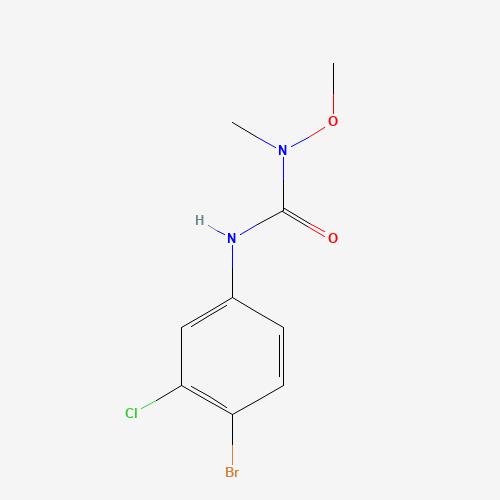
CAS13360-45-7
分子式C9H10BrClN2O2
分子量293.545 g/mol
非危品
Chlorbromuron is a member of ureas.
科学粮草官-词典编辑部,修订于:2026-07-06
Toxicity
ToxicityEPA Ecotoxicity
Pesticide Ecotoxicity Data from EPA: 3
Soil Adsorption / Mobility
An Rf value of 0.14 was measured for chlorbromuron on Hagerstown soil TLC plates(1). An average Koc of 380 was measured for 17 Australian soils(2). An average Koc of 217 was reported for chlorbromuron(3). Koc values from 561 to 3262 were measured in 5 Czechoslovakian soils with a mean value of 1557; adsorption was thought to be related to soil organic matter content(4). According to a recommended classification scheme(5), these measured Koc values suggest that chlorbromuron has slight to moderate mobility in soil(SRC). The vertical distribution of chlorbromuron in a sandy soil (pH=5.9, organic matter=1.13%) was measured following 10 cm of rain; concns were >2, 0, 0, 0 mg/kg at depths of 0-2.5, 2.5-5, 5-7.5, and 7.5-10 cm, respectively(2).
Environmental Bioconcentration
An estimated BCF value of 130 was calculated for chlorbromuron(SRC), using a measured log Kow of 3.09(1) and a recommended regression-derived equation(2). According to a classification scheme(3), this BCF value suggests that bioconcentration in aquatic organisms is high(SRC).
Volatilization from Water / Soil
The Henry's Law constant for chlorbromuron is estimated as 4.4X10⁻⁹ atm-cu m/mole(SRC) from its experimental values for vapor pressure, 3.97X10⁻⁷ mm Hg(1), and water solubility, 35 mg/l(2). This value indicates that chlorbromuron will be essentially nonvolatile from water surfaces(3,SRC). Chlorbromuron's values for vapor pressure(1) and Henry's Law constant(1,2,SRC) indicate that volatilization from dry and moist soil surfaces should not occur(SRC).
Environmental Abiotic Degradation
The rate constant for the vapor-phase reaction of chlorbromuron with photochemically produced hydroxyl radicals has been estimated as 1.0X10⁻¹¹ cu cm/molecule-sec at 25 °C(SRC) using a structure estimation method(1,SRC). This corresponds to an atmospheric half-life of about 1.5 days at an atmospheric concn of 5X10+5 hydroxyl radicals per cu cm(1,SRC).
Food Survey Values
The bulb of rape celery grown in the presence of chlorbromuron did not contain measurable concns of this herbicide (detection limit=0.02 ug/g fresh weight)(1). Chlorbromuron was detected in 12 of 26 composite carrot samples collected from farm deliveries in Ontario, Canada between 1980 and 1985 (concns from 0.03-0.14 mg/kg)(2).
Artificial Pollution Sources
Chlorbromuron's former use(1) as a selective herbicide(2) resulted in its direct release to the environment(SRC).
Probable Routes of Human Exposure
The general population may be exposed to chlorbromuron through the ingestion of contaminated food. Occupational exposure may be through inhalation or dermal contact. (SRC)
Environmental Fate / Exposure Summary
Chlorbromuron's former use as a selective herbicide resulted in its direct release to the environment. If released to the atmosphere, chlorbromuron should exist in both the vapor and particulate phases in the ambient atmosphere, based on a measured vapor pressure of 3.97X10⁻⁷ mm Hg at 20 °C. Vapor-phase chlorbromuron is degraded in the atmosphere by reaction with photochemically-produced hydroxyl radicals with a half-life of about 1.5 days. Particulate-phase chlorbromuron may be physically removed from the air by dry deposition. Measured Koc values from 217 to 3262 indicate that chlorbromuron has moderate to slight mobility in soil. Volatilization from dry and moist soil surfaces should not be significant. Based on soil studies, chlorbromuron is expected to biodegrade in soil and water....
Toxicity Data
LC50 (rat) > 1,050 mg/m3/6h
Adverse Effects
Methemoglobinemia - The presence of increased methemoglobin in the blood; the compound is classified as secondary toxic effect
Non-Human Toxicity Values
LD50 Rabbit dermal >10,000 mg/kg
Antidote and Emergency Treatment
Treatment should include decontamination and aggressive supportive care. Additionally, methylene blue, 1 to 2 mg/kg/dose, should be given if significant methemoglobinemia is present. /Urea-substituted herbicides/









