

 一键配货
一键配货
化合物详情
CAS6027-13-0
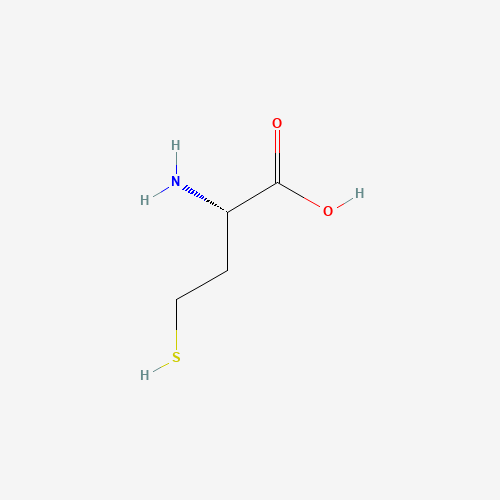
分子式HSCH2CH2CH(NH2)COOH
分子量135.18 g/mol g/mol
危化品
L-homocysteine is a homocysteine that has L configuration. It has a role as a mouse metabolite. It is a homocysteine and a serine family amino acid. It is a conjugate acid of a L-homocysteinate. It is a tautomer of a L-homocysteine zwitterion.
科学粮草官-词典编辑部,修订于:2026-07-06
Toxicity
ToxicitySymptoms
Moderately high levels of homocysteine produce no overt symptoms. Extremely high levels in adults over extended periods of times can lead to the usual symptoms of heart disease (high blood pressure, atherosclerosis, shortness of breath, poor exercise tolerance, etc.). Individuals with genetic forms of homocysteinuria experience such symptoms as dislocation of the lenses in the eyes, nearsightedness, abnormal blood clots, osteoporosis (weakening of the bones), learning disabilities and developmental problems. As a uremic toxin, high levels of homocysteine in adults can cause uremic syndrome. Uremic syndrome may affect any part of the body and can cause nausea, vomiting, loss of appetite, and weight loss. It can also cause changes in mental status, such as confusion, reduced awareness, ag...
Treatment
Several groups of investigators have reported a positive impact of supplementation with vitamins B6, B12, and folic acid, administered alone or jointly, in patients with homocystinuria. Folic acid appears to be useful in most subjects while very high doses of B6 (100 mg or more daily) also seem to have broad utility. The efficacy of supplemental B12 may likewise hinge on baseline B12 status. Lower homocysteine levels in people who eat breakfast cereals may reflect the fact that such cereals are frequently enriched with B vitamins. High intakes of betaine (6 grams or more daily) have been used successfully to treat genetic homocystinuria in humans.
Health Effects
Chronically high levels of homocysteine (hyperhomocysteinemia) is associated with increased incidence of cardiovascular disease and Alzheimer's disease. Elevations in plasma homocysteine are commonly found as a result of vitamin deficiencies, polymorphisms of enzymes of methionine metabolism, and renal disease. Homocysteine is an independent cardiovascular disease (CVD) risk factor. This includes heart attack, stroke, peripheral atherosclerosis, and venous thromboembolism (the blockage of a blood vessel by a migrating clot). Furthermore, the risk associated with homocysteine appears to increase throughout the normal range of concentrations; each 1 micromolar rise in the concentration of homocysteine in the blood corresponds to an increase of about 10% in cardiovascular risk. A high leve...
Exposure Routes
Endogenous
Toxicity Summary
Nitrosylation converts homocysteine (Hcy) into a methionine analogue, S-nitroso-Homocysteine, which can substitute for methionine in protein synthesis in biological systems. In humans, homocyteine-thiolactone modifies proteins posttranslationally by forming adducts in which homocysteine is linked by amide bonds to epsilon-amino group of protein lysine residues (Hcy-epsilonN-Lys-protein). Levels of homocystine bound by amide or peptide linkages (Homocysteine-N-protein) in human plasma proteins are directly related to plasma 'total homocysteine' levels. Homocysteine-N-hemoglobin and Homocysteine-N-albumin constitute a major pool of homocysteine in human blood, larger than 'total homocysteine' pool. Homocysteine-thiolactone is present in human plasma. Modification with Homocysteine-thiolac...
Minimum Risk Level
Serum levels > 15 µmol/L
Carcinogen Classification
No indication of carcinogenicity to humans (not listed by IARC).