


 一键配货
一键配货
化合物详情
CAS133454-47-4
分子式C9H9NO2
分子量426.4806 g/mol
非危品
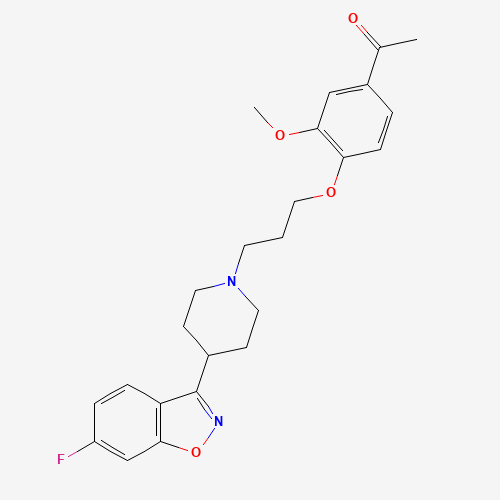
Iloperidone is a member of the class of piperidines that is the 4-acetyl-2-methoxyphenyl ether of 3-(piperidin-1-yl)propan-1-ol which is substituted at position 4 of the piperidine ring by a 6-fluoro-1,2-benzoxazol-3-yl group. A member of the group of second generation antipsychotics (also known as an atypical antipsychotics), it is used for the treatment of schizophrenia. It has a role as a serotonergic antagonist, a dopaminergic antagonist and a second generation antipsychotic. It is a member of piperidines, an aromatic ether, an organofluorine compound, a tertiary amino compound, a member of 1,2-benzoxazoles, a methyl ketone, a monoamine and an aromatic ketone.
科学粮草官-词典编辑部,修订于:2026-07-06
Toxicity
ToxicityInteractions
Because of its alpha1-adrenergic blocking activity and potential to cause orthostatic hypotension and syncope, the manufacturer recommends that iloperidone be used with caution in patients receiving antihypertensive agents and other drugs that can cause hypotension; monitoring of orthostatic vital signs should be considered in such patients.
Hepatotoxicity
Likelihood score: E (unlikely cause of clinically apparent liver injury).
Toxicity Summary
IDENTIFICATION AND USE: Ilperidone is a white to off-white finely crystalline powder formulated into oral tablets. Iloperidone is considered an atypical or second-generation antipsychotic agent. It is used for the treatment of adults with schizophrenia. HUMAN EXPOSURE AND TOXICITY: In premarketing trials involving over 3210 patients, accidental or intentional overdose of iloperidone was documented in 8 patients with no fatalities. In general, reported signs and symptoms were those resulting from an exaggeration of the known pharmacological effects (e.g., drowsiness and sedation, tachycardia and hypotension). Elderly patients with dementia-related psychosis treated with iloperidone are at an increased risk of death and therefore iloperidone is not approved for use in that population. Ilo...
Human Toxicity Excerpts
/SIGNS AND SYMPTOMS/ A potentially fatal symptom complex sometimes referred to as Neuroleptic Malignant Syndrome (NMS) has been reported in association with administration of antipsychotic drugs, including Fanapt. Clinical manifestations include hyperpyrexia, muscle rigidity, altered mental status (including catatonic signs) and evidence of autonomic instability (irregular pulse or blood pressure, tachycardia, diaphoresis, and cardiac dysrhythmia). Additional signs may include elevated creatine phosphokinase, myoglobinuria (rhabdomyolysis), and acute renal failure.
Drug Induced Liver Injury
References: DOI:10.1016/j.drudis.2016.02.015
Non-Human Toxicity Excerpts
/LABORATORY ANIMALS: Developmental or Reproductive Toxicity/ In additional studies in which ... rats .. were given iloperidone ... beginning from either pre-conception or from day 17 of gestation and continuing through weaning, adverse reproductive effects included prolonged pregnancy and parturition, increased stillbirth rates, increased incidence of fetal visceral variations, decreased fetal and pup weights, and decreased post-partum pup survival. There were no drug effects on the neurobehavioral or reproductive development of the surviving pups. No-effect doses ranged from 4 to 12 mg/kg except for the increase in stillbirth rates which occurred at the lowest dose tested of 4 mg/kg, which is 1.6 times the maximum recommended human dose (MRHD) on a mg/sq m basis. Maternal toxicity was...
Populations at Special Risk
Neonates exposed to antipsychotic drugs, during the third trimester of pregnancy are at risk for extrapyramidal and/or withdrawal symptoms following delivery. There have been reports of agitation, hypertonia, hypotonia, tremor, somnolence, respiratory distress and feeding disorder in these neonates. These complications have varied in severity; while in some cases symptoms have been self-limited, in other cases neonates have required intensive care unit support and prolonged hospitalization. Fanapt should be used during pregnancy only if the potential benefit justifies the potential risk to the fetus.
Antidote and Emergency Treatment
Enhanced elimination. Owing to extensive tissue distribution, these drugs are not effectively removed by dialysis or hemoperfusion. Repeat-dose activated charcoal has not been evaluated. /Antipsychotic drugs/
Effects During Pregnancy and Lactation
Patients enlisted in the National Pregnancy Registry for Atypical Antipsychotics who were taking a second-generation antipsychotic drug while breastfeeding (n = 576) were compared to control breastfeeding patients who had primarily diagnoses of major depressive disorder and anxiety disorders, most often treated with SSRI or SNRI antidepressants, but not with a second-generation antipsychotic (n = 818). Among women on a second-generation antipsychotic, 60.4% were on more than one psychotropic compared with 24.4% among women in the control group. Of the women on a second-generation antipsychotic, 59.3% reported “ever breastfeeding” compared to 88.2% of women in the control group. At 3 months postpartum, 23% of women on a second-generation antipsychotic were exclusively breastfeeding compa...









