

 一键配货
一键配货
化合物详情
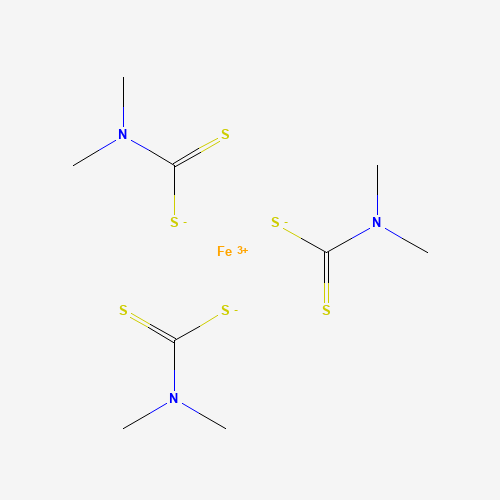
CAS14484-64-1
分子式C9H18FeN3S6
分子量416.49 g/mol g/mol
危化品
Physical Description | Ferbam is a dark brown to black odorless solid. Used as a fungicide. (NIOSH, 2024)
科学粮草官-词典编辑部,修订于:2026-07-06
Toxicity
ToxicityEPA Ecotoxicity
Pesticide Ecotoxicity Data from EPA: 17
Fate Summary
ATMOSPHERIC FATE: According to a model of gas/particle partitioning of semivolatile organic compounds in the atmosphere(1), ferbam, which has a negligible vapor pressure at 20 °C(2), is expected to exist solely in the particulate phase in the ambient atmosphere. Particulate-phase ferbam may be removed from the air by wet and dry deposition(SRC). Ferbam tends to decompose, releasing carbon disulfide(3), under the influence of air, moisture, and heat(2).
Soil Adsorption / Mobility
Adsorption coefficient (Kd) = 300 mg/g
Environmental Biodegradation
AEROBIC: In pH 3.4 sandy soil, ferbam was largely decomposed after 4 to 5 weeks, while in pH 7.0 soil ferbam was decomposed after 14 to 15 weeks(1). Ferbam took longer than 8 weeks to reach the half-decay point in humus sandy soils as determined by activity to Rhizoctonia solani. If the humus content was 1.2% or below, an initial lag in the start of decomposition was observed(2). Ferbam releases carbon disulfide when it decomposes in soil(3).
Environmental Bioconcentration
An estimated BCF of 3 was calculated for ferbam(SRC), using a log Kow of -1.60(1) and a regression-derived equation(2). According to a classification scheme(3), this BCF suggests the potential for bioconcentration in aquatic organisms is low(SRC), provided the compound is not altered physically or chemically once released into the environment.
Volatilization from Water / Soil
Ferbam has a negligible vapor pressure and is not expected to volatilize from water surfaces or from moist soil surfaces(1).
Environmental Abiotic Degradation
Ferbam, as a metal salt, has negligible vapor pressure(1) and is expected to exist in the atmosphere as an aerosol(SRC). Particulate ferbam may be removed physically from air by wet and dry deposition(SRC). Ferbam tends to decompose, releasing carbon disulfide(2), under the influence of air, moisture, and heat(1).
Milk Concentrations
In the pregnant rats, a small but significant amount of radiolabel readily crossed the placenta into the fetus. In lactating rats, radiolabel was secreted into the milk, absorbed by the pups, and excreted in the pups' urine.
ICSC Environmental Data
The substance is very toxic to aquatic organisms. Avoid release to the environment in circumstances different to normal use.
Artificial Pollution Sources
Ferbam's production may result in its release to the environment through various waste streams; it's use as a fungicide(1) will result in its direct release to the environment(SRC). Its production and use in rubber processing(2) may result in its release to the environment through various waste streams(SRC).
Probable Routes of Human Exposure
NIOSH (NOES Survey 1981-1983) has statistically estimated that 3,205 workers are potentially exposed to ferbam in the US(1). The NOES Survey does not include farm workers. Occupational exposure to ferbam may occur through inhalation and dermal contact with this compound at workplaces where ferbam is produced or used(SRC).
Environmental Fate / Exposure Summary
Ferbam's production may result in its release to the environment through various waste streams; it's use as a fungicide will result in its direct release to the environment. Its production and use in rubber processing may result in its release to the environment through various waste streams. If released to air, a negligible vapor pressure at 20 °C indicates ferbam will exist solely in the particulate phase in the ambient atmosphere. Particulate-phase ferbam will be removed from the atmosphere by wet and dry deposition. If released to soil, ferbam is expected to have moderate mobility based upon an estimated Koc of 300. Biodegradation is not expected to be an important environmental fate process based on a 14-15 week degradation rate in soil at pH 7. Ferbam has a negligible vapor pressu...
Symptoms
irritation eyes, resp tract; dermatitis; gastrointestinal disturbance
Interactions
Exposure to ferbam may cause alcohol intolerance.
Target Organs
Eyes, skin, respiratory system, gastrointestinal tract
Adverse Effects
ACGIH Carcinogen - Not Classifiable.
Exposure Routes
inhalation, ingestion, skin and/or eye contact
RAIS Toxicity Values
Oral Chronic Reference Dose Reference: OPP
Human Toxicity Excerpts
/SIGNS AND SYMPTOMS/ Symptomatology (primary toxic reaction, not that induced by alcohol, as inferred in part from clinical reports of disulfiram overdoses): Nausea, vomiting, diarrhea, anorexia, weight loss. ... Headache, lethargy, dizziness, ataxia, confusion, drowsiness, emotional lability and coma. ...Reduction in blood pressure, not usually severe unless fluid and electrolyte deficits are extensive. Suppression of tendon reflexes. Hypotonia and, within a few hr or a few days, flaccid paralysis. ... Resp paralysis and death. Severe dermatitis and hepatitis probably represent hypersensitivity reactions. /Thiram/
Carcinogen Classification
IARC Monographs: Volume Sup 7: Overall Evaluations of Carcinogenicity: An Updating of IARC Monographs Volumes 1 to 42, 1987; 440 pages; ISBN 92-832-1411-0 (out of print)
Non-Human Toxicity Values
LC50 Rat inhalation 0.4 mg/L/4 hr