

 一键配货
一键配货
化合物详情
CAS124-48-1
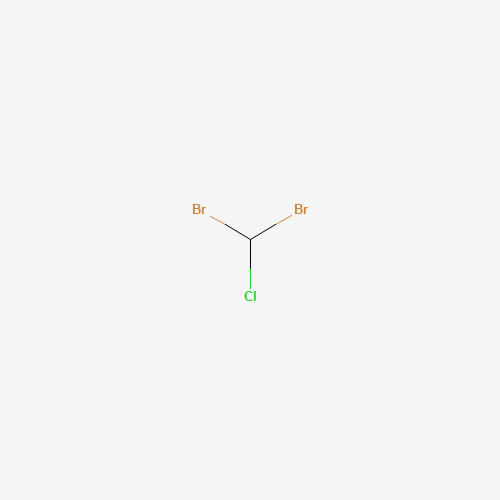
分子式CHBr2Cl
分子量208.28 g/mol
非危品
Physical Description | Chlorodibromomethane is a clear colorless to yellow-orange liquid. Density 2.451 g / cm3. No flash point.
科学粮草官-词典编辑部,修订于:2026-07-06
Toxicity
ToxicityBody Burden
Chlorodibromomethane was identified in one of 12 human milk samples collected from volunteers from four USA cities (Bridgeville, PA; Bayonne, NJ; Jersey City, NJ; and Baton Rouge, LA) (1). Chlorodibromomethane was not detected in any sample from the USEPA National Human Adipose Tissue Survey for fiscal year 1982(2). 12% of 1035 blood samples tested positive for chlorodibromomethane exposure in a non-occupationally exposed U.S. population(3).
Ecotoxicity Values
EC50 Tetrahymena pyriformis (Ciliate; decreased proliferation) 65 mg/L/24 hr; static, 30 °C
Fate Summary
ATMOSPHERIC FATE: According to a model of gas/particle partitioning of semivolatile organic compounds in the atmosphere(1), chlorodibromomethane, which has an estimated vapor pressure of 5.5 mm Hg at 25 °C(SRC), using a fragment constant estimation method(2), is expected to exist solely as a vapor in the ambient atmosphere. Vapor-phase chlorodibromomethane is degraded in the atmosphere by reaction with photochemically-produced hydroxyl radicals(SRC); the half-life for this reaction in air is estimated to be 280 days(SRC), calculated from its rate constant of 5.8X10⁻¹⁴ cu cm/molecule-sec at 25 °C(SRC) determined using a structure estimation method(3). Direct photolysis does not occur below the ozone layer(4).
Soil Adsorption / Mobility
The Koc of chlorodibromomethane is 84(1). According to a classification scheme(2), this Koc value suggests that chlorodibromomethane is expected to have high mobility in soil. Bromodichloromethane, which is similar in structure to chlorodibromomethane, has been observed to have moderate mobility in laboratory soil column experiments utilizing a sandy soil(3). Relatively high soil mobility was noted for chlorodibromomethane during a water infiltration study conducted in the Netherlands along the Rhine River(4). A soil retardation factor of 6 (indicating significant mobility) was estimated during a groundwater recharge project(5).
Environmental Biodegradation
ANAEROBIC: In anaerobic tests using mixed methanogenic bacterial cultures from sewage effluents, chlorodibromomethane was totally degraded within 2 weeks while only 43-50% was lost in sterile controls after 6 weeks; no degradation was noted in aerobic tests in either sterile or seeded conditions(1). Studies conducted under anoxic conditions with denitrifying bacteria found >50% degradation in bacterial cultures after 8 weeks but no degradation in sterile controls(2). Rapid degradation was observed in a continuous-flow methanogenic fixed-film laboratory-scale column using seeded cultures, but only slow degradation was noted in sterile controls(3). Studies show the decrease of chlorodibromomethane through riverbank filtration to be <40 percent(4). Anaerobic rate coefficients were estimate...
Environmental Bioconcentration
An estimated BCF of 9 was calculated for chlorodibromomethane(SRC), using a log Kow of 2.16(1) and a regression-derived equation(2). According to a classification scheme(3), this BCF suggests the potential for bioconcentration in aquatic organisms is low(SRC).
Volatilization from Water / Soil
The Henry's Law constant for chlorodibromomethane is 7.83X10⁻⁴ atm-cu m/mole(1). This Henry's Law constant indicates that chlorodibromomethane is expected to volatilize from water surfaces(2). Based on this Henry's Law constant, the volatilization half-life from a model river (1 m deep, flowing 1 m/sec, wind velocity of 3 m/sec)(2) is estimated as 2.6 hours(SRC). The volatilization half-life from a model lake (1 m deep, flowing 0.05 m/sec, wind velocity of 0.5 m/sec)(2) is estimated as 6 days(SRC). Chlorodibromomethane's Henry's Law constant(1) indicates that volatilization from moist soil surfaces may occur(SRC). The potential for volatilization of chlorodibromomethane from dry soil surfaces may exist(SRC) based upon an estimated vapor pressure of 5.5 mm Hg(SRC), determined from a frag...
Environmental Abiotic Degradation
The rate constant for the vapor-phase reaction of chlorodibromomethane with photochemically-produced hydroxyl radicals has been estimated as 5.8X10⁻¹⁴ cu cm/molecule-sec at 25 °C(SRC) using a structure estimation method(1). This corresponds to an atmospheric half-life of about 280 days at an atmospheric concentration of 5X10+5 hydroxyl radicals per cu cm(1). A base-catalyzed second-order hydrolysis rate constant of 3.1X10⁻⁴ L/mole-sec(SRC) was estimated using a structure estimation method(2); this corresponds to half-lives of 700 and 70 years at pH values of 7 and 8, respectively(2). Direct photolysis or aquatic oxidation (via peroxy radicals or singlet oxygen) are not environmentally relevant processes with respect to chlorodibromomethane(3).
Environmental Water Concentrations
RAIN/SNOW: Chlorodibromomethane was detected at a concentration of 0.4 ng/L in rain collected in southern Germany in 1985(1).
Food Survey Values
An analysis of 12 samples of various German milk products (ice cream, yogurt, curds, buttermilk) found chlorodibromomethane levels ranging from not detectable to 0.3 ug/kg with an overall mean concentration of 0.1 ug/kg(1). Chlorodibromomethane concentrations in food samples ranged from not detected to 0.6 ppb for 24 hour duplicate portion diet in Japanese housewives(2).
Milk Concentrations
An analysis of 12 samples of various German milk products (ice cream, yogurt, curds, buttermilk) found chlorodibromomethane levels ranging from not detectable to 0.3 ug/kg with an overall mean concentration of 0.1 ug/kg(1).
Ecotoxicity Excerpts
/AQUATIC SPECIES/ .... Toxicity of the 4 Cl- or Br-containing trihalomethanes (chloroform, bromodichloromethane, dibromochloromethane and bromoform) to developing common carp (Cyprinus carpio) embryos was determined under conditions of intermittent (8 hr) toxicant renewal, based on percentage hatch as the end point. Nominal median lethal concentrations (LC50) ranged from 161 mg/l for chloroform to 53 mg/l for dibromochloromethane. Decay studies conducted under conditions similar to those used for the toxicity studies, but in distilled water, indicated that half-lives of the trihalomethanes ranged from 4.4-6.9 hr decay was due primarily to volatilization, and higher relative toxicity of dibromochloromethane probably was due to formation of a degradation product (likely Br2). Correction o...
Plant Concentrations
Mean chlorodibromomethane levels of 150-590 ng/g (dry wt) have been detected in various species of marine algae(1).
Effluent Concentrations
An analysis of the USEPA STORET Data Base found that chlorodibromomethane had been positively detected in 6.5% of 1298 effluent observation stations at a median concentration below 2.4 ug/L(1). Chlorodibromomethane was detected in 8 of 63 industrial wastewater discharges in the USA at levels ranging from <10-100 ppb(2). Three municipal wastewater treatment facilities in Cincinnati, OH were found to be discharging levels as high as 25 ppb in 1982(3). Chlorodibromomethane was not detected in a septic tank effluent in a Regina, Saskatchewan, Canada study (detection limit not specified)(4). Effluent water from a paper and pulp mill released into Idefjorden (near Halden, Norway) contained 4 ng/L of chlorodibromomethane annually(5). Chlorodibromomethane concentrations ranged from not detected...
Natural Pollution Sources
Chlorodibromomethane is produced naturally by various marine macroalgae and is present naturally in seawater where it also may volatilize to the atmosphere(1,2).
Atmospheric Concentrations
RURAL/REMOTE: Atmospheric chlorodibromomethane levels ranging from 0.06-10 parts per trillion (median of about 0.4) were found in ambient air samples collected from the north and south Atlantic Ocean, the beaches of the Azore Islands and Bermuda, and southern Germany between 1982-5(1).
Artificial Pollution Sources
Chlorodibromomethane's inadvertent formation during chlorination treatment processes of drinking, waste, and cooling waters(1,2) may result in its wide spread presence in potable drinking waters(SRC). Chlorodibromomethane may be released to the environment from its use as a chemical intermediate(3).
Sediment/Soil Concentrations
Chlorodibromomethane has been qualitatively detected in soil/sediment/water samples collected from the Love Canal near Niagara Falls, NY(1).
Probable Routes of Human Exposure
Chlorodibromomethane was found in blood of women in Cobb County, Georgia at levels of 0.001-0.003 ug/L before showering and 0.003-0.029 ug/L after showering. Chlorodibromomethane was also found in blood of women from Corpus Christi, Texas at before shower levels of 0.002-0.031 ug/L and after shower levels from 0.011->0.093 ug/L(1). Chlorodibromomethane was found in alveolar air of swimmers at rates of 0.8 ug/cm before swimming to 1.4 ug/cm after swimming. Uptake rates were calculated in the range of 1.5-2.0 ug/hour before swimming and 14-22 ug/hour after swimming based on research of five swimmers(2).
Other Environmental Concentrations
A chlorodibromomethane concentration of 2 ppb was detected in stormwater runoff from Eugene, OR as part of the USEPA Nationwide Urban Runoff Program(1).
Environmental Fate / Exposure Summary
Chlorodibromomethane's inadvertent formation during chlorination treatment processes of drinking, waste, and cooling waters may result in its wide spread presence in potable drinking waters. Chlorodibromomethane may be released to the environment from its use as a chemical intermediate. Chlorodibromomethane is also produced naturally by various marine macroalgae and is present naturally in seawater where it also may volatilize to the atmosphere. If released to air, an estimated vapor pressure of 5.5 mm Hg at 25 °C indicates chlorodibromomethane will exist solely as a vapor. Vapor-phase chlorodibromomethane will be degraded in the atmosphere by reaction with photochemically-produced hydroxyl radicals; the half-life for this reaction in air is estimated to be 280 days. Direct photolysis o...
Treatment
EYES: irrigate opened eyes for several minutes under running water. INGESTION: do not induce vomiting. Rinse mouth with water (never give anything by mouth to an unconscious person). Seek immediate medical advice. SKIN: should be treated immediately by rinsing the affected parts in cold running water for at least 15 minutes, followed by thorough washing with soap and water. If necessary, the person should shower and change contaminated clothing and shoes, and then must seek medical attention. INHALATION: supply fresh air. If required provide artificial respiration.
Cancer Sites
Hepatic
Interactions
Acetone potentiates the responses /hepatotoxicity/ to ... chlorodibromomethane. ... Chlordecone (Kepone) ... exhibits remarkable potentiating properties /hepatotoxicity/ with ... chlorodibromomethane ...
Target Organs
Hepatic
Health Effects
Exposure to dibromochloromethane leads to central nervous system depression, which is probably the chief cause of death in acute exposures. Some studies in animals indicate that exposure to high doses of dibromochloromethane may also lead to liver and the kidney injury within a short period of time. (L1173)
Adverse Effects
Occupational hepatotoxin - Secondary hepatotoxins: the potential for toxic effect in the occupational setting is based on cases of poisoning by human ingestion or animal experimentation.
Exposure Routes
Oral (L1173); inhalation (L1173); dermal (L1173)
Toxicity Summary
Dibromochloromethane is oxidized into trihalomethanol by the cytochrome P-450 mixed function oxidase system of liver. Trihalomethanol then decomposes by loss of hydrogen and halide ions to yield the dihalocarbonyl (an analogue of phosgene), which is a highly reactive molecule, and may undergo a number of reactions, including direct reaction with cellular nucleophiles to yield covalent adducts, reaction with two moles of glutathione (GSH) to yield CO and oxidized glutathione (GSSG), and hydrolysis to yield CO2. The fraction of the dose converted to carbon monoxide has not been quantified, but dramatically increased levels of carboxyhemoglobin have been reported following oral exposure of rats to bromoform. (L1173)
RAIS Toxicity Values
Oral Slope Factor Reference: IRIS Current
Human Toxicity Excerpts
/SIGNS AND SYMPTOMS/ Both di- and tri-halogenated methane derivatives have been found to produce increased blood levels of methemoglobin; the greatest increase caused by iodo-, followed by bromo- and chloro- compounds. CNS functional disturbances are reported, including depression of rapid eyemovement sleep, as seen in carbon monoxide exposures. /Di- and tri-halogenated methane derivatives/
Carcinogen Classification
3, not classifiable as to its carcinogenicity to humans. (L135)
Non-Human Toxicity Values
LD50 Golden Syrian Hamster oral 145 mg/kg
1 or Cancer Risk Level 1E-06
Soil Saturation Concentration (mg/kg): 8.02e+02
Evidence for Carcinogenicity
CLASSIFICATION: C; possible human carcinogen. BASIS FOR CLASSIFICATION: Based on inadequate human data and limited evidence of carcinogenicity in animals; namely, positive carcinogenic evidence in B6C3F1 mice (males and females), together with positive mutagenicity data, and structural similarity to other trihalomethanes, which are known animal carcinogens. HUMAN CARCINOGENICITY DATA: Inadequate. ANIMAL CARCINOGENICITY DATA: Limited.
Antidote and Emergency Treatment
Advanced treatment: Consider orotracheal or nasotracheal intubation for airway control in the unconscious patient. Positive pressure ventilation techniques with a bag valve mask device may be beneficial. Monitor cardiac rhythm and treat arrhythmias as necessary ... . Start an IV with D5W /SRP: "To keep open", minimal flow rate/. Use lactated Ringer's if signs of hypovolemia are present. Consider drug therapy for pulmonary edema ... . For hypotension with signs of hypovolemia, administer fluid cautiously. Consider vasopressors if hypotensive with a normal fluid volume. Watch for signs of cardiac irritability and fluid overload ... . Treat seizures with diazepam (Valium) ... . Use proparacaine hydrochloride to assist eye irrigation ... . /Halogenated aliphatic hydrocarbons and related com...
Hazard Quotient Level 3 or Cancer Risk Level 1E-04
Soil Saturation Concentration (mg/kg): 8.02e+02
USGS Health-Based Screening Levels for Evaluating Water-Quality
Reference: Smith, C.D. and Nowell, L.H., 2024. Health-Based Screening Levels for evaluating water-quality data (3rd ed.). DOI:10.5066/F71C1TWP