


 一键配货
一键配货
化合物详情
CAS1641-17-4
分子式C15H14O3
分子量242.2699 g/mol
非危品
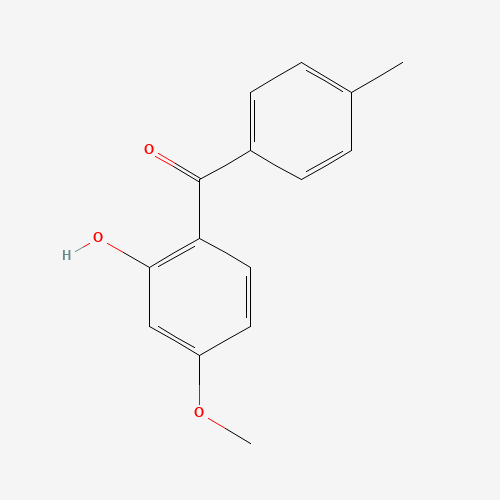
Mexenone is a member of benzophenones.
科学粮草官-词典编辑部,修订于:2026-07-06
Toxicity
ToxicityEcotoxicity Values
LC50; Species: Dugesia japonica (Flatworm); Conditions: freshwater, static; Concentration: 1.4 mg/L for 96 hr (95% confidence interval: 1.2-1.6 mg/L) />99% purity/
Artificial Pollution Sources
2-Hydroxy-4-methoxy-4'methylbenzophenone's production and use as a ultraviolet light absorber(1) may result in its release to the environment through various waste streams(SRC).
Interactions
INTRODUCTION: Between September 1994 and September 1999, we observed 19 cases of photoaggraved contact allergy or contact photoallergy to ketoprofen (non steroidal anti-inflammatory derived from arylpropionic acid). We present a clinical and photobiological retrospective study of these 19 cases with investigation of cross-reactivity between benzophenone-containing molecules. PATIENTS AND METHODS: On clinical level, we investigated the type of eruption, the delay of appearance, the initial area of eruption and areas of diffusion. Phototesting included patchtests and photopatchtests performed with the gel containing ketoprofen (17 patients), ketoprofen 2 p. 100 petrolatum (14 patients), fenofibrate 10 p. 100 petrolatum and 10 p. 100 water (15 patients), 3 benzophenones (19 patients): oxyb...
Toxicity Summary
IDENTIFICATION AND USE: 2-Hydroxy-4-methoxy-4'-methylbenzophenone (Mexenone) belongs to the benzophenone group of sunscreens. HUMAN STUDIES: Mexenone was reported as one of the most frequent contact allergens among other sunscreen agents. The benzophenone group of sunscreens (mexenone, oxybenzone) were the most frequent sensitizers, accounting for 8 of the 27 positive patch tests observed for a sunscreen agents. It has also produced positive responses in photopatch testing. A case report described a patient with long-standing polymorphic light eruption who developed a photocontact allergy to mexenone and several contact allergies. ANIMAL STUDIES: There are no data available.
Human Toxicity Excerpts
/HUMAN EXPOSURE STUDIES/ INTRODUCTION: Between September 1994 and September 1999, we observed 19 cases of photoaggraved contact allergy or contact photoallergy to ketoprofen (non steroidal anti-inflammatory derived from arylpropionic acid). We present a clinical and photobiological retrospective study of these 19 cases with investigation of cross-reactivity between benzophenone-containing molecules. PATIENTS AND METHODS: On clinical level, we investigated the type of eruption, the delay of appearance, the initial area of eruption and areas of diffusion. Phototesting included patchtests and photopatchtests performed with the gel containing ketoprofen (17 patients), ketoprofen 2 p. 100 petrolatum (14 patients), fenofibrate 10 p. 100 petrolatum and 10 p. 100 water (15 patients), 3 benzophe...
Antidote and Emergency Treatment
Advanced treatment: Consider orotracheal or nasotracheal intubation for airway control in the patient who is unconscious, has severe pulmonary edema, or is in severe respiratory distress. Positive-pressure ventilation techniques with a bag valve mask device may be beneficial. Consider drug therapy for pulmonary edema ... . Consider administering a beta agonist such as albuterol for severe bronchospasm ... . Monitor cardiac rhythm and treat arrhythmias as necessary ... . Start IV administration of D5W TKO /SRP: "To keep open", minimal flow rate/. Use 0.9% saline (NS) or lactated Ringer's (LR) if signs of hypovolemia are present. For hypotension with signs of hypovolemia, administer fluid cautiously. Watch for signs of fluid overload ... . Treat seizures with diazepam (Valium) or lorazepa...









