

 一键配货
一键配货
化合物详情
CAS107-32-4
分子式CH2O3
分子量62.0248 g/mol
非危品
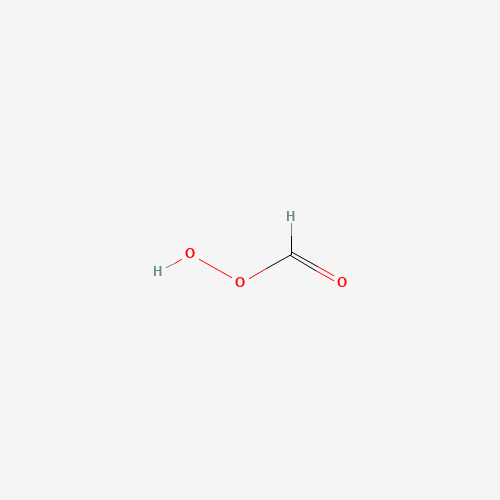
structure
科学粮草官-词典编辑部,修订于:2026-07-06
Toxicity
ToxicityFate Summary
ATMOSPHERIC FATE: According to a model of gas/particle partitioning of semivolatile organic compounds in the atmosphere(1), peroxyformic acid, which has an estimated vapor pressure of 78 mm Hg at 25 °C(SRC), determined from a fragment constant method(2), is expected to exist solely as a vapor in the ambient atmosphere. Vapor-phase peroxyformic acid is degraded in the atmosphere by reaction with photochemically-produced hydroxyl radicals(SRC); the half-life for this reaction in air is estimated to be 4 days(SRC), calculated from its rate constant of 4.0X10⁻¹² cu cm/molecule-sec at 25 °C(SRC) that was derived using a structure estimation method(3). Peroxyformic acid contains chromophores that absorb at wavelengths >290 nm(4) and therefore may be susceptible to direct photolysis by sunligh...
Soil Adsorption / Mobility
Using a structure estimation method based on molecular connectivity indices(1), the Koc of peroxyformic acid can be estimated to be 1(SRC). According to a classification scheme(2), this estimated Koc value suggests that peroxyformic acid is expected to have very high mobility in soil. The estimated pKa of peroxyformic acid is 7.77(3), indicating that this compound will partially exist in anion form in the environment and anions generally do not adsorb more strongly to soils containing organic carbon and clay than their neutral counterparts(4).
Environmental Bioconcentration
An estimated BCF of 3 was calculated in fish for peroxyformic acid(SRC), using an estimated log Kow of -1.62(1) and a regression-derived equation(2). According to a classification scheme(3), this BCF suggests the potential for bioconcentration in aquatic organisms is low(SRC).
Volatilization from Water / Soil
The Henry's Law constant for the neutral species of peroxyformic acid is estimated as 1.9X10⁻⁶ atm-cu m/mole(SRC) using a fragment constant estimation method(1). This Henry's Law constant indicates that peroxyformic acid is expected to volatilize from water surfaces(2). Based on this Henry's Law constant, the volatilization half-life from a model river (1 m deep, flowing 1 m/sec, wind velocity of 3 m/sec)(2) is estimated as 15 days(SRC). The volatilization half-life from a model lake (1 m deep, flowing 0.05 m/sec, wind velocity of 0.5 m/sec)(2) is estimated as 110 days(SRC). Peroxyformic acid's Henry's Law constant indicates that volatilization from moist soil surfaces may occur(SRC). Peroxyformic acid is expected to volatilize from dry soil surfaces(SRC) based upon an estimated vapor p...
Environmental Abiotic Degradation
The rate constant for the vapor-phase reaction of peroxyformic acid with photochemically-produced hydroxyl radicals has been estimated as 4.0X10⁻¹² cu cm/molecule-sec at 25 °C(SRC) using a structure estimation method(1). This corresponds to an atmospheric half-life of about 4 days at an atmospheric concentration of 5X10+5 hydroxyl radicals per cu cm(1). A base-catalyzed second-order hydrolysis rate constant of 2.8X10+4 L/mole-sec(SRC) was estimated using a structure estimation method(2); this corresponds to half-lives of 4 minutes and 24 seconds at pH values of 7 and 8, respectively(2). Peroxyformic acid contains chromophores that absorb at wavelengths >290 nm(3) and therefore may be susceptible to direct photolysis by sunlight(SRC).
Artificial Pollution Sources
Peroxyformic acid's production and use as a chemical agent for oxidation, epoxidation, and hydroxylation reactions(1) may result in its release to the environment through various waste streams(SRC).
Probable Routes of Human Exposure
Occupational exposure to peroxyformic acid may occur through inhalation and dermal contact with this compound at workplaces where peroxyformic acid is produced or used. (SRC)
Environmental Fate / Exposure Summary
Peroxyformic acid's production and use as a chemical agent for oxidation, epoxidation, and hydroxylation reactions may result in its release to the environment through various waste streams. If released to air, an estimated vapor pressure of 78 mm Hg at 25 °C indicates peroxyformic acid will exist solely as a vapor in the atmosphere. Vapor-phase peroxyformic acid will be degraded in the atmosphere by reaction with photochemically-produced hydroxyl radicals; the half-life for this reaction in air is estimated to be 4 days. Peroxyformic acid contains chromophores that absorb at wavelengths >290 nm and therefore may be susceptible to direct photolysis by sunlight. If released to soil, peroxyformic acid is expected to have very high mobility based upon an estimated Koc of 1. The estimated p...
Lethal Concentration
collection=toxvaldb&kind=^LC$
Human Toxicity Excerpts
/ALTERNATIVE and IN VITRO TESTS/ Since performic acid is used as a potent disinfectant, chemical sterilant and/or skin antiseptics, information related to its toxicity for living tissues was needed to evaluate the degree of its biotolerance and compare it to that of peracetic acid. In tests on cultured HEp-2 cells distinct cytotoxic effects occurred after treatments with 0.05% and higher concentrations. The 0.005% to 0.000,05% concentrations had only minor effects on the morphology of cells, if passaged they were capable of further growth, but were clearly inhibited in their growth ability. The lowest concentration tested (0.000005%) had no appreciable effect on HEp-2 cells. At the same concentration levels, the cells were affected to a greater degree with performic acid than with perac...
Antidote and Emergency Treatment
/SRP:/ Advanced treatment: Consider orotracheal or nasotracheal intubation for airway control in the patient who is unconscious, has severe pulmonary edema, or is in severe respiratory distress. Early intubation, at the first sign of upper airway obstruction, may be necessary. Positive-pressure ventilation techniques with a bag valve mask device may be beneficial. Consider drug therapy for pulmonary edema ... . Consider administering a beta agonist such as albuterol for severe bronchospasm ... . Monitor cardiac rhythm and treat arrhythmias as necessary ... . Start IV administration of D5W /SRP: "To keep open", minimal flow rate/. Use 0.9% saline (NS) or lactated Ringer's(LR) if signs of hypovolemia are present. For hypotension with signs of hypovolemia, administer fluid cautiously. Cons...