

 一键配货
一键配货
化合物详情
CAS122647-31-8
分子式C20H36N2O3S
分子量500.649 g/mol
非危品
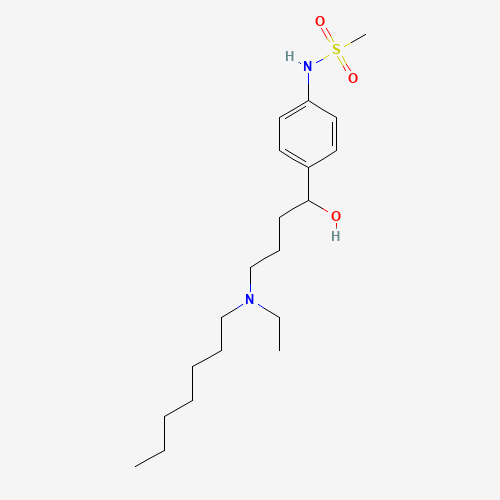
Ibutilide is a member of benzenes and an organic amino compound.
科学粮草官-词典编辑部,修订于:2026-07-06
Toxicity
ToxicityInteractions
Ibutilide is a class III antiarrhythmic agent indicated for cardioversion of atrial fibrillation and atrial flutter to sinus rhythm (SR). The most serious complication of ibutilide is torsades de pointes (TdP). Magnesium has been successfully used for the treatment of TdP, but its use as a prophylactic agent for this arrhythmia has not yet been established. The present study investigated whether high dose of magnesium would increase the safety and efficacy of ibutilide administration. A total of 476 patients with atrial fibrillation or atrial flutter who were candidates for conversion to SR were divided into 2 groups. Group A consisted of 229 patients who received ibutilide to convert atrial fibrillation or atrial flutter to SR. Group B consisted of 247 patients who received an intraven...
Adverse Effects
Before administering ibutilide, it is recommended to conduct a medication reconciliation involving the ordering clinician and a clinical pharmacist due to the potential for interactions with many other drugs.
Toxicity Summary
Currently, the antidote for ibutilide does not exist. In animal models, acute overdose has caused central nervous system (CNS) toxicity, including CNS depression, rapid gasping, and convulsions.
Human Toxicity Excerpts
/CASE REPORTS/ Ibutilide is a novel class III antiarrhythmic agent used for the termination of atrial flutter and atrial fibrillation. It mainly affects membrane potassium currents (IKr) and prolongs the cardiac action potential. This effect is reflected as QT-interval prolongation in the ECG. Drugs that affect IKr-currents are known to cause malignant ventricular arrhythmia. ... Three patients with heart failure where ibutilide triggered malignant ventricular arrhythmias (sustained torsades de pointes) /were reported/. All patients experienced dramatic hemodynamic deterioration. One patient died because of sustained arrhythmia. ... Ibutilide is contraindicated in patients with heart failure and should be used with caution in patients with ischaemic heart disease or previous myocardial...
Drug Induced Liver Injury
References: DOI:10.1016/j.drudis.2019.09.022
Non-Human Toxicity Excerpts
/LABORATORY ANIMALS: Developmental or Reproductive Toxicity/ In two Segment II Teratology studies, timed-pregnant Crl:CD[BR] (Sprague-Dawley) rats were treated orally (gastric intubation) on days 6-15 of gestation with ibutilide fumarate (ibutilide), a class III antiarrhythmic that has been shown to increase the refractory period and action potential duration of myocardial cells. In the first study, ibutilide does of 20, 40, and 80 mg/kg/ day were tested. Although maternal toxicity was equivocal in the 80 mg/kg/day group, all 23 rats that conceived had entirely resorbed litters when the animals were killed on day 20 of gestation. Similarly, 12 of 24 litters were completely resorbed in the 40 mg/kg/day group, with an 87.7% postimplantational loss. Of the surviving fetuses in this group,...
Populations at Special Risk
Women have a higher incidence of torsades de pointes than men, but it is not known if the risk of drug-induced torsades de pointes varies during the menstrual cycle. ... A volunteer sample of 58 healthy adults (38 men and 20 women) aged 21 to 40 years /were given/ a low dose of ibutilide (0.003 mg/kg), infused intravenously for 10 minutes. Subjects were monitored for 120 minutes. Women received the intervention on 3 separate occasions to correspond with menstrual cycle phases, which were verified by using hormonal assays. QT interval, recorded from electrocardiogram at timed intervals during and after ibutilide infusion and standardized for variations in heart rate (QTc). Maximum (mean (SD)) millisecond increase in QTc after ibutilide infusion was greater for women during menses (63 (13...
Antidote and Emergency Treatment
/SRP:/ Advanced treatment: Consider orotracheal or nasotracheal intubation for airway control in the patient who is unconscious, has severe pulmonary edema, or is in severe respiratory distress. Positive-pressure ventilation techniques with a bag valve mask device may be beneficial. Consider drug therapy for pulmonary edema ... . Consider administering a beta agonist such as albuterol for severe bronchospasm ... . Monitor cardiac rhythm and treat arrhythmias as necessary ... . Start IV administration of D5W /SRP: "To keep open", minimal flow rate/. Use 0.9% saline (NS) or lactated Ringer's if signs of hypovolemia are present. For hypotension with signs of hypovolemia, administer fluid cautiously. Watch for signs of fluid overload ... . Treat seizures with diazepam or lorazepam ... . Use...