


 一键配货
一键配货
化合物详情
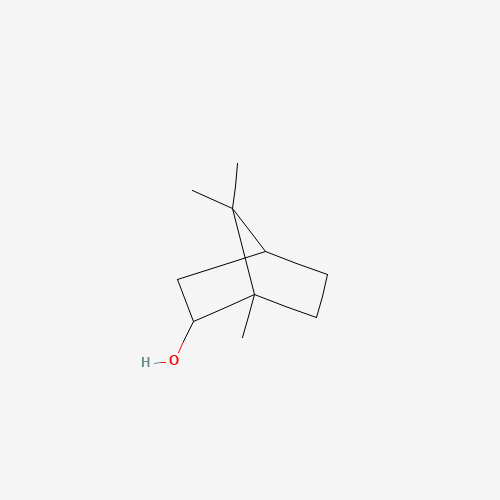
CAS507-70-0
分子式C10H18O
分子量154.25 g/mol g/mol
危化品
Physical Description | Borneol appears as a white colored lump-solid with a sharp camphor-like odor. Burns readily. Slightly denser than water and insoluble in water. Used to make perfumes.
科学粮草官-词典编辑部,修订于:2026-07-06
Toxicity
ToxicityFate Summary
ATMOSPHERIC FATE: According to a model of gas/particle partitioning of semivolatile organic compounds in the atmosphere(1), borneol, which has a vapor pressure of 5.02X10⁻² mm Hg at 25 °C(2), is expected to exist solely as a vapor in the ambient atmosphere. Vapor-phase borneol is degraded in the atmosphere by reaction with photochemically-produced hydroxyl radicals(SRC); the half-life for this reaction in air is estimated to be 1.4 days(SRC), calculated from its rate constant of 1.14X10⁻¹¹ cu cm/molecule-sec at 25 °C(SRC) that was derived using a structure estimation method(3). Borneol does not contain chromophores that absorb at wavelengths >290 nm(4) and, therefore, is not expected to be susceptible to direct photolysis by sunlight(SRC).
Soil Adsorption / Mobility
Using a structure estimation method based on molecular connectivity indices(1), the Koc of borneol can be estimated to be 76(SRC). According to a classification scheme(2), this estimated Koc value suggests that borneol is expected to have high mobility in soil.
Environmental Biodegradation
AEROBIC: Borneol was listed as a compound which is very difficult to degrade; it was classified as category 4 (very difficult to degrade) in a 5 tiered rating system on ease of biodegradability(1). In a batch test, 90% removal of borneol was achieved using acclimated activated sludge at 20 °C resulting in a calculated degradation rate of 8.9 mg COD/g-hr(2). Borneol, present at 100 mg/L, reached 97% of its theoretical BOD in 4 weeks using an activated sludge inoculum at 30 mg/L in the Japanese MITI test(3). Borneol, present at 18.7 ng/mL, was 53% degraded over 28 weeks when incubated with groundwater contaminated with creosote. Using a starting concentration of 33.7 ng/mL, borneol concentration was decreased to 12.2 ng/mL using the same inoculum but treated with 1% sodium azide(4).
Environmental Bioconcentration
An estimated BCF of 30 was calculated in fish for borneol(SRC), using a log Kow of 2.69(1) and a regression-derived equation(1). According to a classification scheme(2), this BCF suggests the potential for bioconcentration in aquatic organisms is moderate(SRC).
Volatilization from Water / Soil
The Henry's Law constant for borneol is estimated as 1.38X10⁻⁵ atm-cu m/mole(SRC) derived from its vapor pressure, 5.0210-2 mm Hg(1), and water solubility, 738 mg/L(2). This Henry's Law constant indicates that borneol is expected to volatilize from water surfaces(3). Based on this Henry's Law constant, the volatilization half-life from a model river (1 m deep, flowing 1 m/sec, wind velocity of 3 m/sec)(3) is estimated as 2.2 days(SRC). The volatilization half-life from a model lake (1 m deep, flowing 0.05 m/sec, wind velocity of 0.5 m/sec)(3) is estimated as 29 days(SRC). Borneol's estimated Henry's Law constant indicates that volatilization from moist soil surfaces may occur(SRC). Borneol is not expected to volatilize from dry soil surfaces(SRC) based upon a vapor pressure of 5.02X10⁻²...
Environmental Abiotic Degradation
The rate constant for the vapor-phase reaction of borneol with photochemically-produced hydroxyl radicals has been estimated as 1.14X10⁻¹¹ cu cm/molecule-sec at 25 °C(SRC) using a structure estimation method(1). This corresponds to an atmospheric half-life of about 1.4 days at an atmospheric concentration of 5X10+5 hydroxyl radicals per cu cm(1). Borneol is not expected to undergo hydrolysis in the environment due to the lack of functional groups that hydrolyze under environmental conditions(3). Borneol does not contain chromophores that absorb at wavelengths >290 nm(3) and, therefore, is not expected to be susceptible to direct photolysis by sunlight(SRC).
Environmental Water Concentrations
DRINKING WATER: Borneol was identified in New Orleans LA drinking waters as of November 1974(1). In a report dated 1975, borneol was listed as a compound identified in U.S. drinking waters(2).
Food Survey Values
Borneol has been identified as a constituent in the volatile extract from fresh rhizomes of ginger and ginger essential oil (Zingiber officinale Roscoe)(1,2). Borneol has been identified as a flavor constituent of Pine Sprout Tea from Korean red pine trees (Pinus densiflora Seib. Et Zucc.)(3).
Plant Concentrations
[Table#2523]: IkdlbnVzIHNwZWNpZXMiLCJGYW1pbHkiLCJjb21tb24gbmFtZShzKSIsIlBhcnQiLCJDb25jbiAocHBtKSIKIk15cmlzdGljYSBmcmFncmFucyIsIk15cmlzdGljYWNlYWUiLCJOdXRtZWcsIE11c2thdG51c3NiYXVtLCBNYWNlIiwiU2VlZCIsIjI1NjAwLjAiCiJaaW5naWJlciBvZmZpY2luYWxlIiwiWmluZ2liZXJhY2VhZSIsIkdpbmdlciIsIlJvb3QiLCIxMTAyLjAiCiJaaW5naWJlciBvZmZpY2luYWxlIiwiWmluZ2liZXJhY2VhZSIsIkdpbmdlciIsIlJoaXpvbWUiLCIxMTAyIgoiQ3VyY3VtYSB6ZWRvYXJpYSIsIlppbmdpYmVyYWNlYWUiLCJaZWRvYXJ5LCBTaG90aSIsIlJoaXpvbWUiLCIzMDAuMCIKIkJvc3dlbGxhIHNhY3JhIiwiQnVyc2VyYWNlYWUiLCJXZWlocmF1Y2ggYmF1bSwgT2xpYmFudW0sIE9saWJhbiwgRnJhbmtpbmNlbnNlIiwiRXNzZW50aWFsIE9pbCIsIm5vdCByZXBvcnRlZCIKIkFtb211bSB4YW50aGlvaWRlcyIsIlppbmdpYmVyYWNlYWUiLCJUYXZveSBDYXJkYW1vbSwgTWFsYWJhciwgQ2FyZGFtb20sIEJhc3RhcmQgQ2FyZGFtb20sIENoaW4gS291c2hhIiwiU2VlZCIsIm5vdCByZXBvcnRlZCIKIkFtb21...
Effluent Concentrations
Borneol has been detected in the final effluent from one plant in each of the following industries: paint and ink, inorganic chemicals, textile mills, rubber processing, electronics, and mechanical products, and in the final effluent from two plants in the pulp and paper industry(1). Borneol was identified in one sample taken downstream of a publicly owned treatment works in Sauget Il. in June 1980(2). Borneol was identified in 1 out of 2 secondary effluent samples from Fort Polk, LA, in November 1980, at a concentration of 0.054 ug/L(3). Borneol was detected in raw sewage samples collected in May 2007 from a municipal treatment plant in China(4).
Natural Pollution Sources
Both D- and L- isomeric forms of borneol are naturally occurring(1). The most frequently encountered is L-borneol, characteristic of Compositae, Graminaceae and almost all Pinaceae, as well as in Blumea balsamifera. D-Borneal is characteristic of Cupressaceae, Zingiberaceae, lavenderm lavadin and spike oils, as well as oil from Dryobalanops aromatica Gaertn., Dipterocarpaceae(1,2).
Atmospheric Concentrations
SOURCE DOMINATED: Borneol was detected in the emissions of 2 (Sabalpine Fir and Big Sagebrush) out of 14 vegetation species in forests near Hayden CO; emission rates for both species were reported as 0.1 ug C/hr/gram dry weight(1).
Artificial Pollution Sources
Borneol's production and use as a food flavoring, in fragrances, and in the manufacture of its esters(1) may result in its release to the environment through various waste streams(SRC). Borneol has been identified in tobacco smoke and tobacco substitute smoke and in tobacco collected from cigarettes(2).
Sediment/Soil Concentrations
SOIL: In a study reported in 1983, borneol was identified in the soil extract from a site at a pine-tar manufacturer in Gainesville, FL which closed in 1967(1).
Probable Routes of Human Exposure
Occupational exposure to borneol may occur through inhalation and dermal contact with this compound at workplaces where it is produced or used. Limited monitoring data indicate that the general population may be exposed to borneol via inhalation of ambient air, ingestion of food and drinking, and dermal contact with consumer products containing borneol. (SRC)
Other Environmental Concentrations
Borneol has been identified in tobacco smoke and tobacco substitute smoke and in tobacco collected from cigarettes(1). Borneol has been identified as a constituent in the volatile emissions from 2 out of 10 household products, detergents and liquid floor wax(2) and was identified in the volatile emissions from domestic garden waste(3).
Environmental Fate / Exposure Summary
Borneol's production and use as a food flavoring, in fragrances, and in the manufacture of its esters may result in its release to the environment through various waste streams. Borneol is a constituent of various plants, plant tissues, and many plant essential oils. If released to air, a vapor pressure of 5.02X10⁻⁵ mm Hg at 25 °C indicates borneol will exist solely as a vapor in the atmosphere. Vapor-phase borneol will be degraded in the atmosphere by reaction with photochemically-produced hydroxyl radicals; the half-life for this reaction in air is estimated to be 1.4 days. Borneol does not contain chromophores that absorb at wavelengths >290 nm and, therefore, is not expected to be susceptible to direct photolysis by sunlight. If released to soil, borneol is expected to have high mob...
Interactions
This study was to investigate the synergistic effect of natural borneol/curcumin (NB/Cur) on growth and apoptosis in A375 human melanoma cell line by MTT assay, flow cytometry and Western blotting. Our results demonstrated that NB effectively synergized with Cur to enhance its antiproliferative activity on A375 human melanoma cells by induction of apoptosis, as evidenced by an increase in sub-G1 cell population, DNA fragmentation, PARP cleavage, and caspase activation. Further mechanistic studies by Western blotting showed that after treatment of the cells with NB/Cur, up-regulation of the expression level of phosphorylated JNK and down-regulation of the expression level of phosphorylated ERK and Akt contributed to A375 cells apoptosis. Moreover, NB also potentiated Cur to trigger intra...
Adverse Effects
Occupational hepatotoxin - Secondary hepatotoxins: the potential for toxic effect in the occupational setting is based on cases of poisoning by human ingestion or animal experimentation.
Toxicity Summary
IDENTIFICATION AND USE: Borneol is a solid. It is used as a flavoring, and as a medication, including traditional Chinese medicine. HUMAN EXPOSURE AND TOXICITY: Borneol does not present a concern for skin sensitization. Toxicity is essentially indistinguishable from that of camphor. Human peripheral blood lymphocytes were exposed to varying concentrations of l-borneol in DMSO up to 600 ug/mL for 4 hr, with and without metabolic activation and 24 hr without metabolic activation. Under the conditions of the study, l-borneol was considered non-clastogenic. ANIMAL STUDIES: As with camphor, laboratory animals appear to be much less susceptible to borneol toxicity than man. Borneol increased the activity of CYP2D in rats orally treated by borneol for 7 days. Borneol has been evaluated for ant...
Human Toxicity Excerpts
/OTHER TOXICITY INFORMATION/ / Toxicity is essentially indistinguishable from that of camphor.
Non-Human Toxicity Values
LD50 Mice oral 1059 mg/kg
Non-Human Toxicity Excerpts
/LABORATORY ANIMALS: Developmental or Reproductive Toxicity/ Read across material isobornyl acetate (CAS # 125-12- 2) has an OECD 414 gavage developmental toxicity limit dose study that was conducted in rats. The NOAEL was determined to be 1000 mg/kg/day, based on the only dosage tested. /Isobornyl acetate/
Antidote and Emergency Treatment
Advanced Treatment: Consider orotracheal or nasotracheal intubation for airway control in the patient who is unconscious or is in respiratory distress. Monitor and treat cardiac arrhythmias as necessary ... . Start IV administration of D5W TKO. Use 0.9% saline (NS) or lactated Ringer's (LR) if signs of hypovolemia are present. For hypotension with signs of hypovolemia, administer fluid cautiously. Consider vasopressors if patient is hypotensive with a normal fluid volume. Watch for signs of fluid overload ... . Treat seizures with diazepam (Valium) or lorazepam (Ativan) ... . Use proparacaine hydrochloride to assist eye irrigation ... . /Camphor and related compounds/









