


 一键配货
一键配货
化合物详情
CAS141112-29-0
分子式C15H12F3NO4S
分子量359.32 g/mol
非危品
Isoxaflutole can cause cancer according to The Environmental Protection Agency (EPA).
科学粮草官-词典编辑部,修订于:2026-07-06
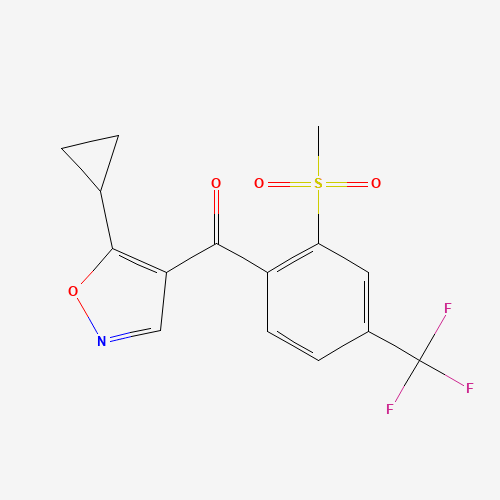
Toxicity
ToxicityEPA Ecotoxicity
Pesticide Ecotoxicity Data from EPA: 178
Ecotoxicity Values
LD50 Colinus virginianus (Northern bobwhite, age 26 wk) oral >2150 mg/kg[USEPA, Office of Pesticide Programs; Pesticide Ecotoxicity Database (2000) on (5-Cyclopropyl-4-isoxazolyl)
Fate Summary
ATMOSPHERIC FATE: According to a model of gas/particle partitioning of semivolatile organic compounds in the atmosphere(1), isoxaflutole, which has a vapor pressure of 7.50X10⁻⁹ mm Hg at 25 °C(2), is expected to exist solely in the particulate phase in the ambient atmosphere. Particulate-phase isoxaflutole may be removed from the air by wet and dry deposition(SRC).
Soil Adsorption / Mobility
The Koc of isoxaflutole is estimated as 440(SRC), using a log Kow of 2.32(1) and a regression-derived equation(2). According to a classification scheme(3), this estimated Koc value suggests that isoxaflutole is expected to have moderate mobility in soil. Neither isoxaflutole nor any of its metabolites were detected in the soil below 10 cm during a soil field dissipation study(4).
Environmental Biodegradation
ANAEROBIC: The half-life for the anaerobic aquatic metabolism of isoxaflutole was reported to be less than 2 hours(1).
Environmental Bioconcentration
An estimated BCF of 34 was calculated for isoxaflutole(SRC), using a log Kow of 2.32(1) and a regression-derived equation(2). According to a classification scheme(3), this BCF suggests the potential for bioconcentration in aquatic organisms is moderate(SRC), provided the compound is not altered physically or chemically once released into the environment.
Volatilization from Water / Soil
The Henry's Law constant for isoxaflutole is 1.85X10⁻¹⁰ atm-cu m/mole(1). This Henry's Law constant indicates that isoxaflutole is expected to be essentially nonvolatile from moist soil or water surfaces(2). Isoxaflutole is not expected to volatilize from dry soil surfaces(SRC) based upon a vapor pressure of 7.50X10⁻⁹ mm Hg(1).
Environmental Abiotic Degradation
The half-lives reported for the hydrolysis of isoxaflutole in aqueous mineral buffered solutions were 433, 241, 95, 43, 65, and 5 hours at pH values of 5.2, 6.0, 7.2, 8.0, 8.3, and 9.3, respectively, at 22 °C(1). The half-lives at these same pH values were 182, 87, 18, 8, 9, and 1.2 hours, respectively, at 35 °C(1). Isoxaflutole hydrolysis half-lives have also been reported as 11.1 hours at pH 5, 20.1 hours at pH 7, and 3.2 hours at pH 9(2). The half-life for the photolysis of isoxaflutole has been reported as 6.7 days in water and 23 hours in soil(2).
Milk Concentrations
The goats were dosed (balling gun) at a dietary burden of 10 ppm for seven days. The administered radioactivity was mainly eliminated via the urine and feces with the remaining radioactivity found in tissues, milk and cage wash and debris. Isoxaflutole was not identified in any of the tissues and milk. RPA 202248 was identified as a major component in all tissues, including milk. RPA 207048 was identified as a minor component in tissues and milk.
Artificial Pollution Sources
Isoxaflutole's production may result in its release to the environment through various waste streams; it's use as a herbicide(1) will result in its direct release to the environment(SRC).
Probable Routes of Human Exposure
Occupational exposure to isoxaflutole may occur through inhalation and dermal contact with this compound at workplaces where isoxaflutole is produced or used. (SRC)
Environmental Fate / Exposure Summary
Isoxaflutole's production may result in its release to the environment through various waste streams; it's use as a herbicide will result in its direct release to the environment. If released to air, a vapor pressure of 7.50X10⁻⁹ mm Hg at 25 °C indicates isoxaflutole will exist solely in the particulate phase in the ambient atmosphere. Particulate-phase isoxaflutole will be removed from the atmosphere by wet and dry deposition. If released to soil, isoxaflutole is expected to have moderate mobility based upon an estimated Koc of 440. Neither isoxaflutole nor any of its metabolites were detected in the soil below 10 cm during a soil field dissipation study. Volatilization from moist soil surfaces is not expected to be an important fate process based upon a Henry's Law constant of 1.85X10...
Effect Level
collection=toxvaldb&kind=^EL$
Lethal Dose
collection=toxvaldb&kind=^LD$
Toxicity Data
LC50 (rat) = 5,230 mg/m3/4h
Adverse Effects
Reproductive Toxin - A chemical that is toxic to the reproductive system, including defects in the progeny and injury to male or female reproductive function. Reproductive toxicity includes developmental effects. See Guidelines for Reproductive Toxicity Risk Assessment.
Benchmark Values
collection=toxvaldb&kind=^BV$
RAIS Toxicity Values
Oral Slope Factor Reference: OPP
Other Toxicity Values
collection=toxvaldb&kind=^Other$
Carcinogen Classification
Not listed by IARC.
Non-Human Toxicity Values
LC50 Rat inhalation >5.23 mg/L 4 hr
Reference and Risk Values
collection=toxvaldb&kind=^RRV$
Non-Human Toxicity Excerpts
/LABORATORY ANIMALS: Subchronic or Prechronic Exposure/ In a 28-day oral subchronic toxicity study, RPA 203328 (a metabolite of isoxaflutole) was administered in the diet to male and female rats. There were no compound related adverse effects on survival, clinical signs, body weight, food consumption, clinical chemistry, hematology, and gross or microscopic pathology. The LOAEL is >1,117.79 mg/kg/day in males and 1,268.73 mg/kg/day in females. The NOEL for both sexes is 1,117.79 mg/kg/day in males and 1,268.73 mg/kg/day in females. /RPA 203328 (metabolite)/
Antidote and Emergency Treatment
/SRP:/ Advanced treatment: Consider orotracheal or nasotracheal intubation for airway control in the patient who is unconscious, has severe pulmonary edema, or is in respiratory arrest. Positive pressure ventilation techniques with a bag valve mask device may be beneficial. Monitor cardiac rhythm and treat arrhythmias as necessary ... . Start an IV with D5W /SRP: "To keep open", minimal flow rate/. Use lactated Ringer's if signs of hypovolemia are present. Watch for signs of fluid overload. Consider drug therapy for pulmonary edema ... . For hypotension with signs of hypovolemia, administer fluid cautiously. Watch for signs of fluid overload ... . Treat seizures with diazepam (Valium) ... . Use proparacaine hydrochloride to assist eye irrigation ... . /Poison A and B/
USGS Health-Based Screening Levels for Evaluating Water-Quality
Reference: Smith, C.D. and Nowell, L.H., 2024. Health-Based Screening Levels for evaluating water-quality data (3rd ed.). DOI:10.5066/F71C1TWP









