


 一键配货
一键配货
化合物详情
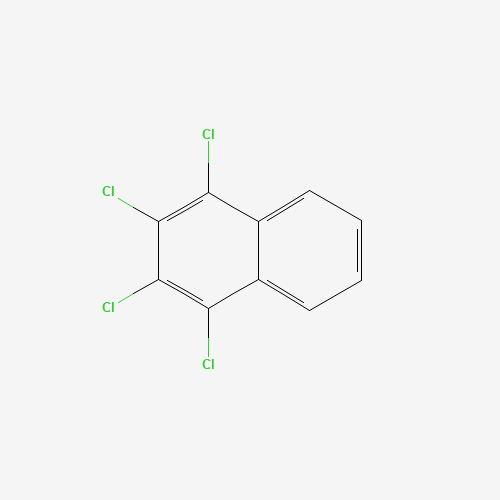
CAS20020-02-4
分子式C10H4Cl4
分子量265.951 g/mol
非危品
Physical Description | Tetrachloronaphthalene is a colorless to pale-yellow solid with an intense aromatic odor. Melting Point:182 C. Presents an environmental danger. Used in lubricants and in the manufacture of insulation for electrical wire. If released into the environment, bioaccumulation takes place in fish. Will persist in the environment causing long-term adverse effects. The halowaxes are technical-grade chlorinated naphthalenes containing tetrachloronaphthalene in its various isomers together with (mainly) trichloro- pentachloro- and hexa-chloronapthalenes in their various isomers.
科学粮草官-词典编辑部,修订于:2026-07-06
Toxicity
ToxicityEcotoxicity Values
LC50 Shrimp 74 ug/l Tetra/penta mixture for 4 days /Tetra-Pentachloronaphthalenes/
Fate Summary
ATMOSPHERIC FATE: According to a model of gas/particle partitioning of semivolatile organic compounds in the atmosphere(1), 1,2,3,4-tetrachloronaphthalene, which has a vapor pressure of 2.9X10⁻⁶ mm Hg at 25 °C(2), will exist in both the vapor and particulate phases. Vapor-phase 1,2,3,4-tetrachloronaphthalene is degraded in the atmosphere by reaction with photochemically-produced hydroxyl radicals(SRC); the half-life for this reaction in air is estimated to be 35 days(SRC), calculated from its rate constant of 9.1X10⁻¹³ cu cm/molecule-sec at 25 °C(SRC), that was derived using a structure estimation method(3). Particulate-phase 1,2,3,4-tetrachloronaphthalene may be removed from the air by wet and dry deposition(SRC). 1,2,3,4-Tetrachloronaphthalene may absorb light with wavelengths >290 nm...
Soil Adsorption / Mobility
Using a structure estimation method based on molecular connectivity indices(1), the Koc for 1,2,3,4-tetrachloronaphthlene can be estimated to be 14,000(SRC). According to a classification scheme(2), this estimated Koc value suggests that 1,2,3,4-tetrachloronaphthalene is expected to be immobile in soil.
Environmental Biodegradation
A predictive method based upon evaluated biodegradation data(1) and the fact that 1,2,3,4-tetrachloronaphthalene contains 4 aromatic chlorine substructures predicts that 1,2,3,4-tetrachloronaphthalene has a low probability of biodegrading quickly in the environment(SRC).
Environmental Bioconcentration
Using a continuous flow through system and a 7-day exposure period, a 1,2,3,4-tetrachloronaphthalene BCF of 33,000 was measured in guppies (Poecillia reticula)(1). In a static system, a mean BCF of 5100 was measured in rainbow trout over a 96-day exposure period(2). In a continuous flow through system, a mean BCF of 21,000 was measured in oligochaete worms(Tubifex tubifex and Limnodrilus hoffmeisteri) over a 79-day exposure period(3). According to a classification scheme(4), these BCF suggest the potential for bioconcentration in aquatic organisms is very high(SRC).
Volatilization from Water / Soil
The Henry's Law constant for 1,2,3,4-tetrachloronaphthalene is 0.000238 atm-cu m/mole(SRC) derived from its vapor pressure, 2.9X10⁻⁶ mm Hg(1), and water solubility, 0.00426 mg/l(2). This Henry's Law constant indicates that 1,2,3,4-tetrachloronaphthalene is expected to volatilize from water surfaces(3). Based on this Henry's Law constant, the volatilization half-life from a model river (1 m deep, flowing 1 m/sec, wind velocity of 3 m/sec)(3) is estimated as 11 hours(SRC). The volatilization half-life from a model lake (1 m deep, flowing 0.05 m/sec, wind velocity of 0.5 m/sec)(3) is estimated as 8 days(SRC). However, volatilization from water surfaces is expected to be attenuated by adsorption to suspended solids and sediment in the water column(SRC). The estimated volatilization half-lif...
Environmental Abiotic Degradation
The rate constant for the vapor-phase reaction of 1,2,3,4-tetrachloronaphthalene with photochemically-produced hydroxyl radicals has been estimated as 9.1X10⁻¹³ cu cm/molecule-sec at 25 °C(SRC) using a structure estimation method(1). This corresponds to an atmospheric half-life of about 35 days at an atmospheric concentration of 5X10+5 hydroxyl radicals per cu cm(1). 1,2,3,4-Tetrachloronaphthlene is not expected to undergo hydrolysis in the environment due to the lack of hydrolyzable functional groups(2). 1,2,3,4-Tetrachloronaphthalene may absorb light with wavelengths >290 nm, and may be susceptible to direct photolysis by sunlight(SRC).
Environmental Water Concentrations
SURFACE WATER: Tetrachloronaphthalene was identified, not quantified, in open waters of Lake Michigan(1). Polychlorinated naphthalenes were detected in groundwater from the Llobregat aquifer in Spain at concns of 0.5-79,100 ng/l, with tetrachloronaphthalene as the major group of congeners(2). Tetrachloronaphthalene was identified in 10 out of 32 wells and boreholes in the Llobregat aquifer at a max concn of 44,100 ng/l(2).
Animal Concentrations
A chlor-alkali plant that is located in southeastern coastal Georgia, near Brunswick, GA, and operated from 1955 to 1994, disposed of its process wastes into large holding pits near the top of the marsh and directly into the marsh and tidal creek(1). The concentration of 1,2,3,4- and 1,2,3,6-tetrachloronaphthalene combined in a composite muscle tissue sample of two boat-tailed grackle (Quiscalus major) collected in August 1995 in Purvis Creek, 1-2 km from a Chlor-Alkali facility were <3 pg/g wet weight(1). The concentration of 1,2,3,4- and 1,2,3,6-tetrachloronaphthalene combined in a composite heptopancreases tissue sample of blue crabs (Callinectes sapidus) collected in March 1997 in the same location was 45 pg/g wet weight(1). Combined 1,2,3,4-, 1,2,3,7-, and 1,2,6,7-tetrachloronaphth...
Effluent Concentrations
1,2,3,4-Tetrachloronaphthalene was found in air-dried fly ash from a municipal incinerator(1).
ICSC Environmental Data
Bioaccumulation of this chemical may occur in fish. It is strongly advised not to let the chemical enter into the environment. The substance may cause long-term effects in the aquatic environment.
Natural Pollution Sources
Polychlorinated naphthalenes do not occur naturally in the environment(1).
Fish/Seafood Concentrations
Aquatic organisms collected in 1992 in the Baltic Sea from the harbor of the Port of Gdynia off the coast of Poland and analyzed for polychlorinated naphthalenes(1). Concentrations (ng/g lipid weight) of 1,2,3,4-, 1,2,3,7-, and 1,2,6,7-tetrachloronaphthalenes combined in the following organisms were: mixed plankton species, 0.18; mussel (Mytilus trossulus), 2.6; crab (Carcinus means), 1.4; lamprey (Lapetra fluviatillis), 0.05; flounder (Platychthis flesus), 0.041; stickleback (Gasterosteus aculeatus), 1.1; lesser sand eel (Heperoplus lanceolatus), 0.12; Baltic herring (Clupea harengus), 0.10; pikeperch (Stizostedion lucioperca), 0.36; elepout (Zoarces viviparus) 0.098; round goby (Neogobius melanostomus), 0.80; cod (Gadus morhua), 0.042(1). Concentrations (ng/g lipid weight) of 1,2,3,4-...
Artificial Pollution Sources
1,2,3,4-Tetrachloronaphthalene's former production and use with other polychloronaphthalenes as waxes and impregnants for protective coatings, water repellents, and wood preservatives may have resulted in its release to the environment through various waste streams(1). The sole U.S. producer ceased manufacturing chloronaphthalene products in 1977(2).
Sediment/Soil Concentrations
SEDIMENT: Surface sediment (0-10 cm) collected in June 1982 from the nearshore sedimentation area of the Wisla River in Kiezmark under Gdansk in Poland contained 0.027 ng/g dry weight of 1,2,3,4-, 1,2,3,7-, and 1,2,6,7-tetrachloronaphthalenes combined(1). A chlor-alkali plant that is located in southeastern coastal Georgia, near Brunswick, GA, and operated from 1955 to 1994, disposed of its process wastes into large holding pits near the top of the marsh and directly into the marsh and tidal creek(2). Surficial sediment (0-5 cm) was collected in February 1996 from two intertidal locations during low tide in the contaminated marsh, about 200 m down form the holding pits and contained 2.4 ng/g dry weight of 1,2,3,4- and 1,2,3,6-tetrachloronaphthalene combined(2). Another sediment sample c...
Probable Routes of Human Exposure
Occupational exposure to 1,2,3,4-tetrachloronaphthalene may have occurred through inhalation and dermal contact with this compound at workplaces where chlorinated naphthalenes were produced or used (SRC). Polychlorinated naphthalenes are no longer produced in the US(1).
Other Environmental Concentrations
Tetrachloronaphthalene was identified in plankton from the Baltic sea at concns of 140-210 picograms/g(1).
Environmental Fate / Exposure Summary
1,2,3,4-Tetrachloronaphthalene's former production and use with other polychloronaphthalenes as waxes and impregnants for protective coatings, water repellents, and wood preservatives may have resulted in its release to the environment through various waste streams. The sole U.S. producer ceased manufacturing chloronaphthalene products in 1977. If released to air, a vapor pressure of 2.9X10⁻⁶ mm Hg at 25 °C indicates 1,2,3,4-tetrachloronaphthlene will exist in both the vapor and particulate phases in the ambient atmosphere. Vapor-phase 1,2,3,4-tetrachloronaphthalene will be degraded in the atmosphere by reaction with photochemically-produced hydroxyl radicals; the half-life for this reaction in air is estimated to be 35 days. Particulate-phase 1,2,3,4-tetrachloronaphthalene will be remo...
Symptoms
Acne-form dermatitis; headache, lassitude (weakness, exhaustion), anorexia, dizziness; jaundice, liver injury
Target Organs
Liver, skin, central nervous system
Adverse Effects
Dermatotoxin - Chloracne.
Exposure Routes
inhalation, skin absorption, ingestion, skin and/or eye contact
Toxicity Summary
IDENTIFICATION: There are 75 possible congeners of chlorinated naphthalenes. Commercial products are generally mixtures of several congeners and range from thin liquids to hard waxes to high melting point solids. The higher chlorinated naphthalene products have been used as impregnants for condensers and capacitors and dipping encapsulating cmpd in electronic and automotive applications and as temporary binders in the manufacture of ceramic components, in paper coating and in precision casting of alloys, in electroplating, stop-off cmpd, as additive in gear oils and cutting cmpd, in flame proofing and insulation of electrical cable and conductors and moisture proof sealants, as separators in batteries, in refractive index testing oils, masking cmpd in electroplating and in grinding whee...
Human Toxicity Excerpts
/SIGNS AND SYMPTOMS/ Exposure to this chemical may cause acneform dermatitis, headache, fatigue, anorexia and vertigo. It may also cause jaundice and other symptoms of liver failure.
Antidote and Emergency Treatment
Maintain an open air way and assist ventilation if necessary. Treat coma and seizures if they occur. Treat hemolysis and resulting hemoglobinuria if they occur by intravenous hydration and urinary alkalinization. There is no specific antidote. Administer activated charcoal if available. Do not induce vomiting, because of the risk of lethargy and seizures. Do not administer milk, fats or oils, which may enhance absorption /Naphthalene/









