


 一键配货
一键配货
化合物详情
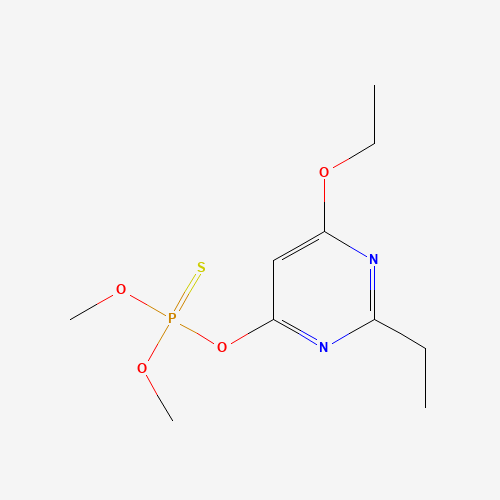
CAS38260-54-7
分子式C10H17N2O4PS
分子量292.29 g/mol g/mol
危化品
Etrimfos is an organic thiophosphate.
科学粮草官-词典编辑部,修订于:2026-07-06
Toxicity
ToxicityEcotoxicity Values
LC50 Rainbow trout 24 ug/l/96 hr /Conditions of bioassay not specified/
Fate Summary
In soil, 50% loss of etrimfos occurs in ca 3-8 days. The principal degradation products are 6-ethoxy-2-ethylpyrimidin-4-ol, small amounts of 2-ethylpyrimidine-4,6-diol and other hydroxylated derivatives, and carbon dioxide.
Soil Adsorption / Mobility
Based upon a reported water solubility of 40 mg/L at 23 °C(1), the Koc for etrimfos can be estimated to be about 570 from a regression-derived equation(2,SRC). Using a structure estimation method based on molecular connectivity indexes, the Koc for etrimfos can be estimated to be 202(3,SRC). According to a suggested classification scheme(4), these estimated Koc values suggest that etrimfos has medium to low mobility in soil(SRC). Following an accidental spill of etrimfos into the Rhine River in Switzerland (estimated discharge of 290-1800 kg), monitoring suggested that etrimfos did not strongly adsorb in sediment and particles in the water(4).
Environmental Bioconcentration
Based upon a reported water solubility of 40 mg/L(1), the BCF for etrimfos can be estimated to be 77 from a recommended regression-derived equation(2,SRC). This BCF value suggests that bioconcentration in aquatic organisms is not important(SRC).
Volatilization from Water / Soil
Based upon a water solubility of 40 mg/L and a vapor pressure of 6.45X10⁻⁵ mm Hg at 20 °C(1), the Henry's Law constant for etrimfos can be estimated to be 6.2X10⁻⁷ atm-cu m/mole(SRC). This value of Henry's Law constant suggests that a compound volatilizes slowly from water(2). Based on this Henry's Law constant, the volatilization half-life from a model river (1 m deep flowing 1 m/sec with a wind velocity of 3 m/sec) can be estimated to be about 101 days(2,SRC). Volatilization half-life from an model environmental pond (2 meters deep) can be estimated to exceed 4 yrs(3,SRC).
Environmental Abiotic Degradation
The rate constant for the vapor-phase reaction of etrimfos with photochemically produced hydroxyl radicals has been estimated to be 7.96X10⁻¹¹ cu cm/molecule-sec at 25 °C which corresponds to an atmospheric half-life of about 4.8 days at an atmospheric concn of 5X10+5 hydroxyl radicals per cu cm(1,SRC). At 25 °C, etrimfos undergoes a 50% aqueous hydrolysis loss in 0.4 days at pH3, 16 days at pH6, and 14 days at pH9(2-3). Etrimfos is reported to be highly stable to light and stable when stored in non-polar solvents(2-3).
Environmental Water Concentrations
An etrimfos concn of 50 ug/L was detected in the Rhine River on Nov 1, 1986 at Village-Neuf, Switzerland which was located a short distance downstream from an accidental spill of etrimfos (estimated discharge of 290-1800 kg) from a chemical storehouse on the same day(1).
Plant Concentrations
In plants, etrimfos undergoes rapid metabolism to 6-ethoxy-2-ethylpyrimidin-4- ol, and small amounts of 2-ethylpyrimidine-4,6-diol and other hydroxylated derivatives.
Effluent Concentrations
An estimated 290-1800 kg of etrimfos was accidentally discharged to the Rhine River during a fire at a chemical storehouse in Switzerland on Nov 1, 1986(1).
Artificial Pollution Sources
Etrimfos's use as broad-range non-systemic insecticide(1-2) releases the compound directly to the environment through applications in sprays, dusts and granules(1,SRC).
Probable Routes of Human Exposure
Occupational exposure to etrimfos occurs through dermal contact and inhalation of dust, especially to workers applying the compound as an insecticide(1).
Environmental Fate / Exposure Summary
Etrimfos's use as a broad-range non-systemic insecticide releases the compound directly to the environment through applications in sprays, dusts and granules. If released to the atmosphere, etrimfos will degrade rapidly in the vapor-phase by reaction with photochemically produced hydroxyl radicals (half-life of 4.8 hr). If released to soil or water, etrimfos will degrade readily through hydrolysis and biodegradation. It hydrolyzes in water with a half-life of 14-16 days at pH6-pH9 and 25 °C. Etrimfos is rapidly metabolized in plants, animals and soil to 6-ethoxy-2-ethylpyrimidin-4-ol (EEHP) and other derivatives. Its half-life in soil is typically 3-8 days. Etrimfos is expected to have a low to moderate leaching potential in soil. Occupational exposure to etrimfos occurs through dermal...
Interactions
ANTICHOLINESTERASE (ORGANOPHOSPHORUS) INSECTICIDES ANTAGONIZE POLARIZING MUSCLE RELAXANTS. PHENOTHIAZINES /AND THIOXANTHENES/: ... MAY ENHANCE TOXIC EFFECTS OF ORGANOPHOSPHORUS INSECTICIDES. /INSECTICIDES, ORGANOPHOSPHORUS/
Adverse Effects
Other Poison - Organophosphate
Non-Human Toxicity Excerpts
Toxic to bees by contact.









