


 一键配货
一键配货
化合物详情
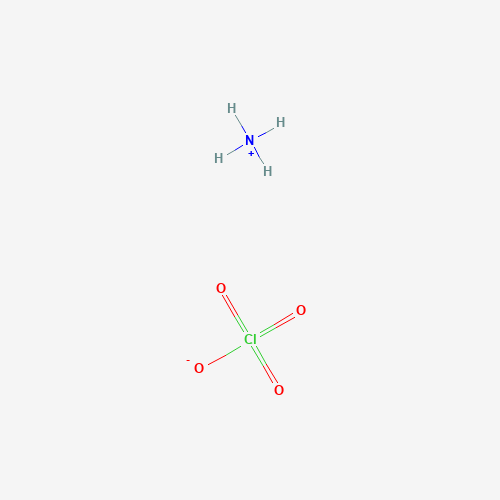
CAS7790-98-9
分子式ClH4NO4
分子量117.489 g/mol
危化品
Physical Description | Ammonium perchlorate appears as a white, crystalline solid or powder. Classified as a division 1.1 explosive if powdered into particles smaller than 15 microns in diameter or if powdered into larger particles but thoroughly dried. Does not readily burn, but will burn if contaminated by combustible material. May explode under prolonged exposure to heat or fire. Used to make rocket propellants, explosives, pyrotechnics, as an etching and engraving agent, and in analytical chemistry.
科学粮草官-词典编辑部,修订于:2026-07-06
Toxicity
ToxicityBody Burden
...Perchlorate in 47 dairy milk samples from 11 states and in 36 human milk samples from 18 states were measured. Perchlorate was detectable in 81 of 82 samples. The dairy and breast milk means were, respectively, 2.0 and 10.5 ug/L with the corresponding maximum values of 11 and 92 ug/L. Perchlorate is present in virtually all milk samples, the average concentration in breast milk is five times higher than in dairy milk. Although the number of available measurements are few at this point, for breast milk samples with a perchlorate content greater than 10 ug/L, the iodide content is linearly correlated with the inverse of the perchlorate concentration with a r2 of >0.9 (n = 6). ... /Perchlorate/
Ecotoxicity Values
LC50; Species: Daphnia magna (Water flea) age <24 hr neonate, clone K6; Conditions: freshwater, static, 20 °C; Concentration: 396210 ug/L for 48 hr
Fate Summary
ATMOSPHERIC FATE: Perchlorate salts such as ammonium perchlorate are expected to exist as a solid aerosol or be absorbed to suspended particulate matter(1). Therefore removal from the atmosphere is expected to occur by both wet and dry depostion(1). Perchlorates are not expected to undergo direct photolysis in air(1).
Soil Adsorption / Mobility
Ammonium perchlorate readily dissolves and dissociates to the perchlorate ion(1). The perchlorate ion is only weakly absorbed to mineral surfaces of moderate ionic strength(1). The ion exhibits high aqueous solubility and together these properties contribute to its ability to readily migrate in groundwater systems(2).
Environmental Biodegradation
ANAEROBIC: Microorganisms isolated from soil have been found to reduce perchlorates under anaerobic conditions using laboratory tests(1). Perchlorate applied to Yolo loam at a concentration of 180 mg/L and incubated anaerobically under flooded conditions was completely biodegraded after 30 days(1). No loss was observed using a Columbia loam soil(1). The facultative anaerobes belonging to the genera Riemerella, Acidovorax and Azoarcus together may be capable of perchlorate reduction(2). However, nitrate does interfere with perchlorate reduction(3). Using sediment and soil samples obtained from two Texas sites associated historically with perchlorate discharge, anaerobic microcosms studies indicate that rapid perclorate degradation did not occur until nitrate was degraded to a relatively...
Environmental Bioconcentration
Using a plant-mediated treatment of perchlorate-contaminated water, perchlorate uptake occurred in eastern cottonwoods (Populus deltoides and hybrid populus), Eucalyptus cineria, and willow (Salix nigra) in sand bioreactors. Perchlorate uptake in willows was found initially rapid at a rate that was linear with the volume of water evapotranspired by the tree until a plateau was reached. From an initial application of 88.8 mg (96.4 mg/L), the total amounts of perchlorate in root, lower stem, upper stem, and leaf after 26 days were 0.04, 0.18, 0.34 and 0.48 mg, respectively. 11% of the perchlorate was not accounted for and believed to be degraded in the leaves(1).
Volatilization from Water / Soil
Ammonium perchlorate readily dissolves and dissociates to the perchlorate ion(1). The ion is not expected to volatilize from soil to the atmosphere as perchlorates exhibit very low vapor pressures(1).
Environmental Abiotic Degradation
When released to water, ammonium perchlorate readily dissolves and dissociates to the perchlorate ion(1). Hydrolysis does not occur for inorganic salts such as ammonium perchlorate that ionize in aqueous solution(1). Perchlorates are not expected to undergo direct photolysis in air or water(1). Perchlorate is inert to reduction despite the high oxidation state of the chlorine, +7(2). In dilute aqueous solutions, the ion is very stable and inert and therefore may persist for decades under normal conditions in groundwater and surface water systems(3).
Environmental Water Concentrations
RAIN/SNOW: Perchlorate ion was identified at concentrations ranging from not detected to 0.6 ug/L in rain samples. The concentration range in snow ranged from not detected to 0.4 ug/L. Sampling was conducted in Lubbock TX from April through November, 2004(1). /Perchlorate/
Milk Concentrations
...Perchlorate in 47 dairy milk samples from 11 states and in 36 human milk samples from 18 states were measured. Perchlorate was detectable in 81 of 82 samples. The dairy and breast milk means were, respectively, 2.0 and 10.5 ug/L with the corresponding maximum values of 11 and 92 ug/L. Perchlorate is present in virtually all milk samples, the average concentration in breast milk is five times higher than in dairy milk. Although the number of available measurements are few at this point, for breast milk samples with a perchlorate content greater than 10 ug/L, the iodide content is linearly correlated with the inverse of the perchlorate concentration with a r2 of >0.9 (n = 6). ... /Perchlorate/
Effluent Concentrations
Over time, ammonium perchlorate, which is used as a solid oxidant and energetics booster, decomposes and must be replaced. Replacement sites as well as ordnance storage areas are known to suffer from perchlorate contamination(1), believed to be the legacy of years of legal dumping of wastewaters dating back several decades; the original salt was probably ammonium perchlorate(1). Perchlorate has been detected in wells in areas where aerospace material and munitions development, manufacture and testing occur, where explosives and fireworks are manufactured and near facilities that discharge the unregulated material(2). It has been speculated that some fertilizer imported from Chile may contain low levels of the compound(2,3). Perchlorate concentrations in fertilizer components were as fol...
ICSC Environmental Data
This substance may be hazardous to the environment. Special attention should be given to crustacea.
Natural Pollution Sources
Perchlorate has been identified in some fertilizer components such as phosphate rock and Chilean nitrate, which contains 0.1% perchlorate(1,2). It has also been identified as occurring naturally in rain and snow(2). /Perchlorate/
Artificial Pollution Sources
Ammonium perchlorate's production and use in explosives, pyrotechnic compositions, jet and rocket propellants(1), as a solid oxidant in space shuttles and intercontinental ballistic missiles(2) and in analytical chemistry(3) may result in its release to the environment through various waste streams(SRC).
Sediment/Soil Concentrations
SOIL: The large-scale disposal of explosives containing ammonium perchlorate salts has resulted in perchlorate contamination of the environment(1). Perchlorate contamination of sediment and soil has been reported at twenty-seven Department of Defense facilities and at two other federal agency facilities in AL, AZ, CA, IN, MA, MD, NJ, NM, TX, UT, WA and WV as of March, 2005(1). Maximum perchlorate concentration in soil ranges from 32 to 2,000,000 ppb(1). The concentration of perchlorate underneath the foundation of a former propellant mixing facility at McGregor Texas Navel Weapons Industrial Reserve Plant ranged from 23 to 1,800,000 ug/kg(1). It was detected in 38% of 113 soil samples from Lake Mead, NV at an average concentration of 57.7 mg/kg, max of 1,470 mg/kg(1). Perchlorate concen...
Probable Routes of Human Exposure
Occupational exposure to ammonium perchlorate may occur through dermal contact with this compound at workplaces where ammonium perchlorate is produced or used(SRC). When released to water, ammonium perchlorate readily dissolves and dissociates to the perchlorate ion(1). The general population is exposed to perchlorate ion via ingestion of contaminated food and drinking water(2).
Other Environmental Concentrations
Perchlorate contamination in the environment is largely the result of the application of Chilean nitrate fertilizers which contain approximately 0.1% perchlorate ion(1). /Perchlorate/
Environmental Fate / Exposure Summary
Ammonium perchlorate's production and use as in explosives, pyrotechnic compositions, jet and rocket propellants, and in analytical chemistry, may result in its release to the environment through various waste streams. Perchlorate salts such as ammonium perchlorate are expected to exist as a solid aerosol or be absorbed to suspended particulate matter. Therefore, removal from the atmosphere is expected to occur by both wet and dry deposition. Perchlorates are not expected to undergo direct photolysis in air. If released in soil, the perchlorate ion is only weakly absorbed to mineral surfaces of moderate ionic strength. The ion exhibits high aqueous solubility and together these properties contribute to its ability to readily migrate in groundwater systems. The ion is not expected to vol...
Symptoms
Irritating to skin, eyes, and respiratory system, depending on the route of exposure. Esophageal or gastrointestinal tract irritation could occur following exposures (L894).
Treatment
In case of oral exposure, immediately dilute with 4 to 8 ounces (120 to 240 mol) of water or milk. Consider after ingestion of a potentially life-threatening amount of poison if it can be performed soon after ingestion (generally within 1 hour). Protect airway by placement in Trendelenburg and left lateral decubitus position or by endotracheal intubation. Control any seizures first. Maintain ventilation and oxygenation and evaluate with frequent arterial blood gas or pulse oximetry monitoring. Early use of PEEP and mechanical ventilation may be needed. Following inhalation, Move patient to fresh air. Monitor for respiratory distress. If cough or difficulty breathing develops, evaluate for respiratory tract irritation, bronchitis, or pneumonitis. Administer oxygen and assist ventilation...
Interactions
Radioactive iodide ((131)I-) protection studies have focused primarily on the thyroid gland and disturbances in the hypothalamic-pituitary-thyroid axis. The objective of the current study was to establish (131)I- urinary excretion profiles for saline, and the thyroid protectants, potassium iodide (KI) and ammonium perchlorate over a 75 hour time-course. Rats were administered (131)I- and 3 hours later dosed with either saline, 30 mg/kg of NH(4)ClO(4) or 30 mg/kg of KI. Urinalysis of the first 36 hours of the time-course revealed that NH(4)ClO(4) treated animals excreted significantly more (131)I- compared with KI and saline treatments. A second study followed the same protocol, but thyroxine (T(4)) was administered daily over a 3 day period. During the first 6-12 hour after (131)I- dosi...
Target Organs
Endocrine
Toxicity Data
LD50: 4200 mg/kg (Oral, Rat) (T13) LD50: 1900 mg/kg (Oral, Rabbit) (T13)
Health Effects
Adverse effects on a wide variety of organ systems can result from disruption in the availability of T3 to target tissues. Organ systems affected by disturbances in T3 levels include the skin, cardiovascular system, pulmonary system, kidneys, gastrointestinal tract, liver, blood, neuromuscular system, central nervous system, skeleton, male and female reproductive systems, and numerous endocrine organs, including the pituitary and adrenal glands. Such an array of secondary potential targets underscores the need to maintain an adequate level of circulating thyroid hormones. Perchlorate, an environmental contaminant, is known to disturb the hypothalamus-pituitary-thyroid (HPT) axis by blocking iodide accumulation in the thyroid. Iodide deficiency can lead to hypothyroidism and goiter (L894...
Adverse Effects
Methemoglobinemia - The presence of increased methemoglobin in the blood; the compound is classified as secondary toxic effect
Exposure Routes
Inhalation (L894); oral (L894); dermal (L894); eye contact (L894).
Toxicity Summary
The primary and most sensitive target of the perchlorate anion (perchlorate) is the thyroid gland. Perchlorate inhibits the transport of iodide (I-) from the blood into the thyroid follicle cells. The inhibition is thought to be accomplished by perchlorate competitively blocking iodide binding to a carrier, or sodium/iodide symporter (NIS), which catalyzes the simultaneous transfer of Na+ and I-across the basolateral membrane of thyroid follicle cells. Perchlorate inhibition of the NIS can limit the availability of iodide needed for the production of the thyroid hormones thyroxine (T4) and triiodothyronine (T3), which in turn, may affect the circulating levels of T4 and T3. All known effects of perchlorate on the thyroid hormone system derive directly or secondarily from the inhibition...
Minimum Risk Level
Chronic Oral: 0.0007 mg/kg/day (L900)
RAIS Toxicity Values
Oral Chronic Reference Dose Reference: IRIS Current
Human Toxicity Excerpts
/ENDOCRINE MODULATION/ Employees at an ammonium perchlorate production facility in Nevada and a larger control population from the same chemical complex without direct AP exposure were monitored extensively for airborne perchlorate exposure. Single-shift and working-lifetime cumulative dose estimates were made using standard breathing-rate estimates and assuming rapid absorption, based upon solubility. Calculated single-shift doses ranged from 0.2 to 436 ug/kg, with an average of 36 ug/kg. Working-lifetime cumulative doses in the higher exposure group ranged from 8,000 to 88,000 ug/kg, with an average of 38,000 ug/kg. Thyroid profiles, including free thyroxine index and thyroid-stimulating hormone level, were obtained both before shift and after shift to assess thyroid-axis perturbation...
Carcinogen Classification
No indication of carcinogenicity to humans (not listed by IARC).
Non-Human Toxicity Values
LD50 Rabbit oral 1900 mg/kg
1 or Cancer Risk Level 1E-06
Fraction of Contaminant Absorbed in Gastrointestinal Tract: 1
Hazard Quotient Level 3 or Cancer Risk Level 1E-04
Fraction of Contaminant Absorbed in Gastrointestinal Tract: 1









